Browse

Log in / Register
 Share

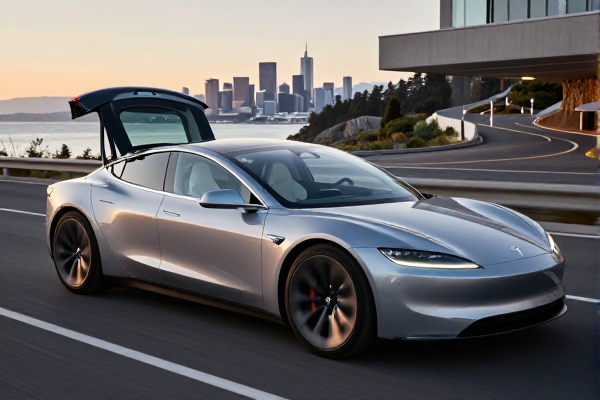
SAN FRANCISCO (May 9, 2026) — Tesla has finally revealed the second-generation Roadster, a redesigned electric sports car that carries SpaceX-designed cold-gas thrusters integrated into the bodywork. The unveiling, nearly nine years after Tesla first showed a next-generation Roadster, moves an idea once treated as a concept stunt into a production-bound vehicle with a specific hardware package.
Tesla’s original Roadster helped put the company on the map in 2008. The follow-up, however, has been one of the longest waits in automotive history. Musk first teased the next-generation Roadster in November 2017, during the event where Tesla unveiled its Semi truck. At the time, the company said the car would arrive by 2020. It was then pushed back repeatedly as Tesla shifted engineering resources to Model 3 production, Model Y, Cybertruck, and the company’s AI and robotaxi projects.
The delays made the Roadster a running joke among Tesla enthusiasts: the “one more thing” that kept slipping off the calendar. Thursday’s event was designed to change that narrative. Tesla brought a fully dressed, driveable car to a private Bay Area venue, lit it from every angle, and allowed a small group of owners and media to inspect the production-intent example. The most obvious difference from the 2017 prototype is not the exterior paint or the revised front bumper. It is the cluster of small thruster nozzles built into the lower body panels.
Tesla did not release a lengthy press kit, but the numbers it shared publicly are enough to put the Roadster in a different category from almost every other production car.
Musk and several Tesla engineers took turns describing the car as the first “true hypercar” from the company, a title that separates it from the Model S Plaid and the Cybertruck. The Roadster is also designed to be track-capable out of the box, with carbon brakes, adjustable suspension, and a lightweight interior theme that strips out unnecessary premium materials.
What makes the Roadster genuinely unusual, though, is not raw electric power. Several EVs already produce enormous horsepower. The differentiator is the SpaceX hardware. Tesla has spent years refining a compressed-gas system that uses high-pressure air to nudge the car during acceleration, braking, and cornering.
The thrusters are not rocket engines in the traditional sense. There is no combustion and no visible exhaust flame. Instead, the Roadster carries a high-pressure tank of inert gas, likely compressed air or nitrogen, in the central tunnel of the chassis. Small electrically actuated valves release gas through nozzles in the front and rear of the car in short bursts.
When the driver launches the Roadster, the traction system unleashes full electric torque while the thrusters add a second vector of force that helps push the car forward. During braking, the same hardware can fire in the opposite direction to help the friction brakes slow the vehicle. In corners, individual thruster pods can be triggered to counter understeer or oversteer before the driver ever feels the need to correct.
This is the same basic principle NASA astronauts use with the SAFER backpack, a small jet unit worn during spacewalks. On the Roadster, SpaceX engineers have scaled that idea down to a road-legal package. Tesla has not revealed how many launches the gas tank will support, but the system is designed for repeated operation rather than a single publicity stunt.
Tesla sells millions of EVs globally, but it has never really competed in the ultra-expensive sports-car lane. The new Roadster is meant to change that. It gives the company a halo product, a vehicle that overshadows competitors such as the Rimac Nevera, Pininfarina Battista, and Lucid Air Sapphire.
The pricing picture is still incomplete. Tesla previously positioned the Roadster at around $200,000 for the base model and $250,000 for a limited Founder’s Series edition. The company did not confirm a final price during Thursday’s event. If Tesla holds close to those figures, the Roadster will be significantly cheaper than multimillion-dollar exotics while offering comparable or superior straight-line performance. That could pull buyers who might otherwise move toward European hypercars or high-end Porsche and Mercedes models.
There is also a brand argument. Tesla’s product narrative now revolves around autonomy, robotaxis, and Optimus robotics. A 250-mph sports car seems at odds with that future. But in terms of engineering culture, the Roadster sends a clear message: Tesla has not lost the performance focus that defined its early years. The trick will be turning that buzz into profitable, low-volume production.
For analysts who follow Tesla, the Roadster’s biggest challenge is not horsepower or top speed. It is getting the car into customer driveways without another multi-year delay. Tesla has a mixed record with new model launches. The Cybertruck took years to reach volume, and the Semi has been slower than expected.
The Roadster also creates a regulatory question. Cold-gas thrusters are not part of the Federal Motor Vehicle Safety Standards that cover normal cars. No NHTSA test procedure currently exists for a high-pressure gas jet mounted in a bumper. Tesla will likely need a written interpretation from regulators, or it may choose to disable the thruster system in certain driving modes until the car is on a closed course. The high-pressure tank itself will also be subject to pressure-vessel rules, and service centers will need special equipment for refilling and inspection.
None of that is impossible. But it means the Roadster has two timelines: one for the engineering team and one for the compliance team. Tesla did not provide a firm delivery date on Thursday, which was probably intentional. The company has been burned by overpromises before. The safer move is to show a working car, say very little about production timing, and save the surprises for the first customer deliveries.
The next-generation Roadster is the most technically interesting vehicle Tesla has shown in years. The SpaceX thruster package is a genuine breakthrough in automotive packaging, not just a marketing badge. If the production version matches the claimed performance numbers, the Roadster will be remembered as one of the fastest street-legal machines ever built.
But in the automotive world, a great reveal means little if the delivery plan slips. Tesla has finally made the Roadster real. Now the harder part begins: bringing it to market, certifying it in every state, and proving that the halo car can coexist with the company’s increasingly software-focused future.