Browse

Log in / Register
 Share


Feb. 19, 2025 — Tesla’s long-gestating Roadster resurfaced at a private event late last month, and the moment everyone is talking about isn’t a drag race. At a SpaceX hangar in Hawthorne, California, the new prototype briefly left the ground, hovered a few feet over the floor, and set back down, using high-pressure cold-gas thrusters developed with SpaceX. CEO Elon Musk called it an evolved version of the 2017 concept but gave no firm production date. The flight was short; the questions it raises are not.
A few feet off the ground
The signature moment came when the car’s compressed-air system fired nozzles positioned around the body, lifting the prototype into a controlled hover. Musk has described the setup as operating at around 60,000 psi, with pressurized air routed to thruster pods similar to the reaction-control system on SpaceX’s Crew Dragon. There’s no combustion, no flame, no jet fuel in the traditional sense — just spent air venting violently outward to push the car upward for a few seconds.
That’s an important distinction. A jet or rocket engine sustains thrust over time; a cold-gas system is a finite reservoir that empties quickly. Whatever the Roadster does, it does in short bursts. That’s why Musk frames the capability as “brief flight” rather than full aerial driving. The demo vehicle was never meant to cruise over traffic; it was meant to prove the hardware is real.
More than a party trick
Skeptics could dismiss the hover as a publicity stunt, but the thrusters have a functional pitch behind them. Tesla has long claimed the Roadster’s “SpaceX package” will do more than lift the car: the same nozzles can push the car into the pavement for stronger braking, counteract body roll in corners, and eliminate the traction-loss gap between throttle input and tire grip. In Musk’s telling, the flying moment is a byproduct of a system whose real job is handling and straight-line acceleration.
If the performance claims hold, the Roadster would reset the supercar hierarchy. Tesla’s target: 0-60 mph in under one second, an 8.8-second quarter mile, and a top speed beyond 250 mph. Those figures outrun the Rimac Nevera and current Bugatti flagships. The caveat is that they come from a company whose production timelines have a history of slipping. Independent validation will have to wait for a production car.
Design changes after a seven-year wait
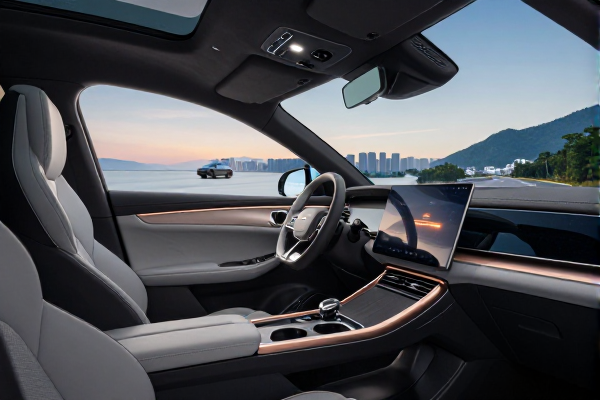
The reveal also confirmed that the Roadster’s design has evolved. The 2017 concept was show-car flash; the 2025 prototype is tighter, lower, and more purposeful. Tesla kept the removable glass roof, but the cabin looks closer to a race cockpit, with a yoke-style steering option and a central screen that matches the Cybertruck’s interior language. Musk called the new version the closest thing yet to production spec, a message aimed at the many deposit holders who have been waiting since 2017.
The waiting list is part of the Roadster’s mythology. Tesla originally opened reservations with $50,000 refundable deposits and $250,000 “Founders Series” placements, promising deliveries in 2020. That date slid to 2021, then 2023, and then went quiet while Tesla focused on Model Y, Cybertruck, Optimus, and its AI programs. Musk hinted at a return in mid-2024, and the Hawthorne event finally converted a rumor into a shiny object. Still, nobody left California with a delivery window. Musk’s most specific words were about how close the design is, not when the factory will build it.
The regulatory gray zone
The harder questions are legal. A car that can leave the ground runs into two sets of rules at once. On roads, the National Highway Traffic Safety Administration’s Federal Motor Vehicle Safety Standards assume tires that stay in contact with the pavement; a vehicle that deliberately lifts off, even briefly, does not fit neatly inside that framework. If the thrusters can fire while the car is in drive, regulators may treat the system as an aircraft feature in a motor vehicle. The FAA, meanwhile, has jurisdiction over anything that flies, and a flying car without an airworthiness certificate is a problem waiting to happen.
Tesla hasn’t said whether the hover function will ship enabled, disabled, or behind a software paywall. The company has precedent: paid over-the-air upgrades, and in the Cybertruck’s case, a lockable range-extender option. A likely middle path is shipping the Roadster with a limited “show mode” for private events while keeping the thrusters locked on public roads — a compromise that lets Tesla claim the feat without inviting a federal standoff.
Compressed air isn’t trivial
There’s also the matter of what the tank holds. Sixty thousand psi is an enormous pressure for a consumer vehicle — several times what hydrogen fuel-cell cars store, and far beyond industrial scuba systems. Vessel burst safety, valve integrity, and refill infrastructure all need certification. Tesla hasn’t released engineering data on the tank’s burst testing, and it hasn’t named a partner for high-pressure refilling stations. Owners who want to use the thruster package will presumably need special equipment, unless Tesla sells an onboard compressor that slowly refills the tanks from standard air — a power-hungry but technically plausible option.
SpaceX’s involvement adds credibility: the company has flown cold-gas thrusters in space for years. But space-hardware qualification does not equal automotive certification. Impact standards, thermal requirements, and the simple question of a tank and a parking attendant in a busy city are all unresolved. Musk’s team will need to prove the system is safe in a fender-bender before NHTSA signs off.
Competitors and context
Tesla isn’t the only company chasing the roadable-aircraft dream. Alef Aeronautics is trying to certify a roadable eVTOL with the FAA; Joby Aviation is building piloted air taxis for urban routes. Those companies are working toward real flight — minutes, not seconds, in the air. The Roadster is a different category: a high-performance sports car with a gravitational stunt built in. It won’t replace an air taxi, and it isn’t trying to.
That may be the smartest part of the strategy. The Roadster’s hover makes headlines without dragging Tesla into the decade-long certification hell that true flying cars face. The halo effect does real work for Tesla: it refreshes the “tech beyond batteries” narrative, puts SpaceX technology in a consumer product, and keeps thousands of paid deposits parked on Tesla’s balance sheet. For a product that may only sell a few thousand units, that’s cheap advertising.
The bottom line
The new Roadster is real, the thrusters are real, and the video evidence of a lifting sports car is hard to argue with. What’s still missing is a date, a price, and a regulatory pathway. Deposit holders have waited seven years; shareholders have watched Tesla’s focus drift across robots, semis, and software. A flying sports car does not change Tesla’s financial core, but it does something many recent Tesla reveals didn’t: it put the company back in the center of the automotive conversation.
As of Feb. 19, 2025, Tesla has not scheduled a formal public unveiling. Musk said the Roadster would likely show up again later this year — and if history is any guide, the next event will come with more performance numbers, more footage, and probably another delay. For now, the takeaway is simple: the car that was supposed to be impossible to build was seen, for a few seconds, hovering like a shuttle mock-up at a tech billionaire’s birthday party. That’s more than most delayed supercars ever deliver.