Browse

Log in / Register
 Share

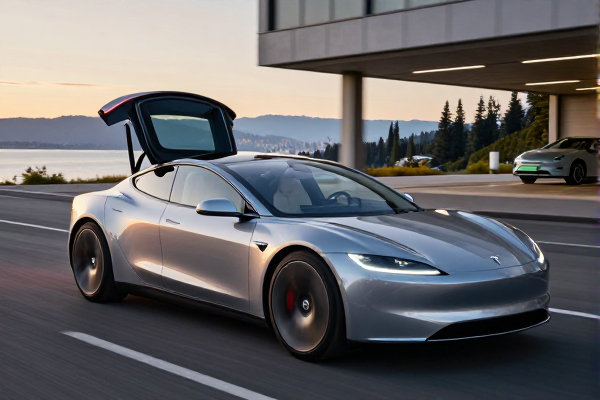
Tesla is expected to finally unveil the production version of its next-generation Roadster on Thursday, ending a nine-year wait sparked by a surprise concept debut in 2017. The electric sports car originally arrived with aggressive performance promises — including 0-60 mph in under two seconds and more than 600 miles of range — and quickly became one of the most anticipated EV launches in the industry. Now, after years of silence and several blown deadlines, the company is ready to show what actually reaches customers.
The 2017 Roadster concept wasn't just another Tesla. Musk rolled it out on stage after the Semi truck presentation, and the specs immediately dominated headlines. The company claimed a 200 kWh battery pack, a top speed above 250 mph, and a base price around $200,000 for the "Founder's Series." For context, that was before the Cybertruck, before the Model Y launched in volume, and before Tesla shifted its focus to self-driving and humanoid robots.
But the Roadster has a much deeper history. Tesla's original Roadster, produced from 2008 to 2012, was the company's very first vehicle — a sharply styled two-door based on the Lotus Elise. That model proved electric cars could be quick and fun, not just eco-friendly commuters. The upcoming second-generation Roadster is designed to push that idea much further, though it's taken far longer to reach showrooms than anyone expected.
Why the long gap? In the years after the 2017 reveal, Tesla poured engineering into Model 3 volume production, then the Model Y, then the Cybertruck's polarizing stainless-steel body, and most recently the Robotaxi and Optimus. Musk has sporadically said the Roadster was still in development, but a definitive unveil date kept slipping. Several reports indicated that design changes and a full reengineering pushed the car out of the company's near-term roadmap. At one point, Musk even hinted that the Roadster would be less of a refresh and more of a completely different machine.
Every time Musk mentioned the Roadster during the last few years, he adjusted expectations. One tweet in 2021 claimed the car would offer "zero compromises" and be "fuel-free," while another teased a spy shot of a prototype with a long hood and aggressive side skirts. Spotted test mules wore heavy camouflage, hinting that engineers were still fine-tuning the exterior just months before the reveal. None of that confirms final specs, but it suggests the Roadster hasn't been frozen on a 2017 design.
Now, with Thursday's event, Tesla is repositioning the Roadster as a halo car — a low-volume, high-performance vehicle meant to showcase what its latest battery and motor technology can accomplish. The focus will likely be on the final exterior styling, interior layout, and updated performance numbers. Production is still widely expected to be limited and expensive, with the first vehicles possibly rolling out in 2027 at the earliest. The company hasn't confirmed pricing for years, but early reservation holders were asked to put down $50,000 deposits.
Here's the part worth paying attention to: Tesla is not bringing back the Roadster out of nostalgia. The timing aligns with a difficult stretch for its core EV business. Sales growth has slowed amid stronger competition from Chinese automakers and legacy brands, and investor attention has drifted toward robotics and self-driving software. A highly visible sports car reveal requires relatively little engineering capital if the basic platform is already close, yet it generates intense media attention and returns the conversation to the company's product design muscle.
From an industry perspective, the Roadster's return also fills a gap every company in the EV space knows about: there are vanishingly few electric supercars that have reached customers. Rimac started delivering its Nevera hypercar, Lucid has its Air Sapphire sedan, and Porsche has the Taycan Turbo GT, but none has the cultural cachet of Tesla's brand name. A successful Roadster reveal would tell the market that Tesla can still flip the script when needed.
One wild card remains the famous SpaceX option. Musk has repeatedly mentioned using cold-gas thrusters to boost acceleration, braking and cornering, drawing from SpaceX expertise. Tesla even filed patents for a system that could redirect compressed air to stabilize the car. Whether such a system makes it into the final product — or gets hammered by regulatory and safety reviews — will likely be one of the biggest open questions after Thursday's event.
Then there are the reservation holders. Some have been waiting since 2017, with their deposits locked in for nearly a full decade. Many have complained about silence from Tesla, while others resold their reservation spots for six-figure sums when the hype peaked. Thursday's reveal will give those early backers their first clear indication of what they've actually been waiting for — and whether the wait was worth it.
Beyond the car itself, investors will watch the reveal closely. Tesla's stock has become more volatile in recent years, swinging on AI and robotaxi narratives, but a Roadster unveiling can still move shares, especially among retail buyers. Still, a presentation cannot guarantee sales, and the Roadster will not be a meaningful revenue or profit driver. Its greatest value may be as a symbol: proof that Tesla, often criticized for incremental updates, can still take a decade to produce an unapologetically ambitious machine.
Thursday's event will also serve as a test for Tesla's launch strategy. The company has backed away from crowded arena events, instead using social media and short livestreams. In a world where everyone watches product launches on phones, the Roadster presentation could set the template for how Tesla introduces its next generation of vehicles. A leaner, faster, more direct reveal could signal a new era for the automaker's communication style.
All told, Thursday marks the end of one of the longest and most public countdowns in Tesla history. In the same week that the company is juggling layoffs, pricing cuts and production changes, the Roadster is a chance to offer a different kind of headline. After nearly nine years of waiting, we're about to see whether the final version matches the myth — or simply becomes another reminder of how hard it is to build a real supercar.