Browse

Log in / Register
 Share

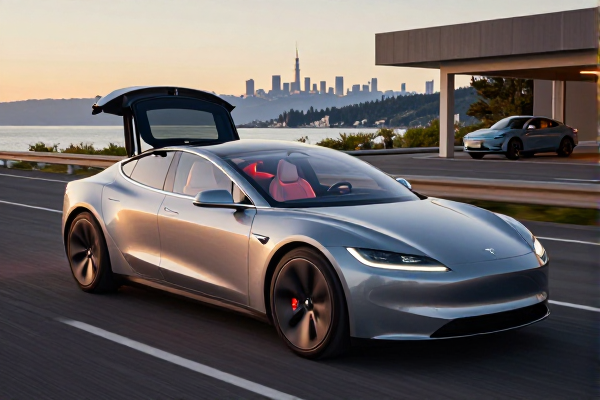
Tesla's second-generation Roadster finally got off the ground. At a May 7, 2026 demonstration at SpaceX's McGregor, Texas site, a pilotless prototype with taped-over windows accelerated to 60 mph in a claimed sub-second, launched over the automaker's lineup, climbed a ramp, and pulled off an airborne flip before landing. Tesla still won't say when customers can buy one—the target is 2028—but it has explained how the car flies. The short version: cold-gas thrusters and a suction-fan system that sound more like an experimental aircraft than a road car.
Elon Musk first announced the Roadster in 2017. The car missed its original 2020 delivery date and spent years as little more than a concept with big promises. That changed when Tesla rolled a working prototype through SpaceX's McGregor testing ground.
Tesla has a habit of showing prototypes that take years to reach customers. The 2017 Roadster reveal was exactly that: a glass-roofed concept with impressive numbers. The 2026 demo is different because the car performed rather than posed. It accelerated, launched, flipped, and landed.
The demo car had no driver. Musk said Tesla wanted to make sure nobody got hurt; the blacked-out windows kept prying eyes off the cockpit and any autonomous hardware inside. Before the reveal, Tesla's head of vehicle engineering, Lars Moravy, laid out the technology in an interview with Hagerty.
The Roadster's signature trick relies on cold-gas thrusters. Instead of burning fuel, they release highly pressurized nitrogen through nozzles to produce thrust. It's the same principle used to orient spacecraft in orbit, repackaged for a car.
The optional Flight package adds six thrusters: four mounted at the corners and two near the front to manage yaw—rotation around the car's vertical axis.
Storing the nitrogen is the bulky part. Behind the driver's seat sits a 200-liter carbon-overwrapped pressure vessel (COPV) rated for up to 10,000 psi. The Flight package adds a second 400-liter tank, bringing total capacity to 600 liters. That extra tank consumes the passenger seat, so a Flight-equipped Roadster is effectively a single-seater.
In launch mode, the rear thrusters can push out more than 80 kilonewtons. Tesla claims the combined system can hit 60 mph in under a second, which would put roughly 5 g on the driver. That's not just fast—it's approaching the edge of what most people can tolerate without training.
The thrusters only tell half the story. Tesla also built what it calls a "sucker system": four 20-kilowatt electric fans pull air from beneath the car, creating low pressure below the chassis. The pressure difference sucks the car toward the road, adding downforce without a big wing.
Four replaceable skirts along the sides contain the airflow. At low speeds, where traditional aero hasn't kicked in, the system boosts tire grip. Moravy claims more than 2 g of lateral acceleration in corners even below 50 mph.
The approach has precedent. The McMurtry Spéirling Pure, an electric track car, uses two fans spinning up to 23,000 rpm to generate about 2,000 kilograms, or 4,400 pounds, of downforce. Tesla's version is more ambitious because it pairs fans with thrusters to actually leave the ground.
There's also a James Bond connection. Musk bought the Lotus Esprit S1 submarine car from The Spy Who Loved Me—known as Wet Nellie—for just under $1 million in 2013. The Roadster doesn't copy that mechanism, but the willingness to try strange ideas clearly came along.
The thruster system has a quirk: thrust fades as nitrogen depletes. Think of releasing an inflated balloon—the first rush is strong, then it decays. Moravy confirmed the effect, meaning the Roadster's most spectacular mode is also its shortest-lived.
Refilling is another constraint. A full 600-liter charge currently takes six to seven hours; Tesla is reportedly working on cutting that to about 30 minutes. Service logistics will matter if the company ever sells this to customers.
Regulatory questions are wide open. How the FAA or NHTSA would classify a car with pressurized tanks and thrusters is unclear. Industry observers point out that the biggest obstacles aren't performance claims. Crash tests would need to account for COPVs mounted near the driver, and refilling nitrogen at 10,000 psi is not like plugging in a battery. Insurance rates and even driver licensing rules could all change if Tesla takes this tech public.
The engineering, in other words, is believable. The business case is less certain. Cold-gas thruster systems are simple but need regular servicing, high-pressure handling, and strict inspection. For a low-volume hypercar, that might be acceptable. For a brand that prides itself on simplicity and scale, it's an unusual direction. Tesla has not said how much the Flight package costs, how it will be serviced, or which markets might approve it for road use.
Even without the flight hardware, the Roadster is built as a serious hypercar. It uses rear-wheel drive—distinct from Tesla's Plaid all-wheel-drive models—with two electric motors producing over a megawatt of power, roughly 1,341 horsepower, and more than 1,400 Nm of torque at the rear wheels.
That's more output than the three-motor Plaid range. Sending that through only the rear wheels makes traction management critical, which helps explain why the suction fans exist: keeping rear tires glued to the pavement early in a run.
Moravy says the car weighs just under 1,700 kg, light for its size in EV terms. Tesla claims a range over 300 miles and says a new battery design can charge from 15% to 80% in about 10 minutes. Neither figure has been verified in production form.
Tesla plans two configurations.
The Performance model gets the suction system but no thrusters. Claimed numbers: 0-60 in 1.6 seconds, top speed 210 mph.
The Thrust model adds the full thruster package. Claimed numbers: 0-60 in under a second, top speed 230 mph. For reference, the McMurtry Spéirling Pure—among the quickest EVs tested in recent years—does 0-60 in 1.3 seconds. A sub-second time puts the Roadster in a different performance bracket, if it can be independently verified.
The new Roadster abandons the rounded contours of the 2017 concept. Designed by Franz von Holzhausen, Tesla's chief designer since 2008, it features a wedge-shaped body with concealed headlights, a full-width LED tail light, and an active rear wing. Tesla reportedly drew inspiration from the SR-71 Blackbird and the F-35 fighter jet.
Von Holzhausen is the designer behind the Cybertruck, Model S, Model 3, Model Y, and Tesla Semi, so the sharp silhouette fits his playbook.
History suggests caution. Musk first promised deliveries in 2020; the date kept sliding. The current target is 2028, leaving Tesla two years to turn a prototype into a certified, sellable product.
Reservations are open: $5,000 holds a Performance model, followed by $45,000 within 10 days. The Thrust model carries the same first payment but a $245,000 second installment. The Flight package is, for now, invite-only.
What's certain is that the Roadster has shifted the conversation around production cars. Even if 2028 proves optimistic—a real possibility—the prototype has already shown that the gap between a sports car and a test vehicle is narrower than anyone expected. Whether that gap closes for buyers depends less on engineering than on safety, regulation, and a company that has rarely met its own deadlines.
For Tesla, the Roadster is more than a halo car. It's a chance to show that the company can still produce something irrational—a product that exists to make people's jaws drop rather than to move units. Whether it arrives in 2028 or later, the prototype has already given the industry something to talk about.