Browse

Log in / Register
 Share

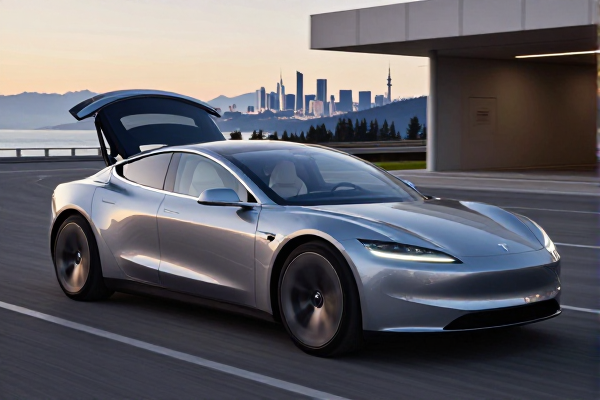
On May 12, 2026, Tesla showed off a new version of its long-delayed Roadster with a demonstration that was hard to ignore. The prototype used high-pressure gas thrusters co-developed with SpaceX to briefly lift itself off the ground. It is the clearest signal yet that a production Roadster with some form of short airborne capability has moved from an engineering prediction to real hardware.
The word "fly" needs careful handling here. The Roadster is not converting into a vertical-takeoff aircraft. According to the demonstration, the car used onboard pressurized gas to create a short upward burst — enough to leave the surface and settle back down. The effect is closer to a controlled jump than the continuous cruising flight that most flying-car concepts promise. Still, for a street-legal sports car, the moment is unprecedented for Tesla.
The Roadster has been one of Tesla's most elusive products. Originally unveiled in 2017 with dramatic claims — 620 miles of range, a 0-60 mph time under 1.9 seconds, and a quarter-mile in less than 8.8 seconds — the car was scheduled to arrive in 2020. That date came and went. So did several others. Tesla spent those years ramping up the Model Y, launching the Cybertruck, and wrestling with battery supply constraints.
Musk has repeated the Roadster promise over the years, often with the caveat that the car would not be built until Tesla had finished other priorities. That made this latest prototype reveal more important than a typical concept-car appearance. It isn't just another sketch or rendering. The thrusters are visible in the realized vehicle, and Tesla made a point of activating them.
The technology behind the fleeting flight is relatively straightforward in concept: compressed gas is stored under pressure and released through thrusters to generate a temporary push. In this case, the thrusters are positioned to nudge the car skyward. On a normal launch, the effect could add a split second of extra acceleration by reducing tire slip at the rear wheels. The party trick is that the force is sometimes strong enough to break contact with the road entirely.
The newly shown prototype seems to use the thrusters during a staged, low-speed run. That may not sound like the "flying car" fans imagined, but it is a meaningful mechanical achievement. A production vehicle needs to store the gas safely, control the release precisely, and prevent the momentum from surprising the driver. Tesla has not said whether the system will be standard on every Roadster, or limited to an ultra-high-end edition.
Tesla no longer has the performance stage to itself. The Rimac Nevera, Lucid Air Sapphire, and Pininfarina Battista have all pushed electric performance toward absurd numbers. The current Roadster's original claims would still put it at the front of that pack, but on paper alone, it no longer feels unassailable.
The SpaceX-tuned thruster system gives the Roadster something unusual in that group. No rival has shown a production-intent car that can briefly lift itself off the ground. Whether that is genuinely useful or just drama, it gives Tesla a technical talking point that no other brand can match with a similar speculative pitch.
Tesla has spent the past several years defending its market share against newer competitors, and the Roadster has been a footnote in that fight. A dramatic prototype reveal does not fix production delays, but it changes the conversation. It signals that Tesla is still willing to turn Musk's wildest public statements into physical engineering.
This is also a different kind of update from Tesla's usual product cadence. Instead of showing a polished studio car with no chance of leaving the floor, the company chose to demonstrate movement. For a project that has missed multiple target dates, that is a meaningful step. It suggests the hardware has matured beyond a single working mockup.
A car that leaves the ground introduces questions that normal performance specs do not. Federal vehicle safety rules do not include a recognized category for production cars that briefly become airborne. Even if the Roadster's thruster hop is designed for off-road or track settings, Tesla will likely have to explain how the system interacts with braking, stability control, and real-world liability.
There is also the question of owner convenience. Pressurized gas tanks need to be refilled. Musk has talked about the Roadster's rocket package as a high-cost option rather than a core feature, which may limit any legal and insurance complications. The broader issue is whether Tesla can convince regulators that a few inches of lift is an advanced suspension feature, not an aircraft-adjacent safety risk.
For years, the Roadster has served as Tesla's emotional anchor. It was the vehicle that showed what an uncompromised electric sports car could be, even while Tesla focused on volume models. This new demonstration gives that story a fresh chapter. The Roadster is not just a fast car anymore; it is a car with an aerospace-inspired trick that no other automaker has seriously attempted.
The engineering breakthrough, if it survives certification, could be remembered as a stunt or as the beginning of a weird new performance niche. What is harder to deny is that Tesla has finally turned the Roadster's promise into something you can see happen. After years of waiting, the next step is at least clearly visible: a sports car that can touch the sky for a moment, then get back to the business of outrunning everything else on the road.