Browse

Log in / Register
 Share

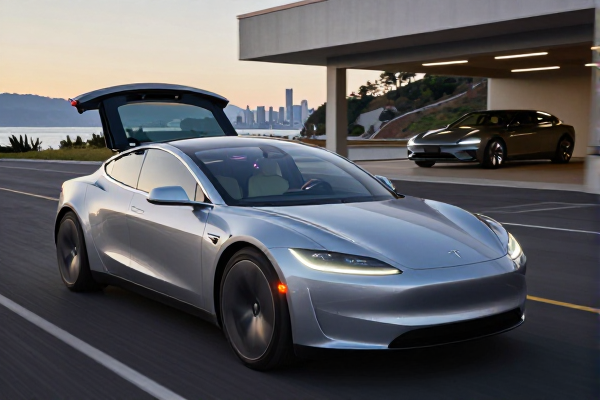
April 11, 2025 – Tesla finally pulled the cover off its redesigned Roadster on Thursday, confirming the long-delayed flagship will carry a $200,000 price tag and use technology developed in partnership with SpaceX. The presentation brought a close to more than seven years of anticipation since the battery-electric supercar was first teased as a prototype back in 2017.
The original Roadster shot into public view at a semi-truck event in 2017, when Elon Musk rolled out a sleek prototype and promised the "fastest production car ever made." At the time, Tesla claimed a 0–60 mph time of 1.9 seconds, a quarter-mile in 8.8 seconds, and a top speed above 250 mph. The company also dangled a "SpaceX option package" that would somehow turn showroom supercars into rocket-adjacent machines.
That promise was toyed with for years. Musk occasionally posted updates on X about the Roadster's design, but the production version kept sliding. As recently as 2023, he said Tesla's engineering team was too tied up with the Cybertruck and other models to focus on a new Roadster. Thursday's event therefore closed a long chapter of "almost ready" messaging.
Tesla didn't share a full spec sheet at the event, but the company did confirm the base price: $200,000. That's more than double the cost of a Model S Plaid and puts the Roadster in the same neighborhood as the Lucid Air Sapphire and well-heeled ICE exotics from Ferrari and Lamborghini.
The centerpiece of the redesign is its joint engineering effort with SpaceX. Tesla's official statement described it as "technology built in collaboration with SpaceX," though executives stayed quiet on exactly how much rocket hardware ends up under the bodywork. Musk has previously talked about using cold-gas thrusters to help the car brake, corner, and jump off the line, so Thursday's emphasis on SpaceX likely points in that direction.
Tesla also did not announce a delivery date at the reveal. The company hasn't confirmed whether existing $5,000 deposits will roll over to the new car, or if the earlier Founders Series Roadster reservation — which cost as much as $250,000 — will carry the same status. Those details will probably arrive as Tesla moves the car closer to production.
The Roadster-SpaceX link sounds like a marketing hook, but it also reflects how far Tesla has pushed its engineering relationship with Musk's rocket company. The two organizations already share talent, battery knowledge, and materials expertise. The Roadster's design reportedly draws on lessons from rocket re-entry shields, including advanced heat-resistant materials and custom carbon-fiber layups that shave weight without sacrificing stiffness.
A production Roadster with cold-gas thrusters would be a first for a street-legal vehicle. The idea has been with Musk since the early 2017 reveal, when he described nozzles placed around the car that could "perhaps even leap a short distance." While the base price likely limits that option package to a small band of buyers, it does give Tesla a rare technical talking point that no competitor can copy overnight.
At first, a $200,000 price tag looks like a big number compared to Tesla's usual lineup. But the Roadster was never meant to be a volume seller. It's a halo car — one whose only job is to keep Tesla on the front page and remind shoppers that the company isn't just a maker of mass-market electric sedans.
The timing matters. Tesla's current lineup is getting older. The Model 3 and Model Y have been refreshed, but the brand still doesn't have a true supercar in its stable. The Roadster gives Tesla the kind of aspirational product that stirs buzz, attracts specialists, and pushes headlines away from quarterly sales numbers.
The Roadster also raises the stakes in the EV speed war. Lucid's Sapphire is already eyeing 1.89 seconds to 60 mph, and Rimac's Nevera offers four-digit horsepower. Tesla needs a car that reclaims the "quickest EV" crown it once owned with the Plaid. A new Roadster with SpaceX enhancements, all wrapped in a sleek looking body, is exactly the kind of statement the company needs to make in a market where China's EV makers are rapidly closing performance gaps.
Until Tesla publishes the full roadmap, the most concrete facts are these: the next-generation Roadster costs $200,000, it's coming, and it will use engineering from SpaceX. The company has a long history of missing its own timing targets, so setting a hard production date may be wise. Still, the fact that Tesla held an actual reveal event suggests the project is much further along than many skeptics believed.
Pre-orders are likely to reopen or continue through Tesla's existing reservation system, but buyers should expect a longer wait than the usual Tesla model. With the Cybertruck's production ramp still absorbing engineering resources, the Roadster will probably arrive in very limited numbers at first, if it arrives at all this decade.
That delay risk is precisely why Tesla needs a strong, clear message about the Roadster's identity. Thursday's reveal delivered that: a two-seat silhouette, a six-figure price, and a clear handshake between Tesla cars and SpaceX rockets. For fans who have held on since 2017, that's enough to call the wait worth it.
The redesigned Roadster isn't about transforming Tesla's revenue stream. It's about making the electric car category feel exciting again. A $200,000 sports car with real rocket-tech credibility might not sell in huge volume, but it doesn't need to.
What it does need to do is force people to look at Tesla in a different way — as the brand that can still surprise the auto industry, even after years of playing the volume game. Thursday's unveiling did exactly that, and it laid down the clearest marker yet that Tesla isn't done pushing the envelope.