Browse

Log in / Register
 Share

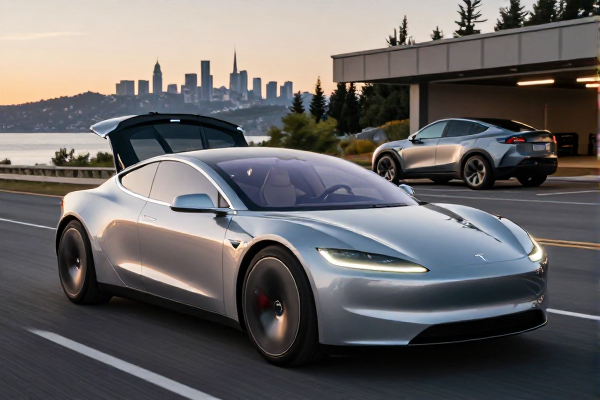
Elon Musk has once again put the Tesla Roadster in the headlines, but this time the hook is flight, not just acceleration. At a Tesla-SpaceX presentation in Texas, Musk unveiled the Roadster Rocket, an updated EV that comes with ultra high-pressure air tanks and rocket thrusters designed to lift the car briefly off the ground. Production remains years away, with the current target set for 2028, and the full flight package is limited to an invitation-only group of buyers. As of Feb. 28, 2025, no federal agency has claimed clear responsibility for a vehicle that can straddle road and air.
The Roadster has followed a long and winding path. Musk first introduced the current-generation design in 2017, promising a 620-mile battery range and a 2020 launch. That date slipped as Tesla's attention shifted to scaling Model 3 and Model Y production, and later to the Cybertruck's own manufacturing struggles. In 2018, Musk raised eyebrows by mentioning an optional "SpaceX package" that would use cold gas thrusters to improve acceleration, braking, and cornering. At the time, many observers treated it as another Musk tease rather than a serious engineering objective.
The Texas demo made clear that the thrusters have since moved from concept art into full-size working hardware. Musk now calls the car the "Roadster Rocket" and uses the phrase "flying car" in his public remarks, albeit with qualifiers. Tesla acknowledges the vehicle is still several years from production, and the unit on stage was a demonstration model operating in a controlled environment, not a road-legal prototype. Whether the final product closely matches the showpiece is anyone's guess.
It is worth pressing on what "flying car" actually means here. The compressed-air system is not intended to provide continuous, steerable flight the way a helicopter or fixed-wing aircraft does. Instead, the thrusters produce short, high-energy bursts meant for load transfer, handling adjustments, or a brief vertical release from the pavement. That is precisely the behavior showcased by the custom ramp built for the event: the car visibly lifts off the ground on command, hangs for a moment, then lands back on its wheels. It does not fly in any conventional sense.
The distinction matters for two reasons. First, it influences which definitions regulators use when deciding whether the Roadster belongs in motor-vehicle law or aviation statutes. Second, Musk has not ruled out pushing the concept further. If future iterations enable sustained flight, the vehicle would almost certainly trigger full FAA certification procedures that today's short-hop demonstrations avoid. For now, the current technical scope keeps the car closer to the highway-enabled category, but even that limited capability is enough to expose the regulatory gray area.
The Department of Transportation has not designated a lead agency for machines that can leave the ground. NHTSA, which writes and enforces federal motor vehicle safety standards, has indicated that any manufacturer must still meet all federal requirements even if the vehicle includes unconventional features. Officials at the agency have said they will continue monitoring development. The FAA, meanwhile, has looked at the concept and concluded that the Tesla vehicle does not qualify as an aircraft under its current definitions.
Taken together, those positions create an odd legal vacuum. On a public street, the Roadster would be a car, subject to NHTSA standards, state traffic laws, and local rules. In the moment it fires its thrusters, it apparently becomes none of the categories regulators know how to handle. Without an aircraft designation, FAA restrictions on altitude, noise, and pilot qualification do not apply. Without a clear assignment of authority, oversight of the flight phase remains a question mark.
The FAA's recent regulatory activity may signal how it will eventually view vehicles like this, but not in a way that helps Tesla today. The agency finalized operational rules for powered-lift aircraft last year, covering electric air taxis and similar flown machines, with the new framework effective in March 2025. Those rules assume rotors or lifting surfaces, a pilot at the controls, and operations in managed airspace. A wheeled supercar with pressurized tanks fits none of those assumptions. The powered-lift example does show, however, that the FAA can construct new categories when the technology demands it — and that process takes years, not months.
Another notable feature of the Roadster announcement is what Tesla did not say. The company has not disclosed which federal agencies it has consulted about the flight hardware, nor has it laid out any certification roadmap for the rocket-equipped model. Regulatory analysts read the silence as a sign that conversations remain preliminary. Tesla has a long history of presenting ambitious concepts first and sorting out compliance nearer to production, an approach that has worked for conventional vehicles. Whether it will work for something with rocket thrusters and public-road aspirations is a much harder question.
Tesla is hardly alone in testing the line between automobile and aircraft. Alef Aeronautics received a Special Airworthiness Certificate from the FAA in 2023 for its experimental flying car, allowing limited test flights in spite of its unconventional silhouette. Aska Aerospace has been taking deposits for the A5, a driveable eVTOL designed for road-driving and vertical flight, and is working openly toward certification. Joby Aviation and Archer Aviation, the leading players in the electric air-taxi space, have made regulatory collaboration a core part of their strategies, with detailed certification plans on file with the FAA. The contrast with Tesla is instructive: most of these companies built their products inside existing aviation pathways, while Tesla is presenting a halo car with rocket accessories and trusting that the regulatory world will eventually adapt.
For ordinary reservation holders, the standard Roadster remains a straightforward pre-order. The rocket version introduces headaches no car buyer has dealt with before. Insurance carriers have no actuarial models for a vehicle with high-pressure tanks and thrusters; some may refuse coverage outright. State DMVs have no inspection rubrics for rocket components, and municipalities may impose noise limits or prohibit ramp-assisted hops. Tesla has not addressed any of these questions publicly. If the flight-equipped Roadster ever reaches customers, each sale could require a bespoke legal arrangement among owner, insurer, and local authorities — hardly the recipe for a mass-market product.
The Roadster Rocket is a reminder that the hardest part of an unconventional vehicle is not always engineering. Tesla's battery, aero, and propulsion teams have years of runway to refine performance. But the car cannot be legally flown, sensibly insured, or sold at scale until regulators decide whose rules apply. The 2028 timeline provides ample room for both technical progress and policy evolution. Yet if federal agencies continue to pass the buck, the flying Roadster will remain what it is today: a spectacular showcase, an engineering statement, and, for now, a very fast something that nobody has yet figured out how to govern.