Browse

Log in / Register
 Share

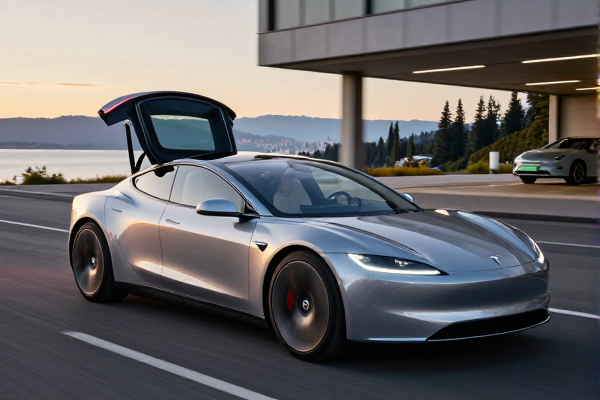
Tesla's next-generation Roadster grabbed headlines because Elon Musk said it could "briefly fly." But on a racetrack, the parts that matter are the ones that keep the car glued to the asphalt. As of April 27, 2026, Tesla's Roadster page still describes a multi-mode fan and ground-sealing system that acts like a vacuum underneath the chassis. The fans pull air out from below the car, and Tesla says the resulting suction is strong enough to hold the Roadster upside down even when it isn't moving.
That detail separates it from every conventional supercar. Normal aerodynamic wings and diffusers only create downforce when the car is moving, and the amount increases with speed. A car running a fixed aero kit has its least amount of grip in slow corners, under heavy braking, and immediately after turn-in. A fan-driven system, by contrast, generates downforce at any speed. It can produce grip before the car rolls, during braking, and even when the driver is trying to launch off the corner.
A Tesla patent application offers more detail on how the system works. Deployable skirts close off large sections of the underbody, forming sealed or partially sealed chambers. Fans then extract air from those chambers, lowering the pressure between the car and the road. Since the pressure above the car is higher, the imbalance pushes the body downward. The skirts are also likely to be active, adjusting their seal depending on how bumpy or smooth the surface is. The overall goal is not just raw downforce, but downforce that can be managed in real time.
Fan cars have a short and complicated history. The Chaparral 2J proved the concept in 1970, using a separate engine to drive two fans and clear the air under the car. It was quick, but it was soon outlawed. The Brabham BT46B won the 1978 Swedish Grand Prix with a fan-assisted diffuser, and the system was effectively banned afterwards. Racing regulators have never been comfortable with active ground-effect devices, mostly because they are difficult to police and can create unfair advantages. Tesla is essentially returning to a banned concept, with modern electronics and an electric powertrain controlling the airflow.
The fan system is only half the story. Tesla pairs it with active wings, a next-generation steer-by-wire system, and a Track Mode designed to lower the ride height and adjust suspension settings on the fly. Drivers can select high-downforce or low-drag modes depending on where they are on the lap. To make the car as sharp as possible, Tesla is using magnesium, titanium, and carbon fiber. The company also says it plans to use manual controls and a fixed seat position, which is unusual for a production car. The idea is to eliminate variables that cause lag between driver input and chassis reaction.
The other major piece of hardware is the cold-gas thruster system. On the Thrust version, thruster pods are mounted at the rear. Tesla says they are enough to push the car from 0 to 60 mph in under 0.9 seconds. The Rocket version adds perimeter thrusters that can generate forward, upward, and lateral rotational movement. That means the car can yaw, pitch, or roll using pulses of compressed gas. Tesla calls the actuators all-electric and says they can make micro-adjustments in a fraction of a second. Cold gas thrusters are not a new idea, but they are new to the object of lap records.
Musk has been talking about tracks for a long time. In June 2019, he said Tesla would do things with the Roadster that were "unfair to other cars." In September of that year, he answered a question about the Nürburgring production-car record with a single word: "Absolutely." By February 2024, he said Tesla had "radically increased the design goals" and that the sub-1-second 0 to 60 time would be "the least interesting part." The message has remained consistent: acceleration is easy; cornering is where the Roadster will be different.
There is still no proof that it is different. Tesla has not published an official lap time or a verified cornering figure. The Nürburgring record remains a target, not a result. Tesla also says the car is not approved for public road use, and the full thruster package on the Rocket version appears to be limited to invite-only customers. Fan cars in the past were banned or pulled because they flicked up debris and made racing unfair. Sealed underbodies also struggle on damaged road surfaces, where the skirts cannot maintain a proper seal. A smooth race track is a far more friendly environment, which suggests the first real validation will have to come from a timed lap at a circuit.
The potential advantage is real if the system works. A car that can generate downforce while stationary has no aero falloff in the slowest section of a track. It can brake later because the rear stays stable. It can turn harder because the front axle keeps its grip. It can also carry more speed through corners that would normally expose the weakness of a conventional wing. This is why Tesla keeps talking about lap records. The Roadster is no longer just a fast car; it is an experiment in active aerodynamics that has never been tried in this form.
Musk's timelines have been wrong before, and the Roadster was originally unveiled in 2017. But the patents and the product page show that the fan and skirt system has moved beyond marketing. Whether it survives contact with a real circuit is another matter. The next milestone will be a lap time, not a social media post. Until that time arrives, the record talk is a promise built on engineering that is, at least on paper, genuinely different from anything else on the road or track.