Browse

Log in / Register
 Share

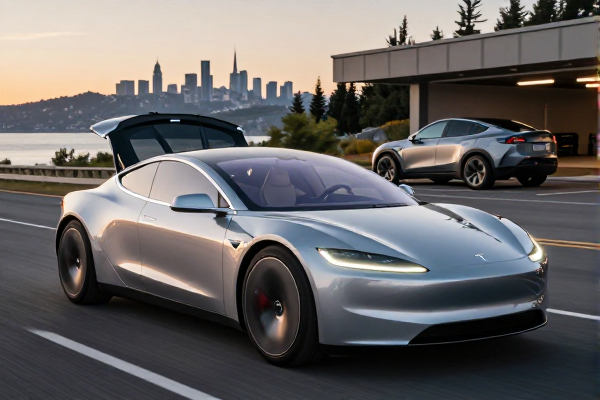
BOCA CHICA, Texas — Tesla finally let its second-generation Roadster out of hiding Thursday night (Oct. 15), staging the reveal at SpaceX's Starbase complex in South Texas. On a closed course, a prototype drove through an inverted stretch of track, launched off a ramp into the air, and sprinted to 60 mph in about one second. CEO Elon Musk, standing near the car afterward, confirmed a 2028 production date and described the machine with a grin: "It's not necessarily a safety-optimized car, but it takes the fun meter to eleven out of ten."
The original Roadster is the model that put Tesla on the map. Built from 2008 to 2012 on a Lotus-derived aluminum chassis, it proved an electric car could feel like a proper sports machine instead of a golf cart with a badge. Roughly 2,400 examples were sold before production ended. One of them later achieved orbit: in 2018, Musk strapped his personal Roadster to SpaceX's Falcon Heavy, a spacesuited mannequin at the wheel, and sent the whole package tumbling past Mars.
The second-generation car has been teased since November 2017, when Musk rolled out what he called "the fastest production car ever made" at Tesla's California design studio. The original promises: three motors, all-wheel drive, a 200-kWh battery, 620 miles of range, a 0-60 time of 1.9 seconds, and a top speed north of 250 mph. Deliveries were initially pitched for 2020. They didn't happen. The car became part of Tesla lore — a spec-sheet ghost that fans argued about and rivals publicly doubted.
Thursday's event closed that chapter. Instead of a PowerPoint presentation, Tesla offered a physical demonstration: a prototype that turned gravity into a suggestion.
The venue was deliberate. Starbase, near the town of Boca Chica in the Rio Grande Valley, is SpaceX's Starship development center. It is a landscape of steel ring sections, launch mounts, and flame trenches, and it borrows nothing from the glass-walled studios normally used for car debuts. Placing the Roadster there linked the car's engineering story to rockets in a way no traditional backdrop could.
Musk has long hinted at an optional "SpaceX package" for the Roadster, a system of cold-gas thrusters that would use compressed air for braking, cornering, and possibly short hops. Thursday's demonstration — the car left the ground after clearing a rise in the course — looked like a preview of that idea, even if Tesla never confirmed which systems were active on the prototype.
The setting also mattered mechanically. The Roadster's two party tricks — inverted driving and a sub-one-second sprint — demand flat, reinforced pavement and precise aero tuning. A stunt like that on a public road would have been a lawsuit waiting to happen; Starbase gave Tesla the space to be dramatic without endangering bystanders.
The headline number: 60 mph in one second. Average acceleration works out to roughly 2.7 g — a sustained push that would white-knuckle most drivers. The Rimac Nevera, currently the benchmark for quick production EVs, manages 0-60 in about 1.7 seconds with its launch-control settings on. The newest Ferrari and Lamborghini flagships need more than two seconds. If Tesla's number holds up in independent testing, the Roadster rewrites what a street-legal car can do to the pavement.
Getting there is mostly a traction problem. A one-second sprint means all four tires must transfer absurd amounts of torque to the road without spinning, which is why the "SpaceX package" makes engineering sense: thrusters can add downforce at launch, pressing the car into the asphalt. It is also why the prototype wore prominent wings and dive planes — road cars rarely need enough aerodynamic load to stay glued to a ceiling, but a car that drives upside down does.
Tesla was lighter on the rest of the spec sheet. No updated top speed was announced, and range was left unspecified. Musk confirmed only that production is slated for 2028. That gives the company time to finalize the battery architecture, suspension, and aero package — and to decide which performance claims survive contact with regulators.
Musk's remark about legality was closer to a confession than a joke. "I'm not sure it'll be legal in all jurisdictions," he said, adding, "there will be such a car that someone can own." No federal rule prohibits a car from reaching 60 mph in one second, and acceleration alone won't get the vehicle banned. But every market has its own type-approval rules. European pedestrian-protection and crash-safety standards in particular could force Tesla to soften the prototype's razor-edge styling and lightweight structure.
Homologation is the real obstacle. Musk's phrasing — "someone can own" — implied Tesla will build a street-tuned version alongside a more extreme track-oriented one, a two-tier strategy the company has already used with its high-performance Model S and Model 3 variants. Expect regional differences in aero, tires, and software limits, with the wildest version reserved for tracks and the friendlier one aimed at registration desks.
Why does Tesla, a company fighting for market share against cheaper Chinese imports, spend years on a niche sports car? Because the Roadster is a halo in the truest sense: it doesn't sell in volume, but it sets the perception of what the brand can do. In one night, Tesla replaced the narrative of "delayed product" with "technically absurd product." The stunt was advertising, and it was cheaper than a Super Bowl ad.
The Roadster also functions as an internal tech lab. Nailing a 1.0-second 0-60 requires breakthroughs in motor cooling, battery discharge, tire management, and aero. Those learnings will filter into the Model 3, Model Y, and future models. The 2028 timeline reinforces that idea: Tesla is treating the Roadster as a science project that customers will eventually be allowed to buy, not a vehicle it has to rush for a launch-year quota.
Tesla did not open a reservation queue or update the price structure. The original plan called for a $250,000 Founders Series and a base car around $200,000, and those figures are almost certainly stale. Musk spent no time on pricing, suggesting those details are still being worked out — or that inflation will deliver a heftier number than fans want to hear.
The factory that will build the Roadster also remains unnamed. Tesla's US assembly base is split between Fremont, California, and Austin, Texas. A sports car built in Texas, near Starbase, would tighten the thematic connection; a California build would follow tradition. No hints emerged from Thursday's event.
Early reaction online focused on the clips rather than the commentary, which is exactly what Tesla wants: a car that generates its own proof. The inverted pass, in particular, dominated social feeds, and even skeptical automotive journalists conceded that the prototype moved with a violence no current production EV can match.
Two years is an eternity in automotive development, and Tesla has a history of making promises that slip. The smart expectation is that the production Roadster will differ from Thursday's prototype: final cars undergo crash testing, regulatory validation, and the thousand small compromises that turn a showpiece into a product. The upside of the 2028 target is that whatever Tesla ships will be a genuine advancement, not a cobbled-together homage to a 2017 keynote.
For the moment, the Roadster has accomplished what it needed to. It got people talking, got engineers arguing, and gave Musk another chance to sound like the only car executive with a sense of humor about his own industry. The stunts were real. The acceleration claim was specific. And the promise that "someone can own" this machine stands as the most important sentence of the entire event.