Browse

Log in / Register
 Share

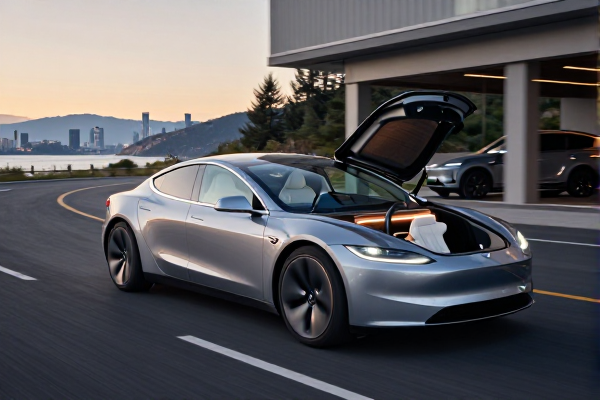
On April 17, 2025, Tesla finally gave the world a closer look at its next-generation Roadster, and the car’s signature trick is a literal hop into the air. Using what CEO Elon Musk describes as a “SpaceX option,” the electric sports car can launch itself off the ground and spin mid-air before landing. Musk confirmed that customer deliveries are still not expected until 2028, extending a timeline already more than a decade after the model’s 2017 unveiling.
The thruster system works by releasing pressurized gas through tiny nozzles around the car’s body. This generates a short, sharp reaction force — enough to push a heavy sports car upward and let it rotate. The principle is similar to the reaction-control thrusters used on rockets for steering in space. Tesla has not supplied technical specs for the system, so it is unclear how much gas is stored or how often the boost can be used.
The Roadster was never supposed to be a flying car in the conventional sense. Musk has used the word “hover” in the past, but the demonstration shows something more modest: a hop. Even a few feet of lift is unusual for a production-intent vehicle, though, and the feature immediately separates the Roadster from every other hypercar on the market.
For years, the $200,000 base price and a 1.9-second zero-to-60 time defined the Roadster’s appeal. That speed claim is still stunning for a car with four wheels and a steering wheel. The thruster package would only enhance that performance image. But Tesla hasn’t said whether the 2017 price still applies. The company’s order page, when open, requires a $50,000 deposit, and earlier reservations are presumably still valid. Tesla has not said whether new reservations are active, and it is unclear what a production-thruster option will cost.
The biggest challenge may not be engineering. It’s regulation. The National Highway Traffic Safety Administration mandates that every new car sold in the U.S. meet a comprehensive set of Federal Motor Vehicle Safety Standards. Those standards were written for vehicles that stay on the ground. A car that can briefly leave its lane, shift its center of mass, or alter its trajectory with jet thrusters will need testing and approval permutations never before considered. NHTSA has not signaled whether it would treat the Roadster as a standard vehicle or require a new exemption.
There’s also the driver training piece. Consumer vehicles are expected to be easy to operate safely. If the thruster system is engaged on a public road, the driver would need to manage an unstable instantaneous force. In a hypothetical emergency, such a system could either avoid an accident or cause one. Insurers, who already price exotic cars aggressively, will likely treat the air-thrust feature as an unknown risk.
The timing of the announcement is notable. Tesla has spent the last year cutting prices in response to slower EV demand, while its products have faced mounting quality scrutiny. Some industry observers say a flashy concept is useful because it doesn’t require a factory or a supplier — just a demo and a press release. Others wonder if the engineering team’s time might be better spent on solving high-volume production issues or launching a long-promised robotaxi.
Even within Tesla’s lineup, the Roadster occupies a strange position. It was first shown alongside the Semi in 2017, when the company was building some of the most expensive industrial battery packs on the market. The Semi still isn’t in mass production, and the Roadster has been postponed multiple times. Musk now describes the 2028 target as a goal, not a promise. That leaves a large window for the car to miss another date.
If Tesla does reach production in 2028, the Roadster won’t be the first car with unconventional propulsion. There have been hovercar concepts, flying taxis, and even wheeled vehicles with fans. But none has attempted to combine street credentials with a real vertical propulsion system. That makes the Roadster a fascinating engineering experiment, even if its road alternative — an extremely fast EV — is thoroughly conventional.
For consumers, the short-term takeaway is simple: add the Roadster to the list of impossible-sounding Tesla promises. It may arrive, it may not. Meanwhile, the thruster trick has already done its job — it put Tesla back in the conversation about future transportation. Whether regulators let the Roadster jump in public is another story, and that story will probably take longer than a 2028 production date to unfold.