Browse

Log in / Register
 Share

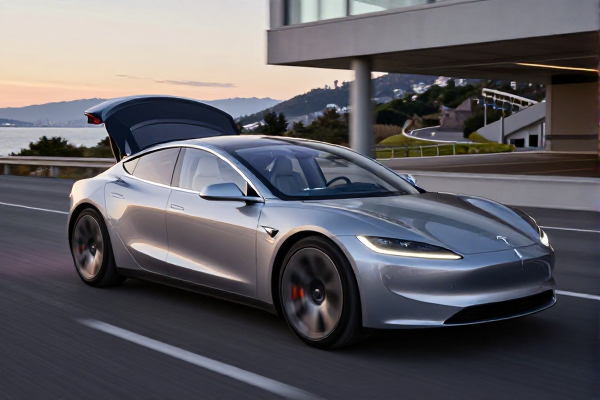
Tesla has finally taken the wraps off its second-generation Roadster, and the presentation was not the usual hands-off launch. The car got air under its wheels, turned itself around, and came down in a way that made one thing clear: the “flying Roadster” promise was not just a keynote joke. As of April 26, 2026, Tesla says volume production is set for 2028, though it has not named a delivery date.
The new Roadster looks nothing like the sleek, low-slung shape that leaked online before the event. Tesla went with a more aggressive, angular body that borrows heavily from the Cybertruck design language. There are flat panels, hard creases, and straight lines. Aero wheels, butterfly doors, and a low nose give it a retro-modern feel that some will compare to the Lamborghini Countach of the mid-1970s.
It is a polarizing look. But the exterior is only one part of the story.
Tesla’s designers did not just make the Roadster faster; they gave it hardware that no other production car has used. Hidden headlights, a full-width taillight bar, active aero, and a multi-mode suction system are all there. Then there are the cold-gas thrusters, which borrow technology from SpaceX. Those thrusters can fire in short bursts through electric actuators, which lets the car literally hop, flip, and hold an upside-down position for a short time.
That is not a typical EV trick, and it will almost certainly stay in controlled driving modes if the final car reaches buyers.
The Roadster’s Ano White finish is not a standard showroom white. Tesla says it is the same protective coating used on space vehicles, offering UV resistance, cryogenic protection, electrostatic dissipation, and corrosion protection. Those properties are needed for rockets during launch and recovery, and they translate into a body that should handle extreme heat and weather without fading.
The gold-tinted glass is another aerospace touch. It mimics the copper coating used in space suits, and there are titanium accents throughout the car. The body itself is built from magnesium, titanium, and carbon fiber. That mix is designed to keep weight low while giving the chassis enough stiffness to survive the forces generated by the thrusters.
Inside, the Roadster is closer to a modern fighter jet than a traditional Tesla interior. The steering system uses a yoke-shaped control rather than a standard wheel. The seats and dashboard are finished in what Tesla calls Ultrawhite, with grey microsuede bolsters. A center touchscreen sits in the middle of the dashboard, with a pair of smaller screens positioned behind the yoke as forward displays.
The layout is clean, but the real story is still what happens when the driver lets the thrusters do the work.
The hardware that makes the Roadster “fly” is a combination of cold-gas thrusters, a suction system, and active aerodynamic surfaces. Tesla has fitted electric actuators to the thrusters so the bursts can be timed precisely. In the demo, the car fired the thrusters to jump and rotate in a way that looked impossible for a vehicle with a conventional suspension.
The multi-mode suction system helps the car stay pinned to the road even when the car is in an inverted position. The body also has powered fans and active wings that increase traction in corners. Track Mode, which Tesla already offers on other models, gets a new level: it lowers the car and adjusts the suspension to fit the situation.
The end result is a machine that can, at least in a controlled demonstration, go beyond the physical limits of a regular sports car.
Tesla has structured the Roadster lineup in three tiers. The Performance trim comes with active aero, the multi-mode suction system, and the ability to remain upside down briefly. The Thrust version adds rear cold-gas thrusters and is meant to cut the 0-100 km/h time to less than one second. That variant is limited production. The Rocket trim is the top tier, by invitation only. It is a one-seater with thrusters around the perimeter of the car, enabling forward and upward acceleration plus lateral rotational movement.
Tesla has not published U.S. pricing. But the reservation structure that has appeared on Tesla’s site in some markets gives a rough picture. The Performance trim requires a PHP 350,000 initial deposit, about $6,300, with a PHP 3.15 million payment due ten days later. The Thrust trim carries the same initial deposit, but the second payment is PHP 17.15 million, roughly $310,000. The Rocket trim has no public price.
The original Roadster was announced in 2017 with plans for 0-60 mph in 1.9 seconds and a 250 mph top speed. This second-generation Roadster goes much further, but it comes with a familiar question: will Tesla hit the date? Production is now targeted for 2028, and anyone who has followed Tesla’s history knows how easily that timeline can move. Tesla CEO Elon Musk has publicly promised dates for the Roadster before, and “next year” has stretched into “sometime soon” more than once.
The flying stunt will also get attention from road-safety regulators. A road-legal car that can briefly leave the pavement is not a normal vehicle in the eyes of the National Highway Traffic Safety Administration or its counterparts in other countries. Drivers should expect the extreme thrust functions to be geofenced or limited to closed-course settings if the design is approved for public road use. That would not reduce the fun, but it will let Tesla avoid a very complicated safety review.
The Roadster 2 is the first production-car announcement that makes a “flying car” sound plausible in a narrow, controllable way. With a 2028 production window, SpaceX-derived hardware, and an exterior that puts the Cybertruck’s angular language into a tighter package, it is not simply an upgrade over the original Roadster—it is a completely different machine. U.S. buyers in the market for a four-figure-down deposit and an even longer wait should keep an eye on Tesla’s official reservation page.