Browse

Log in / Register
 Share
Share
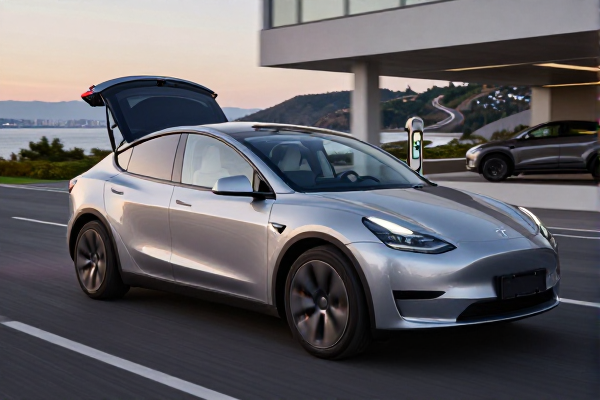
May 5, 2026 — Tesla has submitted a development application for what would become Australia’s largest public electric vehicle charging station. The proposed $3.5 million Supercharger hub, planned for the Thurgoona area of Albury, New South Wales, would feature 37 charging stalls on a vacant site roughly 2.5 kilometers from the Hume Highway.
If approved, the station would overtake Tesla’s 20-stall V4 Supercharger site in Goulburn, which has been described as the largest in the southern hemisphere. It would also more than double the capacity of Albury’s existing 16-stall CBD Supercharger, which has operated since December 2023.
The design calls for Tesla’s latest V4 charging hardware, capable of delivering up to 250 kW per vehicle. The station would also include solar canopies over the parking bays, with enough generating capacity to produce up to 100 kW of electricity on-site. That combination of high-speed chargers and solar coverage is increasingly typical of Tesla’s newer highway-oriented installations.
Location appears chosen with long-distance travel in mind. The Thurgoona site sits beside a gym and across from a supermarket complex, giving drivers practical options for a 20- to 30-minute charging stop. It is also well positioned for the Sydney–Melbourne route, one of Australia’s busiest interstate corridors, especially during summer holiday travel.
Albury City Council will now assess the application. The public notification window remains open until October 21, 2026, and a council report is expected by the end of November. That means construction likely would not begin before late this year, assuming approval is granted.
The Albury proposal is not an isolated project. Tesla has been steadily widening its Australian network, which passed 1,000 Supercharger stalls in June 2026 after activating a new location in Byron Bay. The company says its network now covers more than 10,000 kilometers of major highway corridors, and more than half of its Australian stations accept CCS2-compatible EVs from other automakers.
In Victoria, Tesla is seeking approval to upgrade its Euroa Supercharger, one of its oldest Australian installations. The plan would replace six older V2 stalls with ten V4 stalls and would also open the site to non-Tesla vehicles. Further west, Tesla is exploring a near-doubling of charging capacity at Kaniva, a town on the Melbourne–Adelaide route.
Wagga Wagga council members also considered whether to add more EV chargers at the Tarcutta truck-stop precinct, another key rest point between Sydney and Melbourne. These moves reflect a broader push to strengthen charging infrastructure along highways rather than just in urban areas.
The timing of the expansion aligns with rapid EV adoption in Australia. According to recent data cited by the ABC, electric vehicle consideration among Australian car buyers rose to 31% in 2026, helped by lower running costs, a wider model lineup, and improved access to public chargers.
Ross De Rango, director of Vehicle Charging Solutions Australia, told ABC Victorian Statewide Mornings that highway-adjacent charging sites are becoming increasingly attractive commercial opportunities. He noted that EV registrations have roughly tripled in a period when charging infrastructure grew by a factor of twelve, meaning the network is currently running ahead of demand. Still, he argued that state governments may need to help fund chargers outside major corridors, where private investment is less likely to be profitable.
A more cautious view came from Milad Haghani, an associate professor at the University of Melbourne. He pointed out that if even part of the recent growth in EV sales continues, public infrastructure will face mounting pressure to keep up. “If even a fraction of this demand continues into the future, that means that the infrastructure has some catching up to do,” Haghani told the ABC.
RACV motoring editor Terry Martin also underlined the need for continued investment. RACV operates its own public charging network, and Martin said Australia’s charging network must keep pace with fast-rising EV sales. “More than 180,000 EVs have been sold this year, and a lot of those will be hitting the highway over summer,” he said.
For American audiences, the Albury proposal offers a useful signal about how Tesla is thinking about highway charging globally. The V4 dispensers planned for this site use the same charging standard and hardware deployed across many US Superchargers, and the solar-canopy design mirrors upgrades that Tesla has been introducing at select stations in North America.
The broader trend in Australia also echoes what is happening in the United States, where public charging expansion is increasingly focused on travel corridors rather than urban hubs alone. Federal programs in the US have directed substantial funding toward highway charging, and Tesla’s private rollout in Australia demonstrates how fast that buildout can move when planning approvals are streamlined.
On busy holiday weekends, chargers along the Hume Highway can form queues, which is one reason additional capacity matters. Recent utilisation data shows that most regional Australian charging stations operate without heavy congestion on normal days, but demand spikes sharply during peak travel periods. The proposed Albury station would add 37 simultaneous charging positions, giving drivers another option close to the highway and reducing pressure on Tesla’s older CBD site.
The decision now rests with Albury City Council, though construction timing is not yet clear. Tesla has not publicly responded to requests for comment on the proposal. If approved, the Thurgoona station would become a benchmark for public EV charging in Australia — and another example of Tesla’s strategy of pairing large, solar-equipped hubs with major highway routes.
The project also raises a broader question for both Australia and the US: can charging infrastructure continue to outpace vehicle sales? For now, the data suggests it is keeping ahead. But with EV adoption still climbing, planners and policymakers will need to ensure the pace does not slow.