Browse

Log in / Register
 Share

August 20, 2025 — Tesla has told employees it is preparing a public launch of the Cybercab in Austin as soon as this month, according to a report from The Information. The vehicle would be the first Tesla ever built without a steering wheel or pedals — and for many observers, it’s the least exciting Tesla ever made, because its value depends entirely on a self-driving system the company has not yet proven at scale.
Tesla plans to start by offering Cybercab rides to its own employees on public roads, then fold the vehicles into its “Robotaxi” service in Austin a few days later, people with knowledge of the plans told The Information’s Grace Kay. The company completed emergency training with Austin first responders last week, teaching them how to move the vehicles out of the way, a spokesperson for the city confirmed. Tesla has also been running test drives and giving employees rides on private roads around its Austin campus since July.
The end of August is the internal target, though the timeline could slip. Tesla’s Robotaxi account is already promoting a “Cybercab launch event,” running a promotion through August 23 that enters riders into a draw to attend it: “More rides = better odds.” Tesla did not respond to The Information’s request for comment.
The Cybercab is a two-seat vehicle with no steering wheel and no brake pedal — meaning it has no fallback mode that works without a reliable self-driving system. Tesla says remote operators monitor the vehicles and can take over in an emergency, but that’s exactly the model Waymo has used for years, and Waymo has far more real-world data.
As of Tesla’s July earnings report, it reported 380,000 cumulative driverless miles across its Robotaxi hubs. Waymo, which has operated a commercial driverless service since 2020, says it has surpassed 220 million rider-only driverless miles — a gap of roughly 580x. The fleet numbers are even more telling: Tesla currently has 186 Model Y vehicles registered for its Austin Robotaxi service according to a Texas DMV dashboard, but the portion actually running without a safety monitor has been shrinking, not growing. In July, our reporting showed Tesla’s unsupervised Austin fleet stalled at roughly 17 vehicles, down from about 25 in the spring.
The Cybercab uses similar hardware and software as the Model Ys already operating in Texas and Florida. The new vehicle does not change Tesla’s autonomous driving capabilities, which remain limited due to safety and reliability concerns — as evidenced by the lack of scaling.
Musk originally unveiled the Cybercab in October 2024 as a sub-$30,000 vehicle, and Tesla fans have spent two years talking about buying one. That was never realistic, and it is even less realistic now. A vehicle with no steering wheel and no pedals is only useful inside the geofenced areas where Tesla’s software has been validated — currently small zones in Austin, Dallas, Houston, Miami, and now Tampa and Orlando. Outside of those zones, it’s a paperweight.
Tesla has been building Cybercabs at Gigafactory Texas since February, with over 100 units spotted in factory lots by July. The company is mass-producing a vehicle it can neither sell nor drive itself. The most recent addition was a Starlink antenna on a car that doesn’t need an internet connection to drive.
Electrek’s analysts have been tracking Tesla’s autonomous driving progress for years. The Cybercab launch in Austin is a symbolic milestone, but it does not address the fundamental gap between Tesla’s claims and real-world performance. Waymo now operates in multiple cities with thousands of vehicles, while Tesla struggles to keep even a few dozen unsupervised vehicles on the road. According to a recent report from Guidehouse Insights, Tesla’s approach — relying solely on cameras without LiDAR — has been a major factor in its slower validation. The Cybercab’s lack of a steering wheel actually makes it less flexible than the Model Ys Tesla is already using, because it cannot be manually driven to a different location if needed.
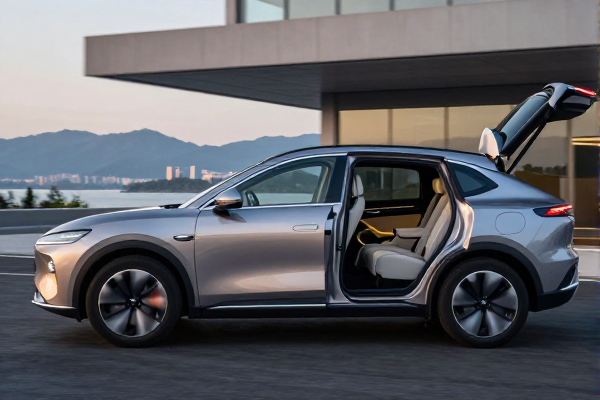
Every previous Tesla vehicle was exciting on its own merits. The Model S redefined the electric car. The Model 3 made it affordable. Even the Cybertruck, a commercial flop by any sales measure, was at least a strange, interesting object you could get in and drive anywhere. The Cybercab has none of that. It’s a small two-seater with a small battery, no significant cargo space, no steering wheel, and no ability to go anywhere you tell it. Its entire value proposition is autonomy, and Tesla has not solved autonomy at any meaningful scale. 380,000 driverless miles a year into Robotaxi versus Waymo’s 220 million is not a rounding error, it’s a different sport. Strip away the self-driving promise, and you’re left with a superefficient EV with butterfly doors and no way to drive it.
And nobody with a brain is going to buy one privately. Even if Tesla eventually sells them, what you’d own is a vehicle that only functions inside whatever polygon Tesla’s software has been validated for.
But it’s Tesla in 2025. Within the next few weeks, the company could launch a “flying car” that doesn’t actually fly — it hovers on cold gas thrusters, remotely operated, with nobody inside — and an autonomous vehicle that can’t reliably drive itself. Two products defined entirely by capabilities they don’t have.