Browse

Log in / Register
 Share
Share
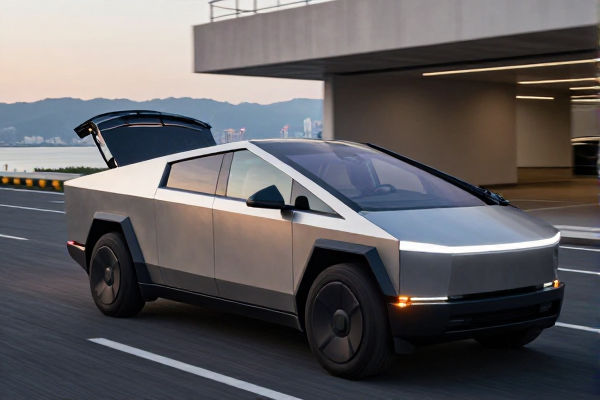
June 2024 — Recent submissions to the U.S. Environmental Protection Agency (EPA) have shed new light on Tesla's upcoming Cybercab, revealing specifications that position it as a remarkably lightweight and efficient entry in the electric vehicle market. With a curb weight significantly lower than Tesla's current lightest model and efficiency figures that set a new benchmark for the brand, the Cybercab is shaping up to be a pivotal product in Tesla's strategy, blending its ambitions for autonomous ride-hailing with practical EV engineering.
The most striking figure uncovered in the EPA documentation is the Cybercab's curb weight: a mere 3,113 pounds (1,412 kg). This places it approximately 700 pounds lighter than the lightest variant of the Tesla Model 3 currently available. For context, this weight is notably lean for a modern electric vehicle, even considering the Cybercab's reported two-door, two-seat configuration. The gross vehicle weight rating is listed at 3,730 lbs, indicating a payload capacity of around 617 pounds, which is adequate for its intended passenger use.
Beyond weight, the filing highlights the vehicle's powertrain. The Cybercab is listed with a single front-mounted motor producing 219 horsepower. While this output is modest compared to Tesla's performance-oriented models, it aligns with the vehicle's primary conceived purpose as a robotaxi, where relentless efficiency and cost-per-mile are paramount over acceleration. The battery specification, inferred from voltage and amp-hour ratings, points to a capacity of roughly 48 kWh.
The true headline for EV enthusiasts, however, is efficiency. The EPA data indicates the Cybercab achieves an estimated 165 watt-hours per mile (Wh/mi). This figure not only makes it the most efficient Tesla model disclosed to date but also positions it among the most efficient electric vehicles on the global market. This exceptional efficiency is the key enabler for the vehicle's next crucial metric: range.
Under the EPA's standardized test cycle, the Cybercab is credited with a range of 418.2 miles. Industry analysts and publications, including InsideEVs, consistently caution that such lab-cycle numbers rarely translate directly to real-world driving. Factoring in variables like climate control, road conditions, and driving style, the actual usable range for consumers is projected to be a more practical, yet still impressive, 280 to 290 miles. This range, coupled with the small battery, underscores the profound efficiency of the vehicle's design and powertrain.
The Autonomous Path and Prototype Clues
A significant layer to the Cybercab narrative is its development journey toward full autonomy. Initially unveiled as a concept for a dedicated robotaxi with no traditional controls, recent sightings of test prototypes tell a different story. Multiple units have been photographed and filmed equipped with a steering wheel and pedals. This pragmatic pivot suggests Tesla's initial rollout strategy likely involves a human-operated version. This approach allows the company to generate revenue, gather vast amounts of real-world data, and refine its Full Self-Driving (FSD) software stack incrementally before transitioning to a driverless taxi service.
This development phase is critical. Tesla's ability to validate its autonomous system across millions of miles in a dedicated vehicle platform could provide a formidable advantage. Industry observers note that the lightweight and efficient design of the Cybercab directly supports the economics of a robotaxi network, minimizing electricity costs per mile, which is a primary operational expense.
Market Context and Competitive Implications
The Cybercab's specifications land in a rapidly evolving segment. Companies like Waymo and Cruise are deploying autonomous vehicles, though primarily based on modified conventional cars like the Jaguar I-PACE or Chevrolet Bolt. Tesla's strategy of building a vehicle from the ground up for autonomy and efficiency represents a distinct approach. The weight and efficiency metrics revealed in the EPA filing are tangible evidence of the potential cost advantages of this integrated design.
Furthermore, the 48-kWh battery size is a deliberate choice. It keeps the vehicle's cost and weight down, which benefits efficiency. For a taxi service where vehicles may be fast-charged multiple times a day, a smaller battery that charges quickly can be more optimal than a larger, heavier, and more expensive pack designed for ultra-long distances. This logic reflects a nuanced understanding of fleet operations rather than just consumer retail preferences.
Looking Ahead: Timelines and Expectations
The question of launch timing remains. Tesla has previously targeted a release before 2027. As we move through 2024, the appearance of increasingly refined prototypes with production-intent features is a positive signal, but a firm debut date is still unknown. The EPA certification process itself is a major step toward production readiness.
When it does arrive, the Cybercab may represent a dual-purpose vehicle: first as an unusually efficient and lightweight electric car for early adopters, and ultimately as the physical backbone of the "Tesla Network" of autonomous taxis. The EPA data provides the first concrete technical foundation for both of those futures, confirming that the vehicle is being engineered not just for autonomy, but for a fundamental rethink of electric vehicle economy.