Browse

Log in / Register
 Share

June 5, 2025 — When Tesla rolled out the Cybercab robotaxi at a Warner Bros. studio in Burbank in October 2024, the missing steering wheel dominated the conversation. The quieter, more lasting story is the hardware that took its place: a 21-inch touchscreen at the center of a two-seat cabin. The display is the car's only control surface, its entertainment hub, and Tesla's clearest signal yet that the future of riding will look a lot like the future of watching.
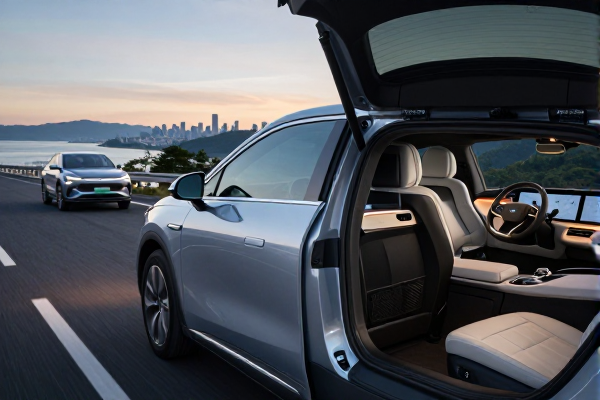
Automakers spent a century shaping interiors around a person holding a wheel. The Cybercab removes that person from the equation. There are no pedals, no stalks, no instrument cluster and no conventional mirrors. The front of the cabin opens into two lounge-style seats under a full glass canopy, with one large panel anchoring the space. From route to audio, climate to charging status, everything funnels through that single 21-inch screen.
In Tesla's current models, a driver gets a small cluster behind the wheel plus a center display for navigation and media. The Cybercab collapses those two layers into one. If nobody drives, there is no reason for a second screen. The panel becomes the sole point of contact between human and machine.
A detail often lost in the reveal: the display can turn toward whoever sits in the driver's position during supervised operation. It sounds odd for a robotaxi, but it has a practical job. Testing, valet moves, garage runs and regulatory checkouts all need occasional human control. A rotating panel allows that without adding a conventional dashboard.
That flexibility also fits Tesla's staged rollout. Before the robotaxi runs fully alone, it will likely rack up supervised miles in controlled settings. In that phase, the screen is both passenger amenity and operator workstation.
The Cybercab's screen-only theme extends to how the car refuels. Tesla designed the vehicle with no charging port; it pulls power from an inductive pad, so the robotaxi can top itself off without cables or human effort. The central display relays charge status, power draw and cost. Removing the port removes yet another physical touchpoint — and gives a fleet operator one less part to maintain.
The business case rests on two numbers. Tesla aims for a Cybercab price under $30,000, and Musk told the Burbank crowd the vehicle could operate at roughly $0.40 per mile, against what he described as U.S. personal transportation costs of about $1.20 a mile. If those figures hold, ride-hail fares could fall below what many households spend to own a car. That changes what the 21-inch screen means: at 40 cents a mile, a comfortable, entertaining cabin isn't a luxury add-on. It's the reason passengers choose one robotaxi over another.
Since the reveal, the timeline has moved ahead of what many expected. On Tesla's April 2025 first-quarter earnings call, executives said robotaxi production would begin in 2026, using a Cybercab built on the Model 3 architecture first; a more dedicated version of the vehicle would follow in a later phase. No exact month was given, and the company has missed autonomous-driving deadlines before. But the roadmap confirms a key point: the wheel-less, screen-driven interior will define Tesla's ride-hail fleet, not just sit inside a showcase model.
Entertainment may be Tesla's quiet advantage. The company already ships Netflix, YouTube and Hulu in its consumer cars, plus a large game catalog. A robotaxi is, by definition, a car people ride rather than drive — so that media library becomes a fleet feature rather than a parking-lot perk.
Waymo's rider interface is deliberately simple: a small touchscreen for trip status and support calls, with passengers defaulting to their own phones. Zoox has spent years building a lounge-style four-seater that runs public pilots. Cruise tried a similar cabin concept before the program was wound down. Against that field, the Cybercab's large-format panel is the sector's most aggressive bet that screen time will become a competitive advantage.
That same software stack will eventually show the vehicle's camera view, giving passengers an optional window into what the robotaxi is seeing. With Tesla planning a next-generation AI 5 computer for the platform, the company argues the system's hazard perception will exceed human reaction. The screen simply becomes the way to present that capability.
The Cybercab's price point also points to private buyers. A vehicle near $30,000 with no steering wheel is a strange purchase for someone who wants to drive, but it works as a second car or a commuter that can drop its owner off and park itself. For that audience, the change is more psychological than technical: no key fob ritual, no shifter, no speedometer — just a screen that presents trips, media and vehicle status. It will test whether consumers can accept total screen dependence as normal, rather than as a compromise.
The cabin story should not be confused with the autonomy story. Analysts at Guidehouse Insights and Gartner have warned for years that Tesla tends to promise robotaxi-ready software well before it can be safely delivered. The 2026 timing still depends on solving hard edge cases: heavy weather, construction zones, unusual pedestrian behavior. The interior is a strong bet on what transportation will feel like. The harder question is when that experience can legally and reliably happen on public roads.
A car without a steering wheel also needs regulatory answers. Federal motor vehicle safety rules were written around conventional controls, and states hold much of the authority over actual deployment. Texas looks like the most likely first testbed; its autonomy rules are friendlier to driverless fleets than California's approval process. The future of the 21-inch display will be decided as much in permit offices as in design studios.
One more layer: in an emergency, there is no driver to pull over and communicate with a dispatcher. The screen may be the only lifeline between a confused passenger and remote assistance. Tesla's interface design will carry that responsibility, not just handle movie playback.
The milestones are clear: Texas deployment permits, Cybercab production on the Model 3-based platform in 2026, and eventually the first rides in the dedicated vehicle. Each step will test whether the screen improves the ride or simply exists while a human remains nearby. One thing is already settled: the conversation about robotaxis will no longer focus on the wheel that disappeared. It will be about the screen that took its place.