Browse

Log in / Register
 Share


A viral clip that surfaced this month shows the Tata Sierra EV suspended from a rooftop in Pune, Maharashtra, held in place by what looks like an oversized spider's web. The footage, posted by Instagram user @rudramotors.tml, was staged as part of a promotional campaign around the release of Spider-Man: Brand New Day. It may look like a movie set, but it is a real automotive marketing stunt — and it is drawing fresh attention to one of India's most anticipated electric SUVs.
Last updated: June 16, 2025
The video is brief but striking. A full-size Sierra EV hangs several meters above the ground, attached to the side of a building with a thick network of web-like cables. There is no spider at the wheel, of course. The rigging is designed to look dramatic while keeping the vehicle secure. According to the original post, the display was set up in Pune as part of a nationwide series of Spider-Man: Brand New Day promotions. Movie-themed publicity has become increasingly elaborate in India, and this is one of the more memorable examples — a multi-ton electric SUV dangling over a city street.
Tata Motors has not publicly detailed the logistics of the stunt, but it is safe to assume engineers and safety crews were on hand. The key takeaway is the message: Tata is willing to go big to make the Sierra EV stand out.
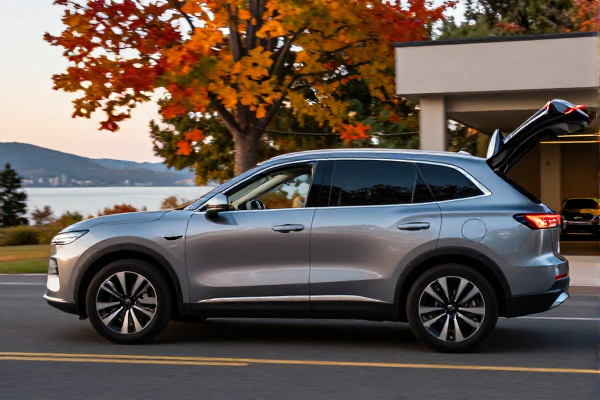
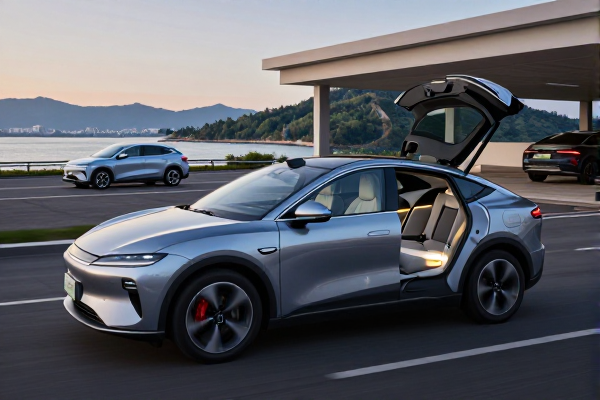
The Sierra EV is not just another electric crossover. It is Tata's flagship expression of its new design language, and it arrives at a moment when India's EV market is transforming quickly. Sales of electric passenger vehicles in India have climbed over the past two years, but the segment still represents only a low single-digit percentage of total passenger car sales. In other words, the race for early market leadership is intense.
The competition includes the Mahindra BE 6, Mahindra XEV 9e, MG Hector Tomahawk and Kia Carens Clavis — all five-door electric models engineered specifically for Indian road conditions. None of these nameplates are currently sold in U.S. showrooms, which means American buyers will not find the Sierra EV at a local dealership anytime soon. Still, enthusiasts have been tracking Tata's SUV push closely, especially as the company continues to hint at broader global ambitions.
Under the skin, the Sierra EV offers a genuinely flexible powertrain lineup. Buyers can choose between a 63 kWh battery and a 75 kWh battery. Both packs come with liquid cooling and an IP67 rating, which protects against dust and temporary water immersion — a useful feature during India's monsoon season.
The 63 kWh version produces 238 PS (about 235 horsepower) and 315 Nm (232 lb-ft) of torque. The 75 kWh pack is available in two configurations. A single-motor layout develops 209 PS (206 hp) and 315 Nm. The range-topping dual-motor variant, which Tata calls QWD (Quad Wheel Drive), pushes output to 306 PS (302 hp) and 504 Nm (372 lb-ft). That is enough to put the Sierra EV in the same performance conversation as many mainstream American electric crossovers.
Tata quotes real-world range figures using its internal C75 testing standard. The 63 kWh model is claimed to deliver between 440 km and 460 km — roughly 273 to 286 miles. The single-motor 75 kWh variant stretches that to 510-530 km (317-329 miles). The dual-motor QWD version, with its extra performance, settles at an estimated 480-500 km (298-311 miles).
For a vehicle that is not sold in the United States, those claims would be competitive with models like the Ford Mustang Mach-E and Volkswagen ID.4 — though the comparison is imperfect, since Tata's pricing is far more aggressive.
Charging is where the Sierra EV looks particularly strong. On a DC fast charger delivering at least 110 kW (for the 63 kWh pack) or 120 kW (for the 75 kWh pack), Tata claims a 20-80 percent charge in just 26 minutes. That is an excellent result by global standards. Home charging is slower but still practical: with a 7.2 kW AC wallbox, a 10-100 percent charge takes about 8.9 hours on the 63 kWh version and 10.5 hours on the 75 kWh version.
The flagship Sierra EV is quick when it needs to be. In Boost mode, the QWD version runs 0-100 km/h (0-62 mph) in 5.8 seconds. That is respectably quick for a large SUV. Tata has also equipped the Sierra EV with its Ultra Glide suspension featuring Frequency Dependent Damping. The idea is to deliver a plush ride over broken roads while maintaining composure at highway speeds — an engineering balancing act that matters as much on potholed Indian streets as it does on uneven American highways.
As for pricing, the Sierra EV ranges from 18.79 lakh to 26.48 lakh ex-showroom in India. At current exchange rates, that translates to roughly $21,800 to $30,800. To be clear, these are Indian prices; taxes, import costs and equipment differences would change the picture if the Sierra ever arrived in the U.S. But the math helps explain why Tata has become the best-selling EV brand in India: the value-to-price ratio is difficult to beat.
It would be easy to write off the rooftop display as a publicity gag. The strategy behind it is more sophisticated than it looks. India's EV buyers skew younger and more digital-first than the average car shopper. A billboard reaches thousands; a well-executed, unusual visual can generate tens of millions of impressions through social media. Every news article, Instagram share and YouTube short about the Pune stunt functions as free advertising for Tata.
This style of stunt marketing has a long history in the auto world. In the United States, automakers have staged everything from cars hanging from cranes to rooftop product placements tied to Hollywood franchises. The Spider-Man: Brand New Day tie-in follows the same logic: borrow the cultural pull of a beloved character to create an instant association with a new model.
The risks should not be ignored either. Suspending a heavy vehicle over a public street requires coordination with local authorities and strict safety protocols. A single misstep in execution could turn a viral sensation into a reputational crisis. The fact that the Pune display went off without reported incident is a plus, but it also underscores how much work happens behind the scenes.
Tata Motors has not said whether the rooftop stunt will be repeated in other cities. It probably does not need to. The campaign has already achieved its main objective: making people stop and look at the Sierra EV. Between the two battery options, the range-topping dual-motor variant and a price point that undercuts most Western rivals, Tata's electric SUV has plenty to talk about on its own merits. The spider web just makes the conversation more fun.