Browse

Log in / Register
 Share

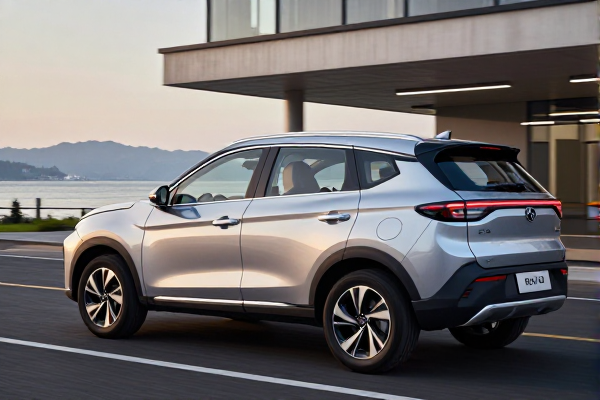
Tata, the Indian automaker that owns Jaguar Land Rover, is pressing its emerging-market comeback with a new compact crossover named after a bird of prey: the Osprey. As of July 2025, the model is on sale in South Africa from R249,900 (about $13,300), landing in a budget-SUV battlefield crowded with Chinese newcomers and Indian-sourced rivals. On paper, the Osprey looks like a value heavyweight — sharp styling, six standard airbags, and a five-star Bharat NCAP crash rating. In practice, it pairs those strengths with a handful of equally visible compromises.
Tata's track record in South Africa is thin. Its previous volume offering, the B-segment Bolt, went on sale in 2016 and never seriously challenged entrenched rivals like the VW Polo. Tata eventually withdrew, regrouped, and returned in 2024 with a far more coherent lineup: the entry-level Tiago hatch, the C-segment Harrier SUV, and a pair of crossovers — the Curvv and Punch — now joined by the Osprey.
The brand is clearly done with half-measures. But it still has to prove it can convert product breadth into lasting sales momentum.
It's fair to ask why Tata needs both the Punch and the Osprey, since the two are almost identical in size and overlap heavily on price. The answer is in the styling. The Osprey is the more striking of the pair: a sleeker roofline, chunkier proportions, and a more planted presence on the road. It also brings a dual-clutch automatic transmission to a class where CVTs and torque converters are the default — a genuine point of difference for buyers who care about how their car feels to drive.
That combination gives the Osprey a stronger showroom story than its sibling, even if the mechanical underpinnings are closely related.
South African pricing starts at R249,900 for the 1.2L turbo Smart+ with a manual gearbox, climbing to R279,900 for the automatic version of the same trim. The mid-level Creative line opens at R309,900, while the range-topping Creative+ PS — the PS badge stands for panoramic sunroof — lists at R329,900 (roughly $17,500 at current exchange rates).
Warranty coverage runs five years or 125,000 km (about 78,000 miles), with a service plan of three years or 45,000 km (28,000 miles).
The price band is one of the most hotly contested in any market. The Osprey lines up against Chinese imports such as the Chery Tiggo Cross, Omoda C5, Jaecoo J5 and Lepas L4, plus Indian-platform rivals including the Renault Kiger, Nissan Magnite, Suzuki Fronx and Kia Sonet. That's a knife fight, and every bit of added kit and safety equipment matters.
The Osprey makes a strong safety pitch. Every trim level gets six airbags as standard — a direct answer to the criticism aimed at the earlier Tiago, which skimped on airbag count. The car also carries a five-star rating from Bharat NCAP, India's official new-car crash-test programme, which follows Global NCAP-style protocols.
It's a meaningful credential in a segment where budget buyers are often told to accept fewer protections. Tata is clearly betting that demonstrated safety will be a differentiator, and that bet looks well-placed.
Like nearly all Indian-designed cars in this class, the Osprey is deliberately sized just under four metres (13.1 feet) long — a length that triggers a lower tax rate in India and keeps prices down. It's 1,804 mm (71 inches) wide and 1,620 mm (63.8 inches) tall, with 208 mm (8.2 inches) of ground clearance that approaches genuine off-roader territory. A full-size spare wheel is included, and the boot holds 382 litres (13.5 cubic feet).
Those are competitive figures on paper, and they hold up reasonably well in practice for cargo and rough-road ability.
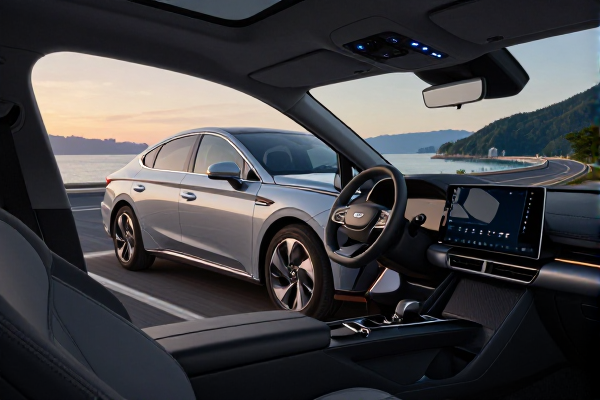
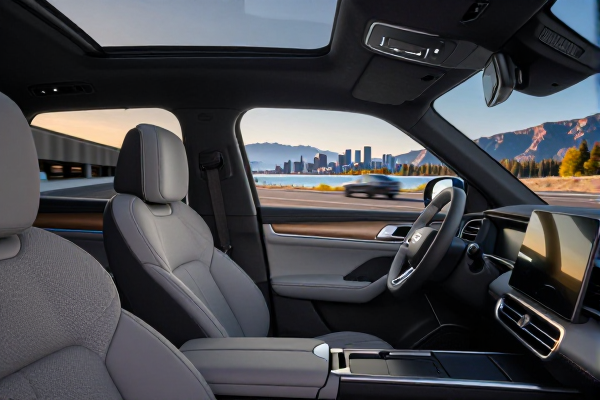
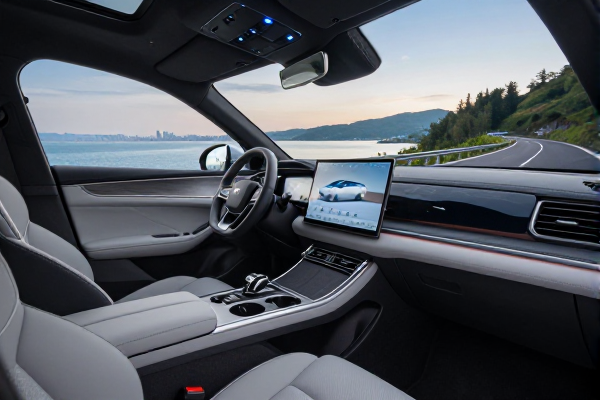
Tata loads the Osprey with equipment that was unthinkable at this price a few years ago: keyless entry and start, climate control, LED exterior lighting, blind-spot monitoring, a 360-degree camera, voice control, and a panoramic roof on higher trims. The touchscreen measures 10.25 inches, and the digital driver display spans seven inches. Both are acceptable for the money.
The ergonomics are less convincing. The USB-C ports sit in a tiny tray ahead of the gear lever — a space so tight that plugging in a phone requires awkward finger contortions. There are no front cupholders worth naming, and the door pockets are too narrow for an ordinary water bottle. Combined with a snug rear seat, the cabin feels smaller than the exterior promises.
Material quality leans industrial. Hard plastics dominate, and piano-black surfaces — including on the steering wheel face — are unlikely to age gracefully. The test car's instrument-cluster shroud showed visible panel gaps. The leather upholstery was a R8,000 (about $430) dealer-fit option rather than a factory item.
In a direct showroom comparison, several Chinese rivals now deliver a softer, more premium-feeling cabin for the same money. For shoppers who judge cars by touch and sight, that's a serious consideration.
Power comes from a turbocharged 1.2-litre three-cylinder engine. Three-pots are common in this segment, but this one runs rawer than the best of them: it vibrates noticeably at idle and needs a heavy right foot on steep climbs. The seven-speed dual-clutch automatic shifts smoothly when cruising and responds eagerly under hard acceleration, but it turns clumsy in stop-and-go traffic, with jerky downshifts when braking toward a halt.
At freeway speeds, the Osprey settles into a comfortable rhythm, tracking well at the national limit as long as passing maneuvers aren't constant. It is happiest on open roads with gentle gradients.
One more anomaly: the parking distance sensors chirp in ways that don't consistently correspond to the object ahead — more musical than instructive. The 360-degree camera, thankfully, is clear enough to serve as the primary aid.
The Osprey isn't sold in the United States, at least in this form. Tata Motors' American footprint today is limited to Jaguar Land Rover, which it has owned since 2008. But the parent company has repeatedly signaled that Tata-branded EVs could eventually reach North America, even if no concrete launch has been confirmed.
In that context, the Osprey offers a useful preview of Tata's entry-level strategy: invest heavily in safety and features, spend less on refinement, and let value do the selling. That approach is increasingly common across Indian and Chinese automakers, and it is reshaping small-car economics worldwide.
The upside is evident here — structural safety and feature content that once belonged in more expensive vehicles. The downside is equally clear: savings show up in material quality, calibration, and ergonomic shortcuts. The Osprey illustrates both sides of that trade-off in one package.
The Tata Osprey is a genuinely good-looking compact crossover, generously equipped and backed by a credible five-star safety result. In a crowded budget-SUV fight, that's a strong hand. But the sharp edges — a cramped interior, a coarse three-cylinder, imperfect gearbox manners, and cabin finish that trails its Chinese competitors — will surface the moment a buyer gets behind the wheel. The Osprey wins on the spec sheet; it needs to make a better case in person.