Browse

Log in / Register
 Share

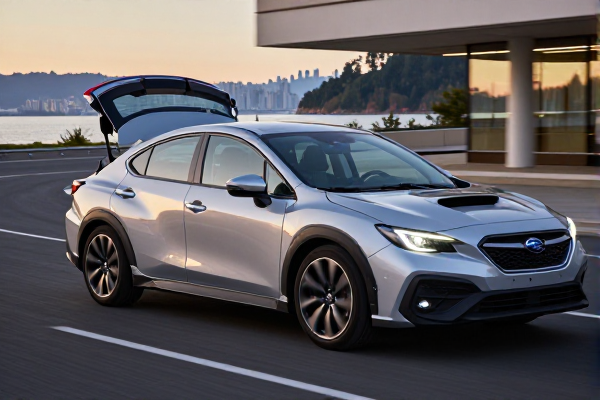
Spy photographers have caught a deeply odd Subaru WRX prototype lapping the Nürburgring, one that looks almost like a "longtail" endurance racer from the rear. The current-generation WRX has been on sale since the 2022 model year, and while Subaru has flooded different markets with special editions, a proper STI has never shown up. As of March 17, 2025, this prototype is the clearest sign yet that Subaru is still developing the WRX—but what it's building remains a genuine mystery.
From the front, it's just a WRX
From the A-pillar forward, this test car is indistinguishable from an ordinary showroom WRX. The familiar hexagonal grille, angular bumper, side air intakes, and signature hood scoop are exactly where they'd be on any other example. No flared arches, no extra cooling ducts, no canards, no dramatic splitters. It appears to ride on standard production wheels, with no exotic brake hardware peeking through the spokes. At first glance, you'd walk straight past it.
The rear end is the whole story
The rear is another matter entirely. Fresh bodywork has been attached to the rear quarters, extending outward and sitting roughly level with the taillights. A matching lip spoiler has been fitted in line with those extensions, giving the sedan a stepped, stretched profile that recalls the longtail endurance cars of Le Mans lore. A strip of camouflage on the rear diffuser is the only other visible change, hinting that at least one part underneath the tape is destined for production.
A departure from the wing tradition
This prototype also walks away from Subaru's own design language. The regular WRX wears a modest trunk-lid spoiler, while the WRX STI is famous for the towering pedestal wing that has been its visual signature for nearly two decades. Any future STI, or STI-flavored special, would logically carry something similar. The low lip spoiler and extended quarter panels sit on the opposite end of the aesthetic spectrum, which suggests either a genuine design shift or a purely functional test rig that was never meant to look pretty.
Why a "longtail" makes sense on the Nürburgring
Longtail bodywork is an established tool in motorsport. Porsche used it on the 917 to slice drag and raise top speed on the Mulsanne straight; the McLaren F1 GTR Longtail and Porsche 911 GT1 later adopted the same idea, and modern GT3 cars still play with tail extensions to balance downforce and drag. The concept works by giving the airflow a longer, smoother path to rejoin behind the car, which lowers rear lift and improves high-speed stability. On a road-going compact sedan, the idea is wildly unusual—but Subaru's engineers don't throw development money at nothing. They will be measuring real changes in drag and rear lift, and the Nürburgring's fast sections are the perfect laboratory for it.
It doesn't look like an STI mule
What makes this sighting more curious is everything the prototype doesn't have. There are no upsized multi-piston brake calipers visible through the wheels, and the standard front bumper shows no extra ducting for engine or oil cooling. A development car carrying significantly more power would look far angrier, with a bigger front splitter, additional heat exchangers, and race-bred hardware. If this were a full STI test mule, Subaru would want enthusiasts to notice wider fenders and serious brakes. Instead, the camouflage is limited to the rear bodywork, which says "aero experiment" far more than "performance flagship."
Theory one: another special edition
So what is Subaru actually planning? The most obvious explanation is another special edition. Since the current WRX arrived, the model has been a magnet for limited runs: the track-oriented WRX TR and the WRX tS in the U.S., plus a rotating cast of STI-styled packages in Japan. A distinctive tail would give any new edition instant visual identity. And a lip spoiler working together with a revised diffuser is not pure styling—it could bring a small but genuine improvement in high-speed stability, which is exactly the kind of talking point a modern special edition needs.
Theory two: aerodynamic homework
There is also a drier, more technical possibility. Automakers routinely bolt temporary panels onto mules to validate computational fluid dynamics predictions before committing to expensive production tooling. Keeping the front of the car standard would allow engineers to isolate the rear end's contribution to drag and lift. Under that reading, the strange quarter-panel extensions could be throwaway test rigs, while the camo-wrapped diffuser is the part actually intended for a production model. We've seen this pattern before: subtle aero tweaks hiding under camouflage during mid-cycle development, with the drama dialed back once the parts are finalized.
The Japan manual announcement matters here
The timing adds yet another layer. About a week before this prototype was photographed, Subaru announced it would bring the six-speed manual back to the WRX in Japan—using the TY85 gearbox from the previous-generation WRX STI rather than the TY75 transmission that U.S. buyers get. That is a serious commitment to a car designed primarily around the CVT in its home market. It tells you Subaru still sees a future in the current WRX and is willing to dig up STI parts from the past to keep the model fresh. Whether that energy eventually produces a full STI, a limited-edition run, or simply a nostalgic throwback package is the question now resting on this prototype's strange, wide tail.
Where does that leave the STI?
There is, of course, an elephant in the room: if Subaru is doing this much work on the WRX's aerodynamics, why not go all the way and build the STI that fans keep asking for? The honest answer is that the business case has gotten harder. Emissions regulations, development costs, and the shrinking performance-sedan market make a bespoke high-output STI a much tougher sell than it was in the 2000s. That doesn't mean it's impossible, but it does mean Subaru is more likely to test inexpensive solutions like aero packages before committing to a full performance model.
What it means for American buyers
For American buyers, the stakes feel higher than anywhere else. The U.S. is the WRX's biggest market, and the STI has not returned under this generation; the last full STI sedan ended with the 2021 model year. Subaru has tried to fill that void with the WRX TR and the WRX tS, both of which pair Brembo brakes and chassis upgrades with the standard engine's output. Subaru has also said the STI badge will not disappear, hinting that its future is electrified. A gasoline-powered STI built off the current car, then, remains a long shot. This longtail development car looks far more likely to spawn a stylish limited edition or a modest aero refresh than a 400-horsepower super-sedan.
The bottom line
Until Subaru confirms anything, this longtail WRX is a puzzle wrapped in camouflage. But one conclusion is already safe: the WRX remains an engineering priority at Subaru, and after five years of special editions without a true STI, that alone counts as a meaningful statement.