Browse

Log in / Register
 Share

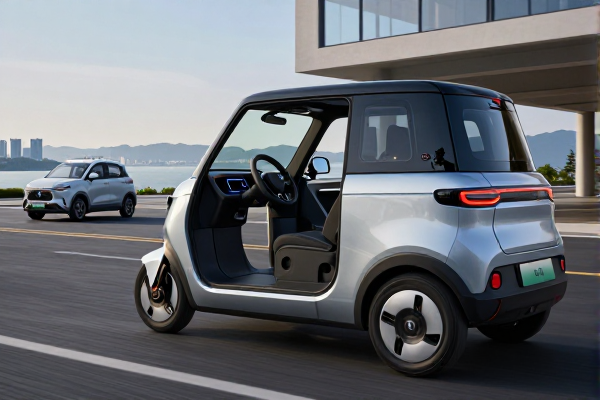
April 1, 2025 — For years, electric vehicle owners have been tethered to charging stations, but a new two-wheeler from California-based startup Lightfoot is flipping that paradigm. The Lightfoot scooter embeds two 120-watt solar panels directly into its bodywork, allowing it to harvest energy from the sun whenever it's parked outside. The company claims this trickle-charging capability can add meaningful range over a day of urban use — without ever plugging in.
At first glance, the Lightfoot looks like any other modern electric scooter: sleek, compact, and city-friendly. But the plastic body panels conceal an integrated photovoltaic system. Two monocrystalline silicon panels, each rated at 120 watts, are laminated into the side fairings and the front apron. When sunlight is available, the panels feed a maximum power point tracking (MPPT) controller that charges the battery at up to 240W total.
According to Lightfoot's engineering team, a full day of direct sunlight (about 6 peak sun hours in Southern California) can recover roughly 1.44 kWh — enough for about 15-20 miles of range depending on riding conditions. While that won't eliminate the need for conventional charging on long trips, for daily commuters parking outdoors at work or home, the solar top-up can significantly reduce grid dependency.
Range anxiety remains the number one barrier to EV adoption, surveys from the U.S. Department of Energy show. Lightfoot's approach is a passive solution: instead of hunting for chargers, riders simply park in the sun. The onboard battery is a 2.5 kWh lithium-ion pack with fast-charge capability (80% in 45 minutes via CCS), but the solar panels continuously replenish it whenever the scooter is stationary.
"This isn't a gimmick," says Dr. Elena Marquez, a sustainable mobility researcher at Stanford University. "For a typical 20-mile round-trip commute, the solar input could cover nearly the entire energy consumption if the scooter is parked in direct sunlight for 8 hours. It changes the psychology from 'charging is a chore' to 'parking is charging'."
The Lightfoot isn't just a solar experiment. It's built for daily use: a 45.2-liter lockable storage box under the seat fits a full-face helmet plus groceries or a laptop bag. The compact footprint (70 inches long, 28 inches wide) fits easily into bike lanes and crowded parking spaces.
Performance figures are equally impressive for a scooter in the 750W class. Dual hub motors deliver a combined 1,500W peak (2.0 hp), pushing the Lightfoot to a governed top speed of 45 mph — sufficient for most city streets. Suspension uses motorcycle-style telescopic forks and a mono-shock rear, while hydraulic disc brakes front and rear ensure confident stopping.
A 5-inch touchscreen display provides navigation, battery status, solar charging rate, and energy flow diagrams. The scooter also includes regenerative braking, which recovers energy during deceleration — adding another source of free juice. Riders can monitor solar contributions in real time via the Lightfoot mobile app, which also logs carbon savings.
"The integration of MPPT and regen braking means the battery gets optimized for every ride," says Chris Nguyen, Lightfoot's product lead. "We're seeing early testers achieve 30-40% longer intervals between grid charging compared to standard e-scooters."
The Lightfoot targets urban commuters who have outdoor parking, live in sunny climates (like the Southwest U.S.), and want to minimize their plug-in time. At a projected starting price of $4,299 (pre-order discount $3,699), it's more expensive than a traditional gas scooter or basic EV scooter, but Lightfoot argues the solar savings and reduced charging infrastructure needs make up the difference over four to five years.
Lightfoot joins a small but growing group of solar-equipped micro-mobility vehicles. The 3-wheeled Aptera solar EV has gained attention but is still in production delays. Meanwhile, companies like Solar Scooters (in the UK) offer detachable solar roofs, but none have built the panels flush into the bodywork like Lightfoot. The startup says it has filed seven patents on the panel integration and thermal management.
The first 100 production units are slated for delivery in Q3 2025 to U.S. buyers. International expansion to Europe and parts of Asia is planned for 2026, pending regional certifications.
Dr. Marquez adds: "The real significance is demonstrating that EVs don't always need a grid connection — they can become mobile energy hubs. Even if the solar only covers 20% of annual energy, that's 20% less strain on the grid. Multiply that across millions of scooters, and it's meaningful."
Lightfoot's approach won't replace charging stations, but it could reshape how we think about EV charging: as something that happens passively, while we work or sleep, powered by the nearest star.