Browse

Log in / Register
 Share


Smart has brought back its beloved two-seat microcar as the all-electric #2. Announced on April 26, 2026, the new city car promises up to 180 miles of WLTP range, a 35.8kWh battery, and a kerb-to-kerb turning circle of just 6.95m. It is the brand’s first genuinely compact EV since the ForTwo was phased out.
The #2 revives the formula that made Smart famous in the late 1990s. The original City-Coupe arrived in 1998 and was renamed ForTwo in 2004, staying in production through two more generations. The last of those, the ForTwo EQ, managed only 84 miles from a 17.2kWh battery. Smart then paused the model line as the company shifted toward larger EVs like the #1 and #3. Now, under Geely ownership, the two-seater is back — and at 2.7 metres long, it has barely grown. The new #2 is just 51mm longer than its predecessor, a remarkable achievement given the much larger battery and modern electronics packed inside.
The #2 is also part of a platform-sharing strategy that keeps costs in check. It is widely expected to use a shortened version of Geely’s SEA architecture, the same scalable platform that underpins the #1 and #3. That would explain how a car of this size can offer a 35.8kWh battery and a five-link rear axle without blowing up the budget.
Under the body sits a rear-mounted electric motor with 82bhp, matching the old ForTwo EQ’s output. But the battery story is more interesting. A 35.8kWh lithium-iron-phosphate pack lifts WLTP range to 180 miles — more than double the previous generation’s 84 miles. Fast charging runs at up to 65kW, and with such a small battery, a 10–80% top-up should fit neatly into a coffee stop. Vehicle-to-load capability is standard, so you can power a portable fridge, a laptop, or camping gear directly from the car during an off-grid afternoon.
Chassis engineers clearly had fun with this one. The #2 gets a five-link rear suspension, a layout usually reserved for much larger vehicles, and a turning circle of just 6.95m. That is tighter than a London taxi and makes parallel parking in dense cities almost laughably easy. The rear-wheel-drive arrangement keeps the front wheels free to steer through an aggressive angle, helping deliver that tiny turning diameter. In practice, a U-turn can be completed in a space that would force a conventional hatchback into a three-point manoeuvre.
Safety was always one of Smart’s strongest selling points, and the #2 continues that tradition. The Tridion safety cell has been re-engineered, with 78 per cent of the body structure made from high-strength steel. Smart claims the cell can withstand a roof load of more than four tonnes — about the weight of a large SUV — so the structure should feel reassuringly solid. Seven airbags protect occupants, while a suite of driver aids branded ‘Smart Pilot Assist’ includes adaptive cruise control and other active safety features. LED headlights are standard, a welcome upgrade for a car of this size.
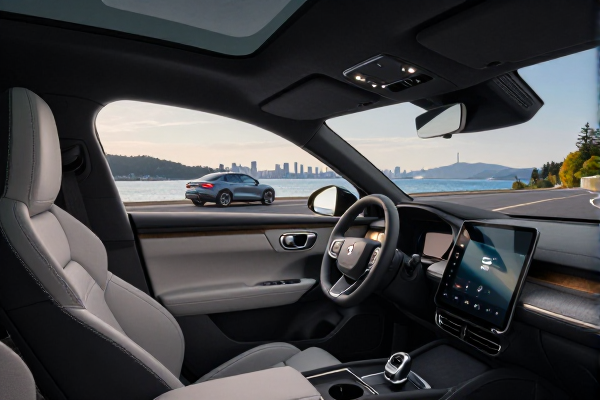
The design is credited to Mercedes-Benz Global, which explains the clean, thoroughly European look. A two-tone paintjob returns, as does the split tailgate that makes loading awkward cargo far less painful. Inside, the #2 is generous with screen space: a 10.1-inch central infotainment display and an 8.8-inch driver display dominate the dashboard. Higher trim levels add a glass roof, heated leather seats, and a seven-speaker Sennheiser sound system. The cabin feels noticeably roomier than the old ForTwo’s, despite roughly the same exterior length.
There is also a special first-edition model. Dubbed the ‘Couture Edition’, it is limited to 999 units in Europe and sits at the top of the range. That car features Atelier White Matte paint, a Platinum Gold roof, 16-inch wheels with gold detailing, and an unusual front insert that, in leaked photos, appears to be spitting out a duffel bag. The grille is said to house a sensor module, but the visual joke has already generated plenty of online attention. Anyone hoping to secure one will likely need to move fast when reservations open.
Pricing has not been announced yet, and Smart will probably continue to drop teasers before the official debut. Given the larger battery and extra equipment, expect a noticeable price increase over the old ForTwo EQ’s sticker. The #2 enters a busy European segment that already includes the Fiat 500e, the Dacia Spring, and the upcoming Renault Twingo E-Tech. Its combination of a true two-seat footprint, safety cell, and useable range could set it apart, especially in cities where parking spaces are measured in centimetres.
Whether the #2 will reach the United States remains an open question. Smart left the US market in 2019, and its current line-up is not sold there. A car this small could find a niche in Boston, New York, or San Francisco, but American buyers have historically gravitated to larger vehicles. For now, the #2 is aimed squarely at Europe, where Smart’s heritage is strongest. If it sells well enough, a US revival might not be impossible — though adapting the car to US crash and noise standards would add cost. For the moment, the little #2 is a refreshing reminder that small, efficient city cars still have a place in an auto industry obsessed with SUVs.