Browse

Log in / Register
 Share

June 1, 2025 — Mike Rogers, the Republican candidate in Michigan's high-stakes Senate race, has reversed his prior endorsement of President Donald Trump's tariffs on Canadian goods. In a 30-second ad released in recent days, the former congressman is shown at a sports bar with a Labatt Blue within reach, delivering a direct rebuke of the White House trade campaign: "Here in Michigan we know that Canada is not our enemy. We need to end this tariff war now."
The spot leans on border-state imagery that Michigan viewers instantly recognize. An image of the Ambassador Bridge, the four-lane span connecting Windsor to Detroit, flashes on screen as Rogers promises to "bring both parties together to lower your prices," calling that "job No. 1."
Trump, however, was in no mood to entertain the message. During an Oval Office exchange with reporters Wednesday, he waved off the commercial, insisting Rogers was simply asking Canada to come to the negotiating table. "Well, I viewed it as though he wanted Canada to make a deal," Trump said. He then returned to his familiar complaints, asserting that Washington "doesn't want them to make cars for us" and accusing Canada of "ripping us off" for years—"and they're not going to rip us off anymore."
For anyone tracking Rogers' statements this year, the ad is a striking about-face. Earlier in 2025, in a Fox News interview, Rogers embraced the administration's tariffs as the engine of what he called U.S. "reindustrialization." He described the policy as "huge for us" and insisted "all of these things are really positive."
He was especially blunt about Canada's auto trade. Rogers argued it should be "absolutely unacceptable" for Canadian producers to sell "hundreds of thousands of cars" in Michigan, claiming those exports "undercut the people who build cars and car parts." "The Canadians have not been good partners on this," he said at the time.
Rogers has long been one of Trump's most loyal allies in the state. When the president endorsed his Senate bid earlier this year, Rogers said he was "thrilled," promising that "together, President Trump and I will unleash a great revival in the state of Michigan."
A former FBI special agent who later chaired the House Intelligence Committee, Rogers ran a hard-edged primary campaign anchored in national security and border enforcement. That profile made him a natural fit for Trump's endorsement in a state that has trended Republican in recent presidential contests but remains fiercely competitive in statewide races.
The simplest explanation for the pivot is political arithmetic. A Politico survey released in late May found that only 26% of Americans think tariffs on Canadian goods are the right move. Voter unease is even more pronounced in states that border Canada, where cross-border supply chains and everyday shopping patterns are woven into community life.
The polling is also grim for Rogers personally. He has trailed his Democratic opponent, Abdul El-Sayed, in most public surveys of the Michigan Senate race, and the gap—while not insurmountable—has put his campaign on edge.
El-Sayed, a physician and former Detroit health official, pounced on the ad within hours. Mocking the Labatt bottle in the frame, he quipped that Rogers "must have had one too many of those Labatts." He went further, accusing Rogers of flipping because his campaign is floundering: "You cheer-led this tariff war from the beginning and you're flip-flopping now because your poll numbers are in free fall. Donald is the reason we're in a trade war. And he's the reason you're running."
The political battle, however, papers over a more intricate economic story. Far from being a rival that undercuts U.S. manufacturing, Canada is wired directly into the American auto industry. Components routinely cross the border half a dozen times before a finished vehicle reaches a dealer's lot, with Canadian plants providing engines, transmissions, and specialized parts for U.S. assembly lines.
This two-way integration did not happen by accident. Decades of free trade encouraged each side to focus on what it produces best, and the result has helped North American automakers compete with low-cost overseas rivals.
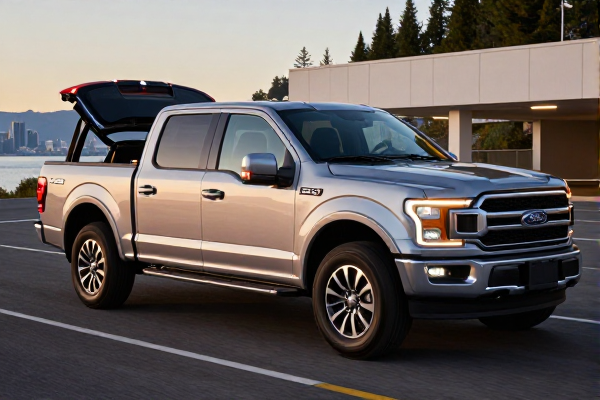
Canada is also a major customer for American-built vehicles. Roughly three-quarters of all cars sold in Canada are imported, with most coming from plants in Michigan, Indiana, and Texas. Ford's F-Series, assembled in and around Dearborn, has long been a top seller north of the border.
For Michigan, the exposure is enormous. Canada buys more Michigan goods than any other country, with two-way merchandise trade consistently exceeding $70 billion a year. A meaningful share of that commerce moves over the Ambassador Bridge, which handles roughly a quarter of all truck traffic between the U.S. and Canada.
The administration says its tariffs are rebuilding American industry, but the early evidence points the other way. Federal figures from the Bureau of Labor Statistics, compiled by the Economic Policy Institute, show about 62,000 manufacturing jobs have been lost since Trump's second term began in January 2025.
Trade economists tracking the conflict warn that tariffs on Canadian components drive up production costs for U.S. plants and retail costs for U.S. households. Ottawa's retaliatory duties—already imposed on selected American imports—add another layer of pressure, particularly for farm states and industrial districts that export heavily to Canada. Canada has made clear it will not lift those counter-measures while tariffs remain in force, even as it keeps the door open to negotiations.
The split in Michigan reflects a broader tension among congressional Republicans. In districts that depend on cross-border trade—from agricultural states to auto-producing seats—a growing number of GOP lawmakers have quietly pressed for delays or carve-outs, even as they avoid open confrontation with the president.
Rogers is the first high-profile Senate contender to go public with that message. His ad carefully avoids naming Trump and frames the issue as a cost-of-living problem rather than a foreign policy rupture. Yet the White House response shows how difficult it is to straddle that line: when the president publicly reinterprets your message, the candidate loses control of the narrative.
Rogers' new position is a bet that Michigan's divided political psyche favors pragmatism over loyalty. A substantial share of Republican base voters in the state still idolize Trump, but the broader general-election audience—including independents and suburban shoppers feeling price pressure—is far more skeptical of the tariff war.
If Rogers holds his ground, the Michigan race becomes an early, high-profile test of whether Trump's trade agenda is a winning message in the industrial heartland. If he buckles under White House pressure, the ad will be remembered as a brief, beer-fueled moment of rebellion and nothing more.
Either way, the Ambassador Bridge, the Labatt label, and the price of a new F-150 have become unlikely props in one of 2025's most closely watched Senate campaigns. Rogers is gambling that Michigan voters care more about their monthly bills than about scoring points in a trade war that many never wanted.