Browse

Log in / Register
 Share

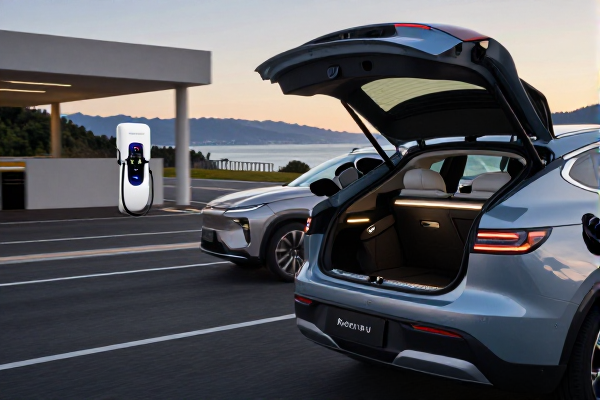
Reston's Waterford Square condominiums have switched on a dual-port Level 2 electric vehicle charger at 11500 Fairway Drive, marking the latest Charge Up Fairfax project to reach completion in the county. As of Oct. 22, 2025, the unit is available to residents of the 48-home community, which held a ribbon-cutting ceremony on Oct. 15 with Hunter Mill District Supervisor Walter Alcorn.
Waterford Square Condominium Association board president Steve Garver said the charger is designed to serve residents who have already made the switch to electric: three current homeowners are expected to use it, and two others own EVs. But he framed the installation as a long-term bet on the neighborhood's direction.
"I think it's the future," Garver said in a statement. "Clearly, it's better for the environment than gas and these days a lot less expensive."
Property manager Hannah Baratz of Abaris Real Estate Management said the amenity could also strengthen resale values, giving prospective buyers with an EV—or plans to buy one—a ready-made place to charge.
The charger was paid for in part by a $10,000 grant plus technical assistance from Charge Up Fairfax, the county program launched in 2023 to help homeowners' associations install EV stations in common areas. The program is designed to remove the upfront costs and logistical hurdles that often stall association-level EV projects.
Alcorn said 30 communities have joined Charge Up Fairfax so far, and 14 of them lie within his district. Reston's Harpers Square Cluster became the county's first program-backed installation in late 2024.
Communities that have completed their chargers include Encore of McLean Condominium Unit Owners Association (four single-port units, January 2026), Midtown North Condominium Unit Owners Association (one dual-port charger, August 2025), Penderbrook Community Association (four dual-port chargers, March 2025), Reflection Homes Association (one dual-port charger, May 2025) and Westwood Village Unit Owners Association (one dual-port charger, May 2025). Several neighborhoods—the Colonies at McLean, Pinewood Lake, Washington Plaza and Waterview Cluster—are still working through their projects.
Not every association has stayed the course. The Nantucket Cluster in Reston withdrew from the program after receiving technical help, Alcorn's office noted.
The Waterford Square project advances a county climate blueprint that calls for carbon neutrality by 2050. Fairfax's Community-Wide Energy and Climate Action Plan, adopted in 2021, set an interim goal of boosting hybrid and electric vehicles to at least 15% of light-duty vehicle registrations by 2030.
Reaching that target will require significant momentum. EVs made up just 3% of the county's registered vehicles—29,055 cars—as of 2023, according to the Electric Vehicle Readiness Strategy published last year. The county government's own fleet is around 13% hybrid or electric, and OEEC Director John Morrill told the Board of Supervisors in December that a full fleet transition may not be possible until 2050, partly because electric options don't exist for every vehicle type.
Fairfax currently counts roughly 369 EV charging station locations with 1,395 ports outside private homes, clustered mainly in the Reston, Herndon and Tysons areas. Many county-owned Level 2 ports at government buildings are open to the public for a fee.
Condos and apartment buildings have long been a weak spot in EV adoption. Renters and owners without garages or assigned parking rarely have a practical place to plug in, so shared stations managed by the association become the critical link. Charge Up Fairfax was built to close exactly that gap, and the Waterford Square project shows the model working at neighborhood scale.
There is also federal money in the pipeline. A U.S. Department of Transportation grant awarded to the Metropolitan Washington Council of Governments in June 2025 includes $2.5 million for Fairfax County to put publicly accessible EV chargers at county facilities, which would complement the HOA-focused efforts.
For boards weighing similar investments, the calculus is shifting: grant funding lowers upfront outlay, resident demand is growing, and resale value becomes a selling point. Waterford Square's new charger is a small installation—one unit serving a 48-home community—but it illustrates how Fairfax is trying to spread EV infrastructure beyond single-family driveways.