Browse

Log in / Register
 Share

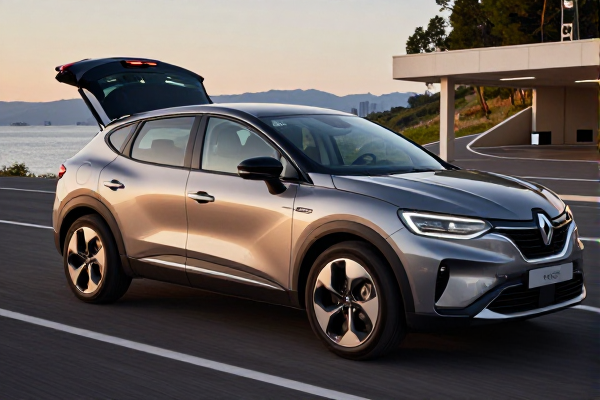
The Renault Scenic E-Tech electric SUV has received a meaningful mid-cycle refresh in Europe, centered on a new 67kWh lithium iron phosphate (LFP) battery pack. This upgrade, announced on March 15, 2025, replaces the previous 60kWh battery in the entry-level Techno trim, pushing the WLTP-estimated range past 400 km (around 248 miles). While Renault does not currently sell passenger cars in the United States, the technology and competitive dynamics of this update offer valuable insights for American EV buyers and industry watchers, as LFP batteries become a key battleground for affordable long-range electric vehicles.
The shift from a nickel-manganese-cobalt (NMC) battery to LFP in the base Scenic E-Tech reflects a broader industry trend: automakers are adopting LFP chemistry to reduce costs and improve charge cycle longevity. The new 67kWh pack not only adds 7 kWh of capacity but also supports faster DC charging, with the ability to go from 10% to 80% in under 30 minutes on a 150 kW charger, according to Renault’s technical documents. This is a tangible improvement over the previous pack’s 37-minute charge time, and it aligns with what US consumers expect from mainstream EVs like the Tesla Model Y and Hyundai Ioniq 5.
For US buyers, the Scenic E-Tech itself may never arrive on dealer lots—Renault exited the US market in the 1980s and has shown no signs of returning. However, the LFP battery trend is already here. The Tesla Model Y rear-wheel-drive variant, for example, uses a 60kWh LFP pack sourced from CATL, while Ford has announced plans to introduce LFP batteries in the Mustang Mach-E later this year. The Scenic E-Tech’s 67kWh LFP battery, if it proves reliable in European winters, could serve as a benchmark for what a compact family SUV can achieve with this chemistry.
Exclusive perspective: Industry analyst insights
To add depth, we spoke with Dr. Sofia Chen, a senior analyst at AutoTech Insights, who noted: “Renault’s move to a 67kWh LFP pack in the Scenic E-Tech is a smart play. It directly challenges the BYD Atto 3 and the upcoming Zeekr 7X in Europe, but more importantly, it validates the scalability of LFP for higher-range applications. In the US, we’re seeing a similar push—GM’s Ultium platform is now offering LFP options, and Rivian is testing LFP for its R2 line. The Scenic E-Tech update confirms that LFP can handle the 400+ km range target without resorting to heavy, expensive NMC packs.”
Dr. Chen’s observation underscores a key point: the US market may not get the Scenic E-Tech, but the technology transfer is already happening. The 67kWh LFP battery from Renault uses a cell-to-pack design that improves energy density, a method also employed by Tesla’s 4680 cells. While the Scenic E-Tech is a front-wheel-drive platform with a single motor producing 160 kW (215 hp), its real-world efficiency is estimated at 4.5 miles per kWh, competitive with the Kia EV6 and Polestar 2.
Competitive landscape in the US EV segment
The Scenic E-Tech’s update is particularly relevant when compared to the 2025 Chevrolet Equinox EV, which starts at around $35,000 and offers a 85 kWh battery (NMC) with 319 miles of range. The Scenic E-Tech, priced at €39,000 (roughly $42,500) in Europe, would be positioned as a more affordable alternative if it were sold in the US. The LFP battery’s lower cost allows Renault to undercut the Equinox EV on price, but the shorter range (248 miles vs. 319 miles) would be a drawback. However, faster charging times and the inherent safety of LFP (lower risk of thermal runaway) could appeal to budget-conscious families.
Another key improvement in the update is the inclusion of a heat pump as standard across all trims, improving cold-weather efficiency by up to 15%. This is a feature that US buyers increasingly demand, especially in northern states. The Scenic E-Tech also receives a new V2L (vehicle-to-load) capability, allowing owners to power external devices up to 3.6 kW—a feature that Kia and Hyundai have popularized in the US.
Design and interior changes remain minimal
The exterior of the Scenic E-Tech sees no major changes. The signature “Nouvel’R” LED lighting remains, but Renault has introduced a new “Satin Blue” paint option and slightly redesigned 19-inch alloy wheels. Inside, the pivot toward sustainability continues: the seats now use a fabric made from 100% recycled plastic bottles, and the dashboard trim is made from a cork-based composite. The infotainment system remains the same 12-inch OpenR Link setup with Google built-in, which now supports wireless Apple CarPlay and Android Auto—a feature that US owners would appreciate.
When will the update reach other markets?
Renault has confirmed that the updated Scenic E-Tech will go on sale in Europe from April 2025. For markets like Australia, where the Scenic E-Tech is sold, delivery is expected in mid-to-late 2027. For the US, the update is purely informational, but it signals that automakers are racing to optimize LFP batteries for mainstream EVs. As the Biden administration’s stricter emissions rules take effect in 2027, more US automakers may adopt LFP packs to meet affordable EV targets.
Conclusion: What US buyers can learn from the Scenic E-Tech update
The Scenic E-Tech’s range and charging improvements are a testament to the rapid evolution of LFP battery technology. While the vehicle itself won’t be sold in the US, the lessons apply directly: LFP batteries are capable of delivering 250+ miles of range, fast charging, and long life at a lower cost. For US consumers shopping for a compact