Browse

Log in / Register
 Share
Share
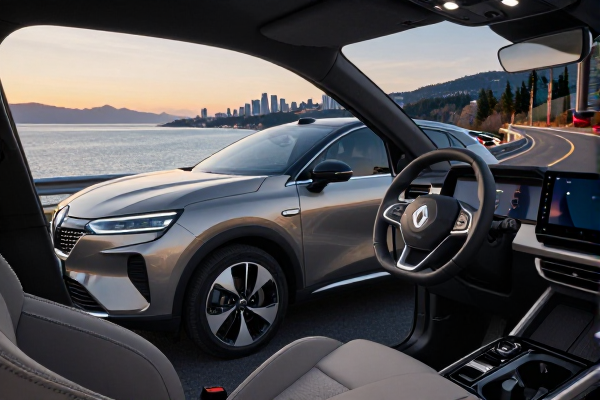
October 9, 2026 — Renault will bring the E-Space MPV concept to the 2026 Paris Motor Show, reviving the storied Espace nameplate as a full-size electric family hauler. About 4.7 metres long, the concept also previews Renault's switch to LFP battery chemistry across its range — a move meant to cut EV costs without sacrificing range. Press previews open Monday, October 12, with public days starting the next day.
The original Espace created the European MPV segment in 1984. More than four decades later, Renault believes the recipe deserves a second act. The E-Space Concept is its argument.
At roughly 4.7 metres, or about 15.4 feet, the concept sits at the large end of the people-carrier scale, slotting between the current Scenic E-Tech and the longer, SUV-style Espace that still sells in some left-hand-drive markets. For American context, that's noticeably shorter than a Toyota Sienna or Honda Odyssey — a reminder that European family vehicles are tuned for narrower streets and tighter parking garages.
Renault describes the car as demonstrating a "new approach" to family-vehicle design. The tall, one-box silhouette is unmistakably MPV, a shape most automakers walked away from when crossovers took over. The difference this time is that the platform underneath doesn't need to accommodate a combustion engine, giving designers far more freedom with the cabin layout.
The "E" in E-Space means more than just electric. It also signals LFP, or lithium ferrophosphate, batteries. Renault says the chemistry will let it offer better range for the same money as before, because the cells themselves are cheaper to produce.
The design team made no secret of its references. Wide U-shaped light strips frame both the front and rear of the car, while the grille carries an illuminated, floating Renault diamond badge. Those cues trace straight back to the original Espace, introduced in 1984.
That first model was arguably as radical in its day as the E-Space is now. It was the first European-developed MPV, with angular fiberglass body panels mounted on a steel spaceframe. It was developed by Matra with Renault mechanicals, and it only happened because Renault took a chance on a concept that others had turned down.
One of those others was Chrysler. In the late 1970s, Matra first offered the vehicle to Chrysler Europe's Simca division. Chrysler declined. Had it said yes, Europe's first MPV could have debuted under an American banner, and the Espace story would have needed a very different chapter.
Three more MPV generations followed the original. The model was withdrawn from the UK in 2012, and left-hand-drive markets received a fifth-generation version from 2015 — a car that had morphed into a conventional SUV in all but name. The E-Space, by contrast, is unashamedly an MPV again.
LFP batteries don't generate the buzz that solid-state technology does, but they matter far more to budget-conscious buyers. Instead of nickel, manganese and cobalt, LFP cathodes use iron and phosphate — abundant, inexpensive materials that avoid the supply-chain headaches of cobalt mining.
The trade-offs are well documented: LFP cells are heavier for a given capacity and offer lower energy density than NMC packs. But they survive more charge cycles, tolerate heat better and cost significantly less. For a family vehicle that gets charged nightly at home and driven for years, that trade-off is often smarter than chasing a few extra miles of range.
Renault's EV division, Ampere, has said publicly that LFP chemistry can cut battery costs by roughly 20 percent on smaller models. The E-Space shows that thinking moving up the range. Tesla, BYD and Ford are converging on the same conclusion — affordable EVs will be built on LFP.
There's a timing element here, too. The Volkswagen ID. Buzz has demonstrated that buyers on both sides of the Atlantic respond to electric people-carriers when they come with personality. The Buzz's reception is a big reason Renault thinks an MPV can win again, this time with electrons.
Renault hasn't sold new cars in the United States in decades, so nobody should expect an E-Space at a local dealership. Yet the concept still matters for American buyers, for three reasons.
First, the Renault-Nissan-Mitsubishi Alliance is one of the world's largest automotive groups. The platform most likely to sit under any production version of the E-Space, the CMF-EV architecture, already supports the Nissan Ariya sold in the US. Battery-cost lessons learned through Renault's LFP rollout could therefore filter into future Nissans, even if the Espace badge never crosses the Atlantic.
Second, the American minivan segment is ready for a dedicated electric entry. The Chrysler Pacifica is the only plug-in minivan at most showrooms today, and it's a hybrid. The ID. Buzz has carved out a niche, but Volkswagen doesn't sell its van in huge numbers. A serious three-row EV minivan from a major manufacturer would face surprisingly little competition.
Third, there's the historical curiosity: the vehicle that became Europe's MPV was nearly a Chrysler product. American readers can be forgiven for following this story with an unusual sense of what might have been.
The E-Space is the headliner, but Renault's Paris stand will be crowded.
The Twingo electric city car will appear in updated form with a "Twingobay" panoramic roof. The glass panel measures 0.7 square metres — about 7.5 square feet — and fills the tiny EV's cabin with natural light. Renault says no sunshade is needed because multi-layer glass blocks 99.9 percent of ultraviolet rays. The Twingo is central to Renault's affordable-EV push in Europe, with pricing expected to start below €20,000.
There's no shortage of retro flavor either. The Renault 8 Gordini concept reinterprets the rear-engined 1960s rally classic with modern styling, while the Renault 4 JP4x4 puts an off-road spin on the resurrected 4 E-Tech. Both reinforce the theme of a brand mining its history while pointedly moving forward.
Journalists get their first look at the E-Space Concept on Monday, October 12, the opening press day of the 2026 Paris Motor Show. The public can see the car from Tuesday, October 13.
Whether the E-Space becomes a production reality remains to be seen. But Renault's direction is clear: LFP batteries are rolling out across the range, and the Espace name is too valuable to leave dormant. If this concept is a preview, an all-electric Espace will aim to carry families in comfort — and be priced so that enough of them can afford it.