Browse

Log in / Register
 Share

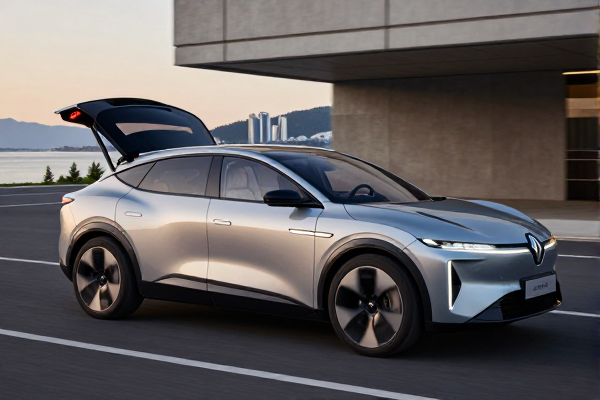
As of this update on May 9, 2026, the Renault E-Space Concept remains one of the most intriguing family-vehicle ideas to emerge from the Paris Motor Show. Renault has spent the past few years reviving its own history with the retro Renault 5 and Renault 4. Now it has reached back to the 1980s and the Espace, the original stylish people carrier. The E-Space Concept is a thoroughly modern take on that idea—and a clear answer to anyone who thinks the minivan format is dead.
The exterior is deliberately nostalgic, but not in a costume-party way. The steeply raked windscreen echoes the glassy, airy look of the early Espace. The floating roof spoiler is a nod to the roof rails carried by third- and fourth-generation Espace vehicles. The slim U-shaped light strips are pure 2026, not 1986. At around 4.7 meters long—roughly 15.4 feet—the concept is shorter than a typical American minivan, which makes it easier to picture in tighter European streets.
There are no conventional pillars between the doors. Instead, the rear doors swing open backward, coach style, and make the roof look as if it is floating over the body. It is a dramatic show-car detail, and the kind of thing that often does not survive the trip to production. The same could be said of the pillarless profile. Crash-test engineering has a way of killing beautiful doors.
Inside, the E-Space Concept does something most three-row SUVs do not: it makes middle-row passengers part of the conversation. The two middle seats can rotate 180 degrees so they face the third row, train style. They can also fold fully flat and become a table for those riding in the back. For families who use that third row often, the trick is genuinely useful.
There are six seats in total, across three rows. That is a more realistic family capacity than many seven-across SUVs, which often make the third row too tight for adults. The flat floor and low ride height are reminders of why MPVs were so good at moving people: no giant wheel wells, no complicated step-over, no mountain-climb access to the back row.
Renault has not yet quoted any battery capacity, driving range, or power figures for the concept. For now, the essential clues are structural. The floor is flat and the wheelbase is long, which leaves useful space under the passenger compartment for energy storage. If the concept becomes a real product, it is likely to sit on the company's next-generation electric architecture, known internally as RGEV Medium 2.0.
Renault's platform road map points to 800-volt rapid charging and more than 450 miles of range for battery-electric models. A hybrid version could exceed 850 miles on longer trips. None of those numbers are official for the E-Space Concept yet; they are planning targets for the architecture underneath. Still, they tell the right story: a future minivan does not have to be compromised on energy tech.
The most striking piece of the cabin is not the rotating seats. It is the dashboard. A steer-by-wire yoke replaces the conventional steering wheel, removing the need for a physical steering column. Next to it, a giant OpenR Panorama display runs across the entire width of the dashboard, while a second, smaller screen handles navigation, audio, and climate.
This is not far-fetched concept art. Renault has already indicated that the panoramic display is planned for the next-generation Scenic, which is expected around 2030. That gives the E-Space Concept more credibility than the usual motor-show weather balloon. Some of the cabin experiments may disappear, but the screen strategy looks real.
Renault does not sell passenger cars in the United States, so the E-Space Concept is not coming to a local dealership. But the design conversation it starts is just as relevant in North America. American families still need room for children, luggage, sports gear, and the occasional road trip. Minivans have always done that job brilliantly; they just stopped being marketed with any excitement.
The electric era gives people carriers a second chance. A low, wide, boxy shape can be more aerodynamic than a tall SUV, and it can carry the same number of people with less battery weight. That adds up to better real-world range and lower costs. The International Energy Agency has noted that the global shift toward larger EVs is putting pressure on battery supply chains and electricity consumption. In that context, the efficient minivan shape starts to look very smart.
The E-Space Concept does not appear out of nowhere. Renault has already brought the Renault 5 back as a small electric car and turned the Renault 4 into a rugged EV with wide appeal. Those two models gave the company a template: use design that people remember, add modern technology, and offer an alternative to the sea of lookalike crossovers.
The E-Space is the same idea, applied to a larger family car. It is also a quiet admission that the original Espace was killed, at least partly, by the SUV boom. Instead of chasing that boom again, Renault is betting that heritage and clever packaging can make the minivan relevant once more.
Renault also used the Paris Motor Show to show a new glass roof for the Twingo E-Tech electric city car. This one is much closer to production than the E-Space Concept. The company has priced the option at €550 or €600, depending on the country, and it will add a lighter, airier feel to the tiny EV.
It is a small feature, but it fits the same broad strategy: make electric cars feel desirable and a little emotional. Not every announcement needs to be a radical concept; sometimes a sunroof is enough to keep a model feeling fresh.
The Renault E-Space Concept is not a promise that a retro minivan is arriving tomorrow. It is, however, a strong signal that the company sees value in the format. Families can get space without driving a hulking SUV. A six-seat electric people carrier can be efficient, useful, and stylish. And Renault, of all companies, has shown that a name from the past can point the way to a more practical electric future.