Browse

Log in / Register
 Share

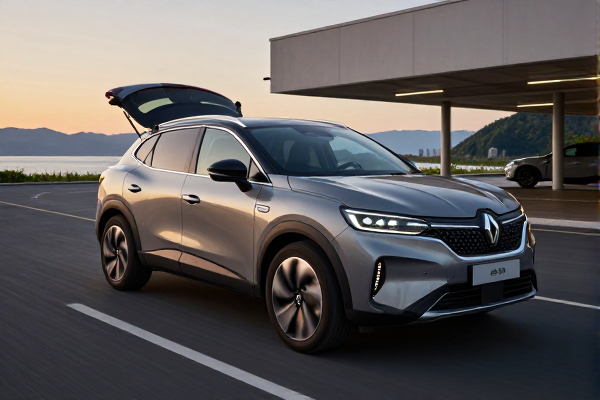
Renault pulled the wraps off a striking new people carrier at the Paris Motor Show this week, and it looks like a loving, forward-thinking tribute to the original Espace. Called the E-Space concept, it reimagines the 1984 pioneering one-box design as a sleek, fully electric “monovolume” with a lounge-like cabin, pillar-free doors, and a cockpit-spanning display. More importantly, Renault insiders have already hinted that a production version is on the table, setting up a potential showdown with upcoming EV family haulers from Kia and VW.
The E-Space isn’t just a nostalgic exercise. Renault’s design chief, Laurens van den Acker, confirmed to Auto Express that the company is seriously considering bringing the Espace nameplate back for a new generation. “It’s not just a bridge to the past, it’s one to the future,” he said, while also acknowledging the difficult reality of selling a non-SUV family vehicle today. “The monovolume market is a bit of a question,” he admitted, “but I think with the advent of connected cars it could make sense again.”
That’s the core challenge. Across Europe and the US, family buyers have shifted heavily toward crossovers and SUVs, leaving traditional MPVs—once the default choice for parents—on the margins. Yet Renault has never been afraid to zig when others zag. The French automaker has found huge success reinventing its retro icons: the Renault 5, the Renault 4, and the Twingo have all returned in modern form. The E-Space concept is the clearest signal yet that the brand wants to do the same for the Espace, only this time with batteries.
Van den Acker argues that the original Espace always had a classless quality to it, similar to a Volkswagen Golf or a Dacia Duster. It was a practical family vehicle that didn’t feel like a compromise, and it could sit comfortably alongside premium German metal in a driveway. He told Auto Express: “People could have an Espace and a Mercedes, or an Espace and a different type of premium vehicle. It’s the car that gives us the most credibility.” For Renault, the Espace has always been more than just a minivan; it’s a statement that the brand can do premium on its own terms.
If the concept reaches production, it likely won’t be a head-on rival for the usual heavyweights. Van den Acker admitted that directly competing with automakers like Volkswagen and premium German brands has rarely been easy for Renault, especially in markets where local offerings are deeply entrenched. Instead, the E-Space could carve out a niche as a tech-packed, design-led family vehicle with a genuinely different character—one rooted in practicality and innovation rather than badge prestige.
The cabin is where the E-Space really pushes boundaries. Renault’s new OpenR Panorama layout features a 1.13-meter-wide display that stretches across the entire dashboard, echoing the panoramic screens seen in the latest BMW iX3. This isn’t just a show-car gimmick: Renault has confirmed that the upcoming Scenic and Rafale models will adopt this cockpit design, too. A compact steering yoke with steer-by-wire technology replaces the traditional wheel, eliminating any mechanical connection to the front wheels and allowing continuous adjustment of steering assistance based on driving conditions. Peugeot is expected to bring the same technology to the mainstream in its next-generation 208, so the race to make steer-by-wire normal is clearly on.
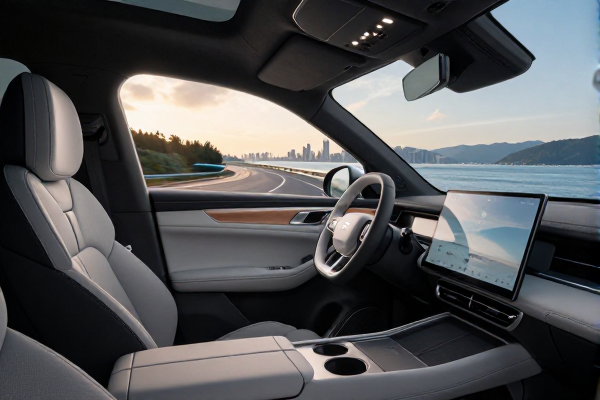
Inside, the E-Space concept feels more like a living room than a vehicle. There are six art-deco-inspired seats with floating mounts, thick long-pile wool carpets, ambient lighting, and enormous glass surfaces that flood the cabin with natural light. The rear-hinged coach doors and the absence of a central B-pillar make loading the second row far easier, while the middle-row seats can swivel to face rear passengers, turning the car into a mobile social space. In true French fashion, there’s even a remote-controlled sliding center console with a small fridge, video game controllers, and a Connect 4 game for those inevitable family road trips.
If anything carries over to a production model, a conventional seven-seat layout seems likely, but the concept’s basic proportion—a short, wedge-shaped nose flowing into a vast glasshouse—is what made the original Espace so special. That “one-box” shape maximized interior volume and practicality while staying reasonably aerodynamic, and the E-Space concept updates it with muscular wheelarches, a U-shaped light strip, and pixel-style running lamps borrowed from the Renault 5. The side skirts even resemble Formula One-style sidepods, giving the concept a subtle motorsport flavor while helping to manage airflow. Functional touches include flush door handles, camera-based side mirrors, and a front splitter that can lower at speed for better aero.
Underneath, the E-Space concept sits on Renault’s upcoming RGEV Medium 2.0 architecture, designed to be electric-first but flexible enough to accept a range-extender setup. A long wheelbase allows for a large battery pack, and Renault is reportedly targeting a 500-mile range for vehicles built on this platform. That kind of range would be a game-changer for a family MPV, removing the biggest practical objection to going electric. The next-generation e-motor drives the rear wheels, which would be a first for the Espace—traditionally a front-wheel-drive model. For buyers not ready to commit to full EV life, a small petrol engine could serve as a range extender, generating electricity on board while the car continues to drive like a pure EV.
Renault CEO Fabrice Cambolive framed the concept as a continuation of the brand’s design philosophy. “When Renault created Espace in 1984, it invented a new way of designing cars by putting people and their lives at the center,” he said. “With the E-Space Concept, we revisit that pioneering spirit for the electric era.” The “voiture à vivre” philosophy—cars designed for living—has been part of Renault’s DNA since the Renault 16, and the E-Space concept is the most ambitious expression of that idea in years.
For American readers, there’s a bittersweet twist. Renault hasn’t sold vehicles in the US market in decades, and the E-Space seems unlikely to change that anytime soon. But the concept still matters for the broader industry. It shows that a major automaker can take the old minivan formula, strip away the stigma, and transform it into something genuinely aspirational—without turning it into another three-row SUV. If Renault can prove there’s demand for a stylish, tech-heavy electric people carrier, it could open the door for other brands to bring their own MPV concepts to life, influencing the vehicles we see in global showrooms by the early 2030s.
At this point, the E-Space remains a concept designed to gauge public reaction. As van den Acker put it, this is “a concept to put our toe in the water and test the [public’s] reaction.” But he also made clear that the Espace is a car “only we could do,” and that it represents “the most credible high-end car Renault has ever done.” With the brand’s retro-revival strategy paying off in Europe and a new modular EV platform ready to go, the stars might finally align for a new Espace to reach production in the next decade.
Whether that happens hinges on how consumers respond—and whether the promise of 500 miles of range and a roomier, smarter cabin can coax families away from their SUVs. The E-Space concept is proof that Renault is willing to try. And if it works, the Espace name may once again define a category rather than follow one.