Browse

Log in / Register
 Share

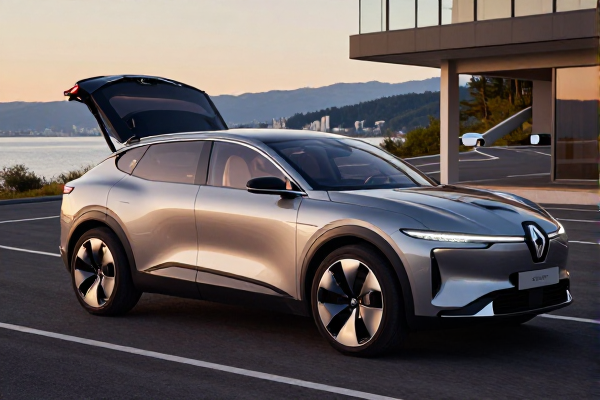
Renault is taking one of its most recognizable European nameplates into the electric age. On May 9, 2026, the French automaker pulled the covers off the E-Space Concept, a fully electric design study that revives the legendary Espace—the 1980s people mover that helped reshape the idea of a family car. The vehicle will make its first public appearance at the 2026 Paris Motor Show in October.
For American readers, the Espace is a bit of a road not taken. It was never a Stateside sales star, but its influence still ripples through the minivan world. The original car was shaped by an American-owned company overseas, and the new concept is a reminder that the one-box family hauler still has a future in the EV era.
The E-Space Concept is not a confirmed production model. Renault is using it to explore what “family travel” should feel like in an electric world, with heavy emphasis on interior space, occupant experience, and the technology that surrounds passengers.
The concept measures about 4.70 meters long, placing it in the same broad footprint as the Volkswagen ID. Buzz and Kia PV5. That size is intentional: all three vehicles are trying to make the boxy, space-efficient family hauler relevant again. The rear passenger area and overall cabin layout have not been fully revealed yet, which suggests Renault is saving the best details for Paris.
On the outside, the E-Space Concept uses a wide U-shaped light signature at both the front and rear. The front face is anchored by an illuminated Renault diamond, with a pixel-style lighting treatment that makes the whole vehicle look slightly digital, almost like a display piece rather than a traditional minivan.
The name itself is not subtle. “E” points to Renault’s E-Tech electrification branding, while “Space” does exactly what it says on the tin. After decades of confusing SUV naming conventions, there’s something refreshing about a car that simply tells you it is about space.
Renault’s history with the Espace is more accidental than people realize. The original concept was drawn by Fergus Pollock, a designer at Chrysler UK, in the early 1970s. That idea was then handed to the French engineering firm Matra, which developed it as a potential new Simca model. By 1978, Chrysler Europe had been sold to PSA Peugeot Citroën, and PSA took a look at the project and passed, deciding it would be too expensive to build.
That turned out to be Renault’s gain. Matra brought the project to Renault in 1982, and the first Espace hit the market in 1984. At the time, it was a radical shape: a one-box body, a flat floor, removable rear seats, and front seats that could swivel 180 degrees. Early sales were slow, but the concept gradually caught on as European families realized how much usable space was packed into that boxy silhouette. The Espace effectively created the large European people-mover category.
What makes that story even more interesting from a U.S. perspective is that the original design started inside Chrysler’s European operation. American minivans, led by the Dodge Caravan and Plymouth Voyager, were finding their own path around the same time, but the Espace was a more radical rethinking of what a family vehicle could be. The new E-Space Concept is essentially Renault returning to that same idea with battery electric power.
No story about the Espace would be complete without mentioning the Espace F1. Built in 1994 to mark the model’s 10th anniversary, it was one of the most unhinged vehicles ever shown by a mainstream automaker.
Underneath the familiar people-mover body sat a carbon-fibre chassis carrying the 3.5-liter V10 from Renault’s Williams Formula 1 partnership. Output was around 820 horsepower, delivered through a sequential gearbox to the rear wheels. It also came with F1-derived suspension, brakes, and aerodynamic body additions. The result was a minivan capable of nearly 300 km/h, in a straight line, with a screaming racing engine where the family luggage should go.
The E-Space Concept is obviously far more rational. There’s no V10 under the floor, and the only place you’ll find racing technology is in the brand’s memories. But Renault is still doing something conceptually similar: taking an established family-hauler shape and using it to test the next generation of technology. Instead of a racing engine, the E-Space gets electrification. Instead of raw power, it is about the experience of everyone sitting inside.
Renault has confirmed that the E-Space Concept will be one of three concept cars at the Paris show. It will share the stage with the Renault 8 Gordini Concept, an electric two-seat coupe inspired by the brand’s 1960s performance model, and the Renault 4 JP4x4 Concept, a four-wheel-drive reinterpretation of the iconic Renault 4.
The company will also use Paris to highlight updated production models. The revised Megane E-Tech will gain a 67kWh LFP battery pack, with claimed range of up to 500 kilometers. This is part of Renault’s strategy to introduce LFP chemistry across more of its EV lineup, reducing costs and limiting reliance on expensive nickel and cobalt.
Renault is not framing LFP as a wholesale replacement for NMC batteries. Instead, the plan is to let the two chemistries serve different roles: LFP for more affordable mainstream models with solid daily range, and NMC packs for vehicles where longer range and higher energy density are the priority. That balanced approach is a sign that Renault is thinking carefully about price-to-range ratio in the increasingly crowded European EV market.
In the short term, the E-Space Concept won’t directly change anything for American car buyers. Renault’s own retail presence in North America is minimal, and the Espace never became a household name here. But the concept is still a useful reference point as the U.S. begins to rediscover boxy electric family vehicles.
The Volkswagen ID. Buzz has already proven that an electric van with retro styling can generate real excitement stateside. Kia is pushing the PV5 into the flexible commercial and passenger segment. If Renault ever chose to bring the E-Space Concept to production, it would be entering a market where minivans are starting to be viewed with fresh eyes.
For now, the most important moment is still ahead. Renault will stage its Paris Motor Show press conference on October 12, 2026, and that event should finally reveal the cabin, the technical details, and—maybe more importantly—how serious the company is about turning this concept into a real car. Until then, the E-Space remains an idea with a lot of promise and a very famous name from the past.