Browse

Log in / Register
 Share

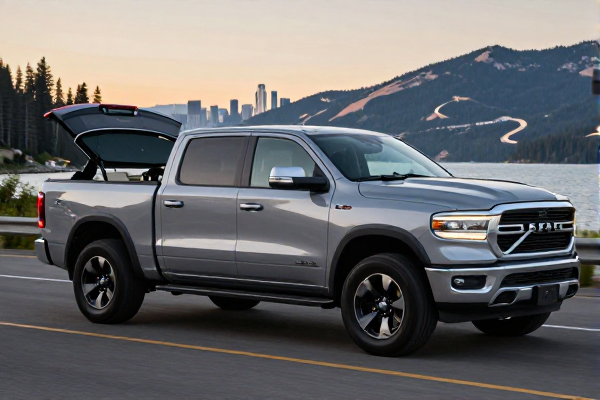
May 9, 2026 — Ram’s order books for the revived 1500 Rumble Bee are full through March 2027. The special-edition truck has only been available for a short period, but buyers have already claimed every build slot on Ram’s books. That makes the Rumble Bee one of the fastest sellouts in the brand’s recent history. The response also answers a question Ram did not ask publicly: is there still room in today’s truck market for a street-focused muscle pickup? Apparently, yes.
The Rumble Bee name first appeared in the mid-2000s, when Dodge offered a limited Hemi-powered Ram trimmed in yellow with black graphics and bee-themed badges. It was not a workhorse or an off-road monster; it was a lifestyle truck with a loud look and a louder exhaust. Enthusiasts kept the name alive on forums and at shows for years. The revived Rumble Bee is different under the skin, but it follows the same playbook: stand out at a stoplight, stay comfortable on the freeway, and do not pretend to be a rock crawler.
Ram’s timing is interesting. Right now, the loudest trucks in North America are off-road flagships like the RHO, Raptor and ZR2. They sell because they offer capability, but they are heavy, expensive and often overkill for normal driving. The Rumble Bee goes the other way. It is a pavement-first special edition, with styling that focuses on the road rather than the trail. It has a black-and-yellow visual identity, dark trim details, and a cabin that leans performance. That is a narrow lane, but Ram clearly decided the lane was long enough.
The proof is in the order bank. Ram has not published a production number for the Rumble Bee, and it may never do so. But for the company to close new orders through March 2027, every planned unit must be spoken for. That is not a normal backlog. It is a deliberate way to manage supply, protect the special-edition badge and keep the truck from piling up on dealer lots. It also creates a simple buyer problem: the truck is effectively unavailable until spring 2027 unless a dealership already has one on the ground.
From the dealer side, the quick sellout is more than a data point. It tells floor staff that there is an under-served group of customers who do not want another off-road package. That group is easy to ignore in an era of lift kits and all-terrain tires. The Rumble Bee gives them something with a different emotional pull. Salespeople who watched the first Rumble Bee generation remember how quickly those trucks became collectibles. The current response is already following the same rhythm. Expect to see dealer ads with market adjustments in some regions, because supply and demand are officially out of balance.
Some shoppers may wonder if the sellout is really about the truck or just about scarcity. In reality, the two go together. The Rumble Bee was never meant to be the brand’s high-volume answer to anything. It is a halo product, a model that makes the rest of the lineup look sharper by comparison. A halo product cannot work if it is as common as a rental spec. Ram’s choice to close the books early is not a mistake; it is the mechanism that makes the name feel valuable.
What happens after March 2027 is still a mystery. Ram has not said whether the order closure is a model-year cutoff, a pause before another batch, or a sign that the company will attach the nameplate to an electric truck. Given how quickly the current edition sold, another production run seems likely. If Ram does choose to extend the Rumble Bee, it will face the challenge of keeping enthusiasm high without destroying the exclusivity that drove demand. The easiest path is to keep future runs short, change some details and make each one feel like a unique moment. That is how the original truck became a collector favorite, and it is the same reason the modern version has become an instant hit.
Ram should also monitor the secondary market. Long sold-out runs usually push prices up, and high resale value tends to reinforce the brand’s premium image. Buyers who missed out will start watching used listings, and many will pay close to original sticker for a clean example. That is not Ram’s main goal, but it is a useful side effect. It keeps the Rumble Bee in conversation even when there are no new trucks to sell.
One thing is certain: the street-truck idea is not dead. Ford and Chevrolet have experimented with street-oriented pickups before, and the Rumble Bee’s success could encourage them to dust off old names or create new ones. That does not mean the segment will become huge; it just proves that a small, well-executed special edition can still create a lot of noise. For Ram, the challenge is no longer whether the Rumble Bee works. It is making sure the next chapter is just as exciting.
The Ram 1500 Rumble Bee is sold out through March 2027, and that is a clear message. The market is ready for a street-focused muscle truck when it is executed with personality and discipline. For shoppers, the advice is simple: if you see one in dealer stock, do not wait. The next chance to order may not arrive until well after the current run is history.