Browse

Log in / Register
 Share

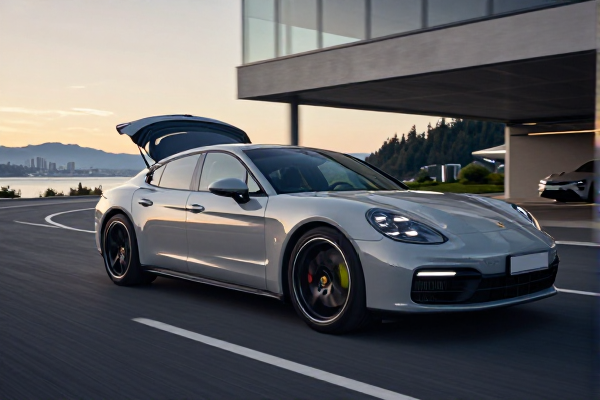
The reign of the poorly-integrated dashboard tablet may finally be coming to an end. In an automotive era dominated by flat, glare-prone touchscreens that often prioritize form over function, Porsche has introduced a compelling alternative with the curved display in its new Cayenne Electric. Announced amidst growing industry backlash against touch-only controls, this design represents a significant pivot towards driver-centric technology. As of August 20, 2024, this innovation is positioning itself not just as a new feature, but as a potential new standard for intuitive in-car interaction.
For years, the automotive industry, led by Tesla, has championed the consolidation of controls into large, central touchscreens. This approach, however, has drawn consistent criticism from drivers and safety advocates alike. The fundamental issue isn't the use of touch technology itself, but the ergonomic failure of mounting a flat slab of glass at a fixed, often awkward, distance from the driver. Operating these screens requires a driver to divert their eyes from the road for extended periods, stretch uncomfortably to reach virtual buttons, and struggle with screen glare in various lighting conditions. This has led to a notable counter-movement, with even Volkswagen Group's CEO publicly questioning the logic behind certain touch-sensitive controls.
Porsche's solution in the Cayenne Electric is elegantly simple yet profoundly effective: a large central display that is physically curved towards the driver. This isn't merely an aesthetic choice; it's a deliberate human-machine interface (HMI) strategy. The gentle, 45-degree fold creates two distinct zones. The lower section, angled upward, naturally brings key frequently-used controls—climate settings, audio source selection, and quick vehicle functions—closer to the driver's fingertips. This area is paired with a built-in wrist rest, allowing for stable, precise inputs without the arm fatigue associated with reaching for a distant screen.
The upper section of the curved display remains in the driver's primary sightline, perfectly positioned for mapping and navigation information. By separating "interaction" and "information" zones through physical form rather than software alone, Porsche addresses a critical safety flaw. Drivers can glance at maps without significantly altering their focus, while tactile exploration for climate controls becomes more intuitive. This design philosophy acknowledges that not all screen real estate is equal; its value is dictated by proximity and ease of access.
Beyond the physical curve, the Cayenne's interface leverages a native Android Automotive OS foundation, featuring integrated Google services. This provides a familiar, responsive software layer that complements the smart hardware. Furthermore, Porsche has retained a degree of essential physical controls, a move that will reassure traditionalists. Dedicated rocker switches for temperature and fan speed, a physical volume roller, and hard buttons on the steering wheel ensure core functions remain accessible without a visual search. This hybrid approach of "curve and key" strikes a pragmatic balance between high-tech capability and operational safety.
Industry analysts note that Porsche's move aligns with a broader shift towards "purpose-built" digital cabins. "We're exiting the phase where screen size was the only metric," says a recent report from S&P Global Mobility. "The focus is now on integration, ergonomics, and reducing cognitive load. Solutions like Porsche's curved display or BMW's new Panoramic Vision—which projects data across the entire width of the windshield—are about embedding technology into the driver's natural field of view and reach, not forcing the driver to adapt to the technology."
While the system is a major step forward, it is not without compromises. Some functions, like activating heated seats or the windshield defroster, remain behind touch-capacitive panels within the screen, which lack the immediate, blind-operation feedback of a physical button. However, given the immense complexity and customization of modern vehicle systems—especially in a vehicle like the Cayenne with numerous drive modes and performance settings—a completely button-free cabin may be an unrealistic ideal. Porsche's configuration appears to be a carefully considered hierarchy of controls.
The introduction of this curved display signals a maturation of in-car tech. The era of simply installing larger screens for marketing bragging rights is fading, replaced by a more thoughtful era of human-centered design. Porsche's innovation demonstrates that advanced technology and intuitive usability are not mutually exclusive. As this design language potentially trickles down to other models and influences competitors, the days of the poorly-considered dashboard tablet are indeed numbered. For drivers, the future promises not just more technology, but technology that works seamlessly with them, making the act of driving both simpler and safer.