Browse

Log in / Register
 Share

Published April 15, 2025
Porsche’s first attempt at an all‑electric SUV with the Macan EV backfired badly—sales cratered by over 75% in 2026 after the petrol versions were axed. Now the German automaker is trying again with a full‑electric Cayenne, but this time the strategy is smarter: the petrol and hybrid Cayennes remain on sale, with new generations reportedly coming later this decade. After two days of driving the new 2026 Cayenne Electric both on pavement and on a rugged trail, here’s how Porsche’s second EV SUV stacks up—and why it might just succeed where the Macan stumbled.
Porsche has learned from the Macan’s pricing shock. When that model went all‑electric, some variants jumped by as much as $30,000. For the Cayenne Electric, the increases are more measured, and in one case the EV is actually cheaper than its hybrid counterpart.
The entry‑level Cayenne Electric SUV starts at $167,700 (the Coupe at $173,500). That’s roughly $20,000 more than the equivalent petrol‑powered Cayenne—but the EV comes with standard air suspension and significantly more power. Step up to the Cayenne S Electric ($193,000 SUV, $194,500 Coupe), and the premium over the petrol S shrinks to just over $8,000. The flagship Turbo Electric ($259,800 SUV, $272,000 Coupe) is actually more than $40,000 cheaper than the Turbo E‑Hybrid. So despite the higher base price, the line‑up offers surprising value at the top end.
Porsche USA has not yet released final US pricing, but expect similar positioning. All US‑bound Cayenne Electric models will come well‑equipped, including matrix LED headlights, a panoramic glass roof, dual‑zone climate control, 8‑way power sports seats, and wireless Apple CarPlay/Android Auto. The S adds 21‑inch wheels, four‑zone climate, and a 14‑speaker Bose sound system; the Turbo adds 22‑inch wheels, adaptive aerodynamics, HD‑Matrix LED headlights, and 18‑way adaptive sports seats.
The decision to keep petrol and hybrid models alive gives buyers a real choice—a key differentiator from the Macan approach.
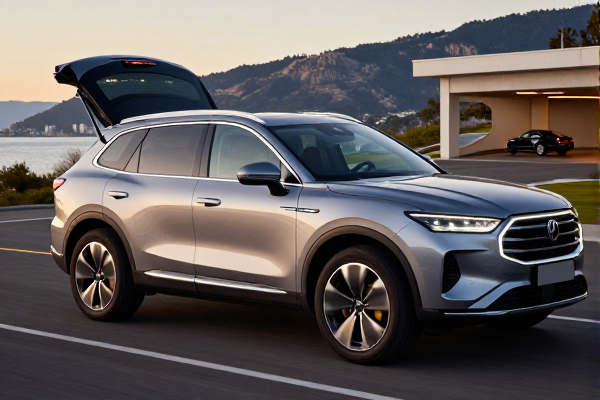
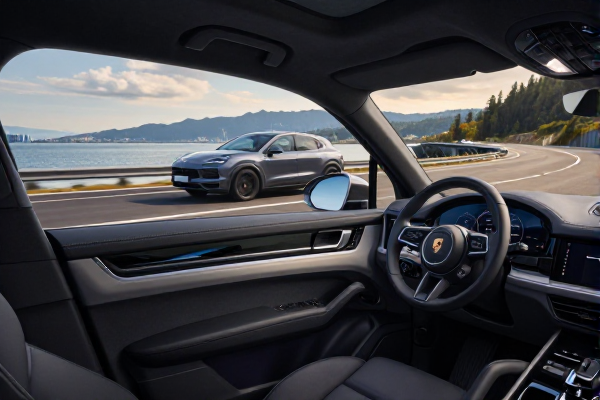
The electric Cayenne shares the same basic silhouette as the outgoing generation but is longer and lower for better aerodynamics. The design details are sharper, especially the slim LED lighting and a cleaner front fascia. Inside, the curved digital instrument cluster and central infotainment screen are joined by an optional passenger display, all wrapped in the expected premium materials.
The most surprising addition is an off‑road package with a unique front bumper that improves approach angles. It gives the Cayenne Electric a pronounced “overbite” look—unconventional, but functional. Few owners will tackle serious trails, but the option signals Porsche’s intent to make its EV SUV genuinely versatile.
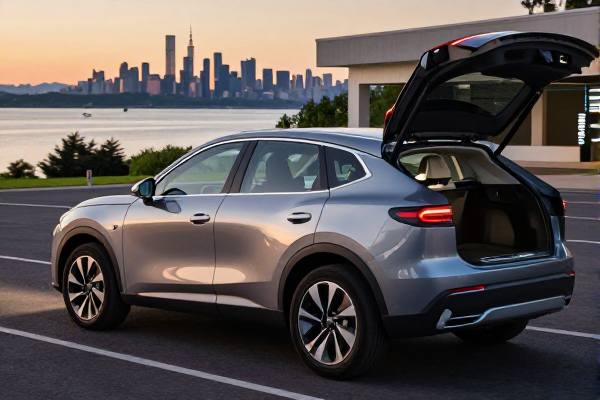
The Cayenne Electric remains a genuine family vehicle. Second‑row space comfortably accommodates two adults and three children, with the SUV body offering more headroom than the Coupe. Cargo capacity ranges from 781 liters (Cayenne SUV) down to 500 liters (Coupe Turbo). The front cabin features a large console with wireless charging, four USB‑C ports, and two cupholders. The curved central screen has a clever palm rest that makes using Apple CarPlay or adjusting settings while driving much easier.
All Cayenne Electric variants use dual motors and all‑wheel drive. The base model delivers 300 kW (325 kW on overboost) and reaches 60 mph in about 4.5 seconds. The Cayenne S bumps power to 400 kW (490 kW on overboost) for a 0‑60 time of 3.8 seconds. Then there’s the Turbo, which Porsche claims can hit 60 mph in just 2.5 seconds thanks to a staggering 850 kW (1,140 hp)—nearly twice the power of the Turbo E‑Hybrid. That makes it one of the fastest SUVs on the market, rivaling the Tesla Model X Plaid and the Rivian R1S Quad Motor.
All models benefit from Porsche’s torque‑vectoring and adaptive air suspension as standard. On‑road manners are predictably