Browse

Log in / Register
 Share

In January 2026, Porsche formally showcased the Cayenne Electric in India for the first time. The debut follows a late-2025 price announcement and cements the model's status as the company's flagship battery-electric SUV worldwide. India's Porsche centers now offer two versions: the Cayenne Electric at Rs 1.77 crore and the Cayenne Turbo Electric at Rs 2.28 crore, both ex-showroom and before options. The introduction makes the Cayenne Electric the third battery-electric Porsche sold in India, after the Taycan and the Macan Electric.
That local milestone is a useful signal for American buyers as well. The Cayenne has long been the best-selling Porsche in the United States, and this electric generation enters a North American market crowded with the Tesla Model X Plaid, Rivian R1S, Lucid Gravity and Mercedes-Benz EQS SUV. Porsche has targeted more than 80 percent fully electric sales globally by 2030, and every regional launch feeds into that goal. Watching the same car go on sale in New Delhi and Detroit within the same model cycle says much about how the brand intends to get there.
Porsche has also been carefully expanding its Indian footprint. The Cayenne EV joins a local lineup that includes the 911, Panamera, Macan, Taycan and the combustion Cayenne. Luxury EV volumes in India remain modest compared with China or North America, but they are growing from a small base, and the brand is betting that early adopter buyers will accept a heavy price premium in exchange for battery technology and badge prestige.
The Cayenne Electric is built on the Volkswagen Group's Premium Platform Electric, an 800-volt architecture shared with the Macan Electric and the Audi Q6 e-tron. Both India versions carry a 113 kWh battery and dual motors with all-wheel drive as standard. The base model develops 408 hp and 750 Nm of torque, with Launch Control lifting that to 442 hp and 835 Nm. The Turbo variant raises output to 857 hp and 1,360 Nm, and to 1,156 hp and 1,500 Nm when Launch Control is switched on.
Performance is serious in either trim. The standard Cayenne Electric reaches 100 km/h in 4.8 seconds with Launch Control; the Turbo does the same sprint in 2.5 seconds, a figure that belongs in supercar territory even for a large luxury SUV. Top speed is rated at 230 km/h for the base version and 260 km/h for the Turbo.
Range and charging figures round out the technical story. WLTP estimates are up to 642 km for the base car and 623 km for the Turbo. The 800-volt electrical system permits DC fast charging at up to 390 kW, restoring the battery from 10 to 80 percent in around 16 minutes and adding roughly 324 km of range during a 10-minute stop. Home charging runs at up to 22 kW on AC, with a full charge from empty taking about five hours and 45 minutes. That performance is among the quickest in the luxury EV class, and it applies to U.S. buyers as well: Porsche offers a NACS adapter for its EVs in North America, which opens access to the Tesla Supercharger network.
The 800-volt foundation does more than shorten pit stops. Higher system voltage trims wiring weight, improves thermal management and keeps electrical loads manageable for the large displays and driver assistance hardware. It is the same technical base that Volkswagen Group will use across a wave of upcoming EVs, so the Cayenne Electric is better read as a template than as an experiment.
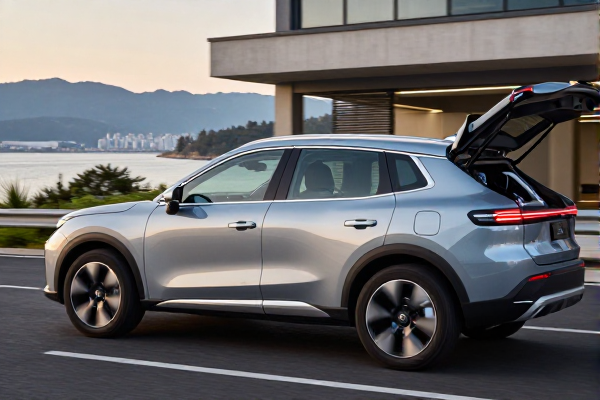
Styling is a mature evolution of the design language Porsche introduced on the smaller Macan Electric. Matrix LED headlights with four daytime-running-light elements define the nose, alongside a wide lower air intake, vertical side ducts and restrained black cladding. A 90-liter frunk under the hood adds genuinely useful storage.
Dimensions confirm the Cayenne Electric's position above the Macan. It measures 4,985 mm long, 1,980 mm wide and 1,674 mm tall with a 3,023 mm wheelbase, stretching 55 mm longer than the combustion Cayenne. Twenty-inch alloy wheels are standard, with 22-inch wheels optional, and soft-close doors are included.
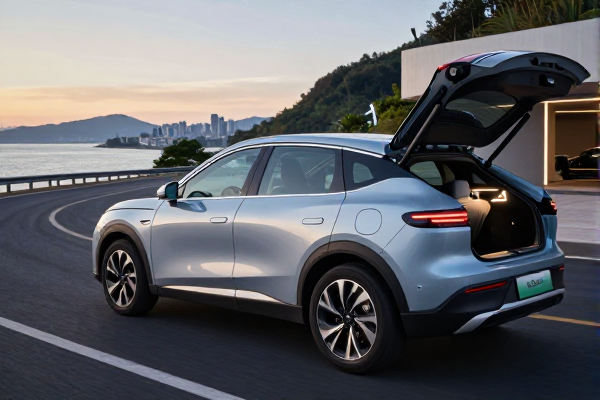
The rear end gets a sporty raked roofline, though the more extreme coupe profile belongs to the related Cayenne Coupe Electric. The dominant visual element is a wraparound clear-lens LED light bar with an illuminated Porsche wordmark, joined by a substantial roof spoiler and a chunky rear bumper that sits beneath a blacked-out panel with horizontal slats and reflectors.
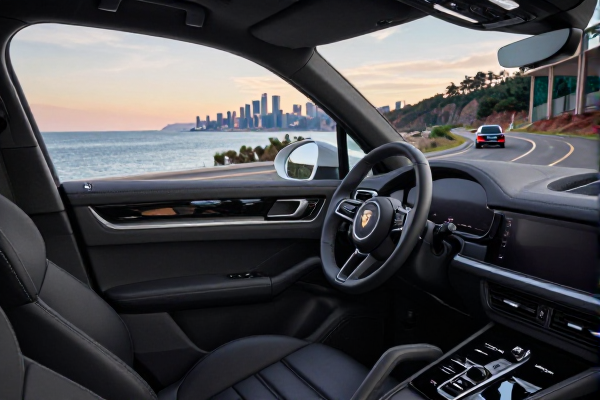
Inside, screens lead the design. A 14.5-inch curved OLED touchscreen anchors the dashboard, with a 14.25-inch OLED driver's display and a three-spoke steering wheel ahead of the driver. A 14.9-inch passenger display is optional. The center console follows a pass-through layout with storage and a wireless charging pad underneath, while a tall central tunnel still separates the front seats. Ambient lighting bathes the footwells and door panels in one of 30 selectable colors.
Standard equipment covers a 10-speaker sound system, eight-way powered and heated front seats with driver memory, a panoramic sunroof, four-zone climate control, a cabin air purifier, powered tailgate and rear sunshades, a 360-degree camera and a full driver assistance package. Luggage space is a generous 781 liters. Porsche's extensive customization catalog applies here too, with upgraded leather, larger wheels and additional technology available on request.
Indian pricing requires translation. Rs 1.77 crore and Rs 2.28 crore convert to roughly $206,000 and $265,000 at current exchange rates, but the gap between those figures and American sticker prices has nothing to do with the hardware. India levies heavy import duties on fully built luxury cars, with total taxes capable of exceeding 100 percent, and those costs are embedded in the ex-showroom tags. In the United States, ordering guides reportedly list the base Cayenne Electric just over $100,000 and the Turbo near $170,000 before destination and options. Same battery, same motors, yet Indian buyers face roughly double the U.S. entry price and a substantial premium at the top end.
The premium that Indian buyers are paying also reflects a market where luxury EV charging infrastructure is still developing. On paper, the 390 kW charge rate is an impressive talking point; in daily use, most owners will depend on home AC charging and on a still limited network of fast stations in the larger cities. So far, affluent early adopters appear willing to accept that trade-off in exchange for the badge and the performance.
In the United States, the Cayenne Electric enters the most crowded luxury electric