Browse

Log in / Register
 Share


Washington, D.C. – Oct. 1, 2026 – Poland’s electric-vehicle market is sending mixed signals. New registrations of fully electric passenger cars fell 23% year on year to 3,406 units in September, according to data from the Polish New Mobility Association (PSPA), F5A and Otomoto, reported by RMF24. Yet the country’s passenger-car EV fleet is still expanding quickly, and commercial electrification is growing even faster.
At the end of September, Poland had 152,768 battery-electric passenger cars on the road, 49% more than a year earlier. Another 13,811 electric delivery vans and cargo vehicles were registered, a year-over-year increase of 68%. Combined, the country’s registered EV fleet stood at 166,579 units.
The headline share figure is less encouraging. Fully electric cars accounted for 6.1% of all new passenger-car registrations in September, down from 8.9% in the same month of 2025. That’s not a collapse, but it does show that demand is becoming more sensitive to price, incentives and model availability.
For US readers, Poland is a useful reality check. Monthly EV registration numbers can be noisy. A single quarter can swing sharply because automakers batch deliveries or adjust pricing before subsidy deadlines. The Polish data suggests that long-term momentum is better measured by fleet growth and charging build-out than by one month’s sales total.
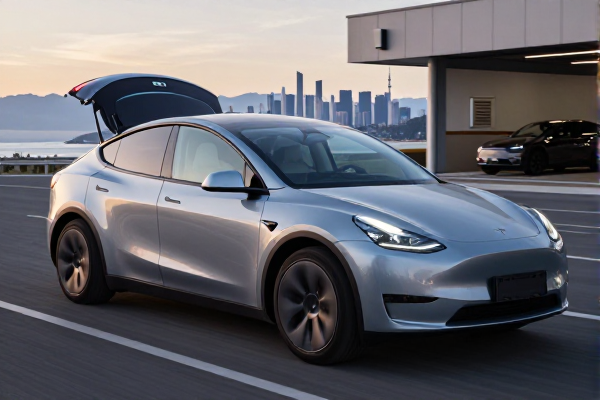
Tesla remains the most popular EV brand in Poland even in a slower month. The Tesla Model Y was the most-registered new electric car in September, with 460 units. The Model 3 followed with 209 registrations, and the Toyota C-HR+ took third with 180.
Combined, the two Tesla models accounted for roughly one in five new electric cars registered in Poland during September. Toyota’s third-place finish is also notable: the C-HR+ is a compact crossover built for the European market, and its early numbers suggest mainstream brands are starting to cut into Tesla’s lead. Audi rounded out the top three brands.
The secondary market is telling a slightly different story. Otomoto, one of Poland’s largest vehicle marketplaces, had 3,769 used electric vehicles listed at the end of September, down 13% from a year earlier. That decline runs counter to the rapid growth of the total EV fleet.
There are a few ways to read this. Owners may be holding onto EVs longer. Dealers could be listing fewer cars to protect margins. Or more used EVs are being sold privately rather than through classified platforms. Either way, a tighter used-EV market makes affordable entry more difficult for price-sensitive buyers.
Poland ended September with 13,936 public charging points. That includes 6,823 alternating-current chargers and 7,113 direct-current fast chargers. Based on the total EV fleet, that works out to roughly one public charger for every 12 registered electric vehicles.
Geography remains a challenge. Warsaw leads the country with 955 public charging points, followed by Gdańsk, Poznań, Kraków, Szczecin and Wrocław. Coverage in smaller towns and along highway corridors is still far thinner, which is one reason consumers outside major cities remain hesitant about going electric.
One month does not define a trend, especially in a market that has seen repeated swings between strong and soft EV registration periods. Poland’s 23% drop in September comes after a stretch of tough year-over-year comparisons and changing incentives across Europe.
What matters more is the underlying shift. Poland is moving from an early-adopter phase into a broader, more competitive market. Fleet growth of 49% in a single year is strong by almost any standard, and the 68% jump in electric commercial vehicles signals that delivery and logistics operators are committing to electrification as part of their long-term operations.
For automakers, the lesson is straightforward: competitive pricing and cheaper entry-level EV models will be needed to restart registration growth. For policymakers, the charging network remains the biggest constraint. Cities such as Warsaw are reasonably well served, but suburban areas, smaller towns and transit corridors still need faster and more reliable DC chargers.
Poland’s experience also matters for the US conversation about EV policy. When incentives shift and sales wobble, it can look like electrification is stalling. The September numbers tell a more nuanced story: adoption is broadening, infrastructure is expanding, and the market is maturing in ways that monthly headlines often miss.
The next few months will show whether September was a temporary slowdown or the start of a steadier, less spectacular growth pattern. Either way, Poland’s EV fleet is no longer a niche part of the auto market. It is becoming a structural part of the country’s transport system — and it is changing faster than the latest registration dip suggests.