Browse

Log in / Register
 Share

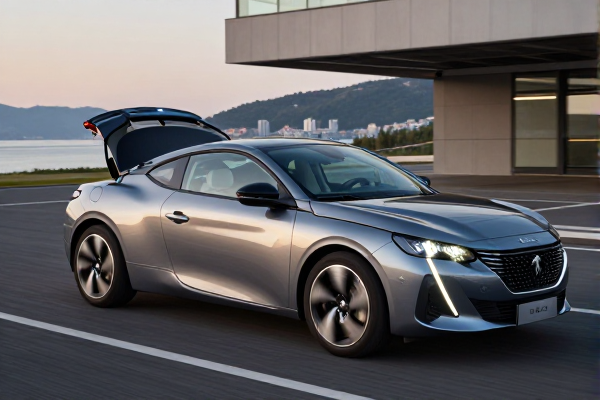
October 16, 2025 — Peugeot used the Paris Motor Show to resurrect the RCZ name as an electric coupe concept, the RCZ Vision, with a solid-state battery, a 1,000-volt architecture, 500 horsepower and an announced 600-kilometer WLTP range. The company also promises a 10-to-80 percent charge in ten minutes. The catch: these are target figures from a working prototype, not from a certified production model, and the battery capacity, curb weight, charger power requirements and charging curves have not been published. Here's a closer look at what the concept actually proves.
The fine print behind 600 km and 373 miles
Peugeot has not said when, or whether, the RCZ Vision will reach production. No battery capacity has been disclosed, no weight figure, no charger-power spec for the ten-minute claim, and no charging curve for different temperatures. What the company has offered is a battery pack that is only 110 millimeters thick, a targeted consumption figure of 11.5 kWh per 100 kilometers, and a top-range claim of 600 kilometers on the WLTP cycle.
Run those two figures together and you get roughly 69 kWh of usable capacity — about 373 miles at roughly 5.5 miles per kWh in US terms. That efficiency would be a step beyond any EV currently sold in America, including the most aerodynamic Tesla and Lucid models. It also explains why the designers could keep the roofline so low: a thin solid-state pack frees space that a conventional liquid-electrolyte battery, with its cooling plates and bulky casing, cannot.
But a target is a target. WLTP numbers tend to shrink when a car reaches the road, and prototypes are often lighter, shed heat more easily and ride on tires friendlier to consumption than production versions. Until homologated figures exist, the 11.5 kWh/100 km number is a laboratory ambition rather than a spec a buyer can plan a purchase around.
The ten-minute charge requires more than voltage
A 10-to-80 percent fill in ten minutes is the real headline of the reveal. If the usable capacity is around 69 kWh, adding roughly 48 kWh in 600 seconds means an average charging rate close to 290 kW. The peak rate during that window would have to be substantially higher, because every battery slows down as it fills. That is the reason for the 1,000-volt architecture — it allows higher sustained power without pushing cable currents into impractical territory.
Voltage alone, however, does not guarantee a ten-minute stop. Charging time depends on the rated power of the station, the battery's temperature at the start of the session, and the software's willingness to hold high power close to the 80 percent mark. Most existing US fast chargers cannot sustain 350 kW, and the ongoing switch to the North American Charging Standard is still leaving many older stations with modest output. The concept would lose most of its advantage at a 150 kW station, where the same 10-80 percent session would stretch toward 20 minutes or more — assuming the battery was preconditioned in the first place.
Winter performance is the other unknown. The announcement includes no data on low-temperature charging, no preconditioning time, and no mention of how the solid electrolyte behaves when the pack is cold. Those details decide whether a ten-minute charge is a daily reality or a highlight-reel achievement.
Solid-state: real promise, long timeline
The genuinely interesting part of the RCZ Vision is the solid electrolyte. Replacing the flammable liquid inside a lithium-ion cell with a ceramic or polymer layer allows higher energy density, better thermal stability and a much thinner cell stack. A pack that measures just 110 millimeters thick helps a low coupe with seating position and aerodynamics; a conventional pack would struggle to reach that height while keeping rigidity and crash protection.
The road from demonstrator to production is not short. Solid-state cells have to be manufactured with almost no defects, at a cost that competes with mature liquid-electrolyte factories, and they have to survive thousands of cycles while coping with mechanical stress from heat and swelling. Toyota has discussed production timelines and then pushed them back. QuantumScape, the well-funded US developer backed by Volkswagen, has shipped early cells to partners but has been careful about volume commitments. Nobody in the industry has yet claimed the last mile is easy.
Stellantis, Peugeot's parent, has a US stake in this exact technology. It has invested in Factorial Energy, the Massachusetts-based solid-state developer, and the two companies have said a Dodge Charger Daytona demonstration fleet with Factorial cells is planned for road testing around 2026. The RCZ Vision is therefore not a standalone show car; it is a polished preview of a battery strategy that already has a North American footprint. Whether that strategy lands in a Dodge, a Jeep or a Chrysler is the realistic question for US buyers, because Peugeot itself does not sell cars in America.
Steer-by-wire: the part nobody mentions
The RCZ Vision also shows a steering system with no mechanical connection to the front wheels — a controller in the cabin instead of a steering column — and electronically controlled brakes. The advantages are real: no column frees up cabin space, simplifies packaging and enables a variable steering ratio that changes with vehicle speed.
The unproven ground is feel and redundancy. Steer-by-wire needs fault-tolerant power supplies and backup control loops, because there is no physical steering shaft as a fallback. Some production systems, such as the one Infiniti introduced more than a decade ago, never changed the conversation. Drivers judge steering by intuition first and technology second, so a production version would have to feel entirely normal before buyers would accept it — a higher bar than any of the concept's performance claims.
Bottom line for US buyers
There is no production date, no price, no warranty, no dealer network, no crash rating and no US availability for the RCZ Vision. Comparing it with the Tesla Model S Plaid, the Lucid Air, or the Porsche Taycan is therefore premature, and any price-based comparison would be fiction. The useful way to read the concept is as a directional signal: a solid-state pack can be thin, a 1,000-volt architecture can support record charging rates, and a coupe silhouette can coexist with a long-distance EV.
Until the missing details appear, the questions worth asking about any future vehicle with this technology are simple. What is the usable capacity? What is the average charge power across the full 10-80 percent window, not just the peak? What does the charging curve look like in sub-zero weather? What does the warranty cover if capacity drops past a threshold? Where is the high-voltage system serviced, and what does a battery replacement actually cost?
Peugeot has sent a strong technological signal from Paris. It has not sent a promise that anyone can put in a contract.