Browse

Log in / Register
 Share

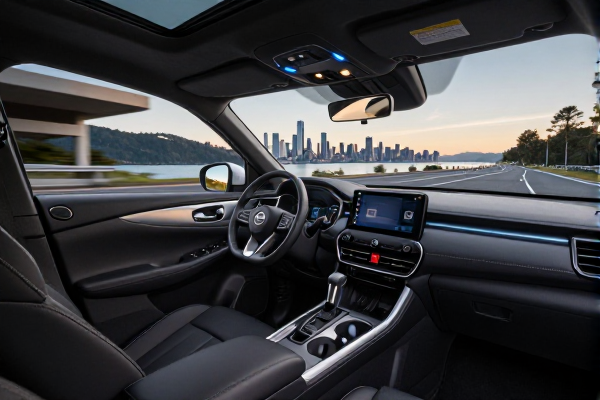
Could a future Nissan pickup let you fold away the entire rear wall of the cab and turn the cabin into an extension of the bed? That is the idea behind a fresh United States patent filing from Nissan, published this week and first spotted by CarBuzz. As of today, May 10, 2026, that filing is raising questions about how far the automaker is willing to go to make its next-generation pickups more flexible.
The patent drawings show what appears to be a Frontier or Navara, but the mechanism itself is the real focus. Nissan’s proposal is designed to tuck the rear bench, the rear bulkhead, and the rear glass into the truck’s body structure. That would allow the bed to reach forward into the cabin, creating a long, unobstructed cargo floor without forcing the owner to remove any panels. Conceptually, it is a foldable barrier between the passenger compartment and the load area.
This is not the first time a midgate-style layout has appeared in the industry. Chevrolet and GMC have offered their own versions in certain trucks, usually with a 60/40 split rear bulkhead and a manually removable glass panel. Those systems work, but they tend to feel like a compromise. There is a storage problem when the glass is taken out, and the whole process can become awkward on a rainy day or when the owner has nowhere to put the pieces.
Nissan’s patent concept appears to solve that awkwardness through packaging. The key drawings show a more mechanical approach, where the seat cushion and seatback fold forward, the bulkhead swings out of the way, and the rear window moves along with the structure rather than being lifted out by hand. If it works as described, the transition from five-seat crew cab to extended-bed workhorse could happen quickly and without loose parts.
A patent filing does not always mean a vehicle is coming. Automakers file patents for many reasons, including experimentation, competitive blocking, and internal research. But this latest filing from Nissan is unusually detailed, and that has prompted analysts to treat it as more than a pipe dream.
There are several reasons why the company may be paying attention to this segment now. Smaller pickup buyers are increasingly looking for versatility, not just hauling capacity. A truck that can switch between passenger-focused duty and cargo-focused duty would give Nissan a talking point that rivals like Ford and Toyota do not currently have. The Compact pickup segment is also heating up again, which means a useful and innovative feature could be a strong differentiator.
At the same time, the engineering challenges are enormous. Letting the outside in means weather sealing has to be much more robust. Rain, dust, wind noise, and even exhaust smells would be a constant risk if the sealing system is not up to automotive-grade standards. The hinge points and latching mechanisms also need to survive years of hard use and heavy loads. If any of those components fail, the owner could be looking at an expensive repair and a cabin that is no longer watertight.
There is also a safety question. The rear bulkhead in a traditional pickup is more than a convenience; it helps keep cargo from turning into projectiles in a crash. A midgate system has to guarantee that any cargo sliding forward remains contained, even after the bulkhead has been repeatedly folded and unfolded. That kind of requirement adds weight and complexity to a part that would be far simpler as a static weldment.
If Nissan decides to power the midgate with electric motors, the cost would climb even higher. An electric mechanism would improve convenience, but it would also add failure modes, wiring, sensors, and control logic in an area of the vehicle that is often subjected to dirt, moisture, and temperature swings. The patent does not mention a power-operated system, but that does not rule out the possibility. Automakers often offer a manual base version and a more premium power-operated version in the same generation.
Even in its simplest form, a fold-away bulkhead will be more expensive to engineer than a fixed wall. That could push the starting price of a future Nissan pickup upward. Considering that midgate buyers are likely to use the feature only occasionally, Nissan has to decide whether the benefit justifies the cost for mainstream consumers. The company could bundle the feature in a higher trim level, but then it risks being seen as a novelty rather than a core capability.
The timing matters here. Nissan is expected to launch a new Xterra around 2028, with other related models likely to follow. That timeline gives the engineering team enough room to evaluate whether the midgate concept is practical for mass production. It also means the patent could still be adapted, simplified, or introduced in stages. A pickup truck and an SUV could share the same fundamental architecture, which might make the patent even more valuable if it can be applied to both body styles.
Frontier buyers would be a natural audience for a midgate option. Many use their trucks for weekend camping trips, hauling gear, and carrying bulky items that do not fit neatly under a tonneau cover. Being able to slide long materials through the cabin without opening the tailgate would make the Frontier considerably more useful. Navara customers in global markets would probably feel the same way, especially in regions where pickups serve double duty as both family transport and working vehicles.
There is no way to know today whether Nissan’s bold midgate design will ever reach a showroom. The automaker has been exploring similar concepts for years, and many of them have remained inside the patent system. Yet this filing feels different because of the level of detail and the way the entire cabin environment is being reconsidered, not just the cargo floor.
If the concept does make it to production, it could redefine what a pickup cabin can do. If it does not, the patent will still offer a useful look at how Nissan is thinking about flexibility, packaging, and the changing needs of truck buyers. For now, the company is keeping its options open, and the next-generation Nissan pickup will tell us which of those options become reality.