Browse

Log in / Register
 Share

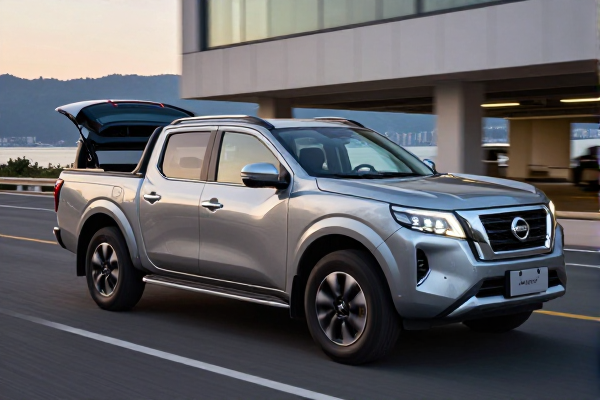
March 15, 2026 — Nissan has filed a patent application with the U.S. Patent and Trademark Office covering a midgate mechanism—a foldable partition between a truck's bed and cabin that creates a continuous cargo floor. The design, listed under application number 20260274351, was first surfaced by CarBuzz and lines up neatly with the development timeline of the next-generation Frontier, expected to debut before 2030. Whether the feature ever reaches production is uncertain, but the filing makes one thing clear: Nissan is actively exploring ways to make its mid-size truck more versatile.
What the Patent Actually Shows
The patent drawings depict a midgate system integrated into the Frontier's cab structure. In normal operation, the rear wall stays closed and the back seat behaves like any crew-cab setup. The innovation kicks in when a driver needs serious cargo length: both rear seatbacks fold flat against the seat cushions, and the panel separating the cabin from the bed swings open and locks into position. What's left is a wide, unobstructed opening and a level surface running from the tailgate all the way to the front seatbacks.
That continuous load floor is the whole point. With the midgate open and the tailgate down, a Frontier owner could slide in 8-foot lumber, a kayak, surfboards, sheet goods, or lengths of steel conduit—without the load hanging precariously over the tailgate. The cargo stays within the truck's structural envelope, protected from weather and, frankly, from thieves who'd otherwise have clear access to an open bed.
There's a catch, though. The midgate is a single rigid piece, so both rear seats have to fold before the pass-through opens. There's no 60/40 option—no way to drop one side, keep a passenger in the other, and still haul something long. That simplifies sealing and hardware, but it also means the truck effectively becomes a two-seater when the feature is in use. For solo work trips or adventure runs, it's perfect. For families, it's a trade-off.
A Segment With No Midgates Today
This is where the patent gets genuinely interesting. Not a single mid-size truck sold in the U.S. currently offers a midgate. The Toyota Tacoma, Ford Ranger, Chevrolet Colorado, GMC Canyon, and Jeep Gladiator all use fixed rear cab walls. Even the Honda Ridgeline, which prides itself on clever cargo solutions like an in-bed trunk and a flat floor, stops short of a physical opening into the cabin.
If Nissan actually builds this, the Frontier becomes the only mid-sizer in America with the capability—and the first production mid-size pickup to offer it in decades. That alone would give Nissan a talking point in a segment where every rival is fighting over towing charts and infotainment specs. A genuine hardware advantage, not just a higher number on a spec sheet, could pull buyers who actually use their trucks for work.
The Midgate's Complicated History
The idea of a pass-through between cab and bed isn't new. It dominated concept-car chatter in the late 1990s, but it was General Motors that made the leap to production with the 2002 Chevrolet Avalanche. Built on the Suburban's underpinnings, the Avalanche treated the midgate as its party trick, turning a full-size pickup into something that could carry a 4x8 sheet of plywood with the tailgate up.
GM spread the technology quickly. The Cadillac Escalade EXT and the Hummer H2 SUT both adopted variations of the same mechanism, giving luxury and off-road buyers a taste of SUV comfort with pickup practicality. But as those vehicles aged out of production in the late 2000s and early 2010s, the midgate quietly vanished. For a while, it looked destined for the same scrap heap as the bench seat with a column shifter—a clever idea that never quite caught on.
Then GM revived it for the electric era. The Chevrolet Silverado EV and GMC Sierra EV both offer a midgate today, working in tandem with the Multi-Flex tailgate to swallow 10-foot cargo with the tailgate up. The return makes sense: a skateboard-style EV platform has no driveshaft tunnel or exhaust system to work around, which makes the structural integration cleaner and the sealed opening easier to engineer.
Why Nissan Might See an Opening
The mid-size truck market has never been more crowded. The Tacoma dominates sales, the Ranger keeps pushing hard, the Colorado was redesigned within the last few years, and the Gladiator holds down the lifestyle end. None of them have a midgate, and GM hasn't extended the feature to its smaller trucks—the Colorado and Canyon make do with a conventional bed.
That leaves a capability gap Nissan could quietly exploit. The next-generation Frontier is expected to ride on a new platform, and electrification is firmly on the table—whether a hybrid, plug-in hybrid, or full EV. A battery-electric Frontier with a flat floor and a midgate would pair the longest practical cargo bed in the segment with zero-tailpipe operation, a combination no competitor is even attempting.
There's also a notable line in the patent filing: the mechanism isn't limited to pickups. The document states it could apply to vehicles beyond trucks, which hints that Nissan sees midgate-style pass-throughs as a platform-level feature rather than a one-off gimmick. A future SUV or crossover with a fold-down rear partition? That's speculative, but patents are written to cover possibilities, and the language suggests Nissan is thinking bigger than a single model.
Reality Check: Patents Are Cheap, Engineering Isn't
It's worth remembering that automakers file hundreds of patents every year for features that never see a showroom. A patent application costs a fraction of what it takes to validate a production component, and many filings exist purely to protect intellectual property or block competitors. The midgate faces real engineering hurdles: a large opening in the cab's rear bulkhead can reduce torsional rigidity, crash performance has to be re-validated, and sealing has to hold up to years of weather, dust, and washboard roads. On a body-on-frame truck that flexes off-road, that's a meaningful challenge.
Cost is another obstacle. Mid-size truck buyers are famously value-conscious, and the Frontier's current pitch relies on strong pricing and a class-leading warranty. Adding a complex, electrically assisted panel—or even a manual one—would add weight and cost. If Nissan prices it as a standalone option, it risks pushing the Frontier above the Tacoma and Ranger where buyers are less forgiving. Bundle it into premium trims and a tow package, though, and the economics look less painful.
The Bottom Line
Nissan has a genuine opportunity here. The Frontier has always been a solid, honest truck, but it rarely leads the segment in innovation. A midgate would change that overnight. It would give owners the one thing every mid-size truck buyer secretly wants—a bed that acts bigger than it is—and it would carry a legacy straight from the Avalanche that GM itself seems to have abandoned on smaller trucks.
None of this confirms the feature will reach production. But the timing is telling. The next Frontier's architecture is being locked down right about now, and patents filed at this stage of development often reflect features that truly are under consideration. Combined with Nissan's track record on bed innovation—the current Frontier's Utili-track adjustable tie-down system was genuinely useful—there's a strong case that the midgate becomes the next Frontier's signature trick.
If it does, the Avalanche's heritage finally has a worthy successor. And for the first time in the mid-size segment, the answer to "which truck can haul the most without dragging the tailgate" might not come from Toyota or Ford. It might come from Nissan.