Browse

Log in / Register
 Share
Share
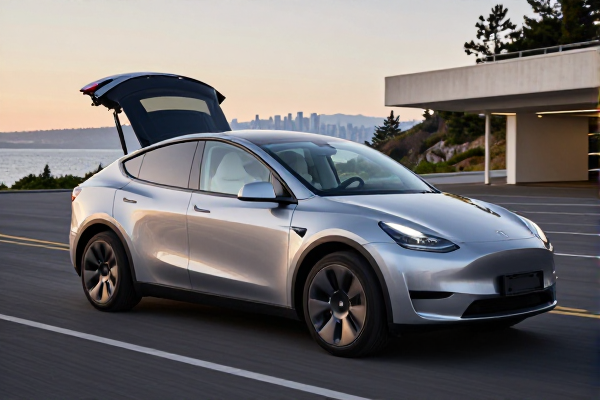
Federal safety regulators have launched an audit of Tesla’s new Cybercab fleet, just hours after the company kicked off paid rides in Austin, Texas, with the two-seat, steering-wheel-free vehicles. The National Highway Traffic Safety Administration (NHTSA) is now examining how Tesla determined that roughly 1,000 Cybercabs comply with long-standing federal vehicle-safety rules—rules originally written for human-driven cars with manual controls.
The move marks the latest clash between the automaker and U.S. regulators, as Tesla races to deploy its robotaxi service without the traditional safety equipment required by law. While the company has touted its “Full Self-Driving” software as safer than human drivers, industry experts say the Cybercab’s lack of a steering wheel, pedals, and mirrors puts it in a regulatory gray zone.
“There’s no reasonable interpretation that suggests the Cybercab can meet the Federal Motor Vehicle Safety Standards,” said Michael Brooks, executive director of the Center for Auto Safety. “Tesla is essentially self-certifying compliance, and that’s a stretch.”
NHTSA’s audit, announced late Thursday, focuses on the company’s self-certification process—a system that allows automakers in the U.S. to declare their vehicles safe without prior government approval. Unlike most other countries, where new models must receive regulatory clearance before hitting the road, the U.S. relies on manufacturer self-certification. But the approach has come under scrutiny as autonomous vehicle technology outpaces the rules.
Tesla’s Cybercab rollout began with a splashy event in downtown Austin, where fans and influencers lined up to ride in the gold, butterfly-door vehicles. The company also operates a paid robotaxi service using its Model Y SUVs in Texas and Florida, which still include manual controls and, in some cases, human backup drivers. The Cybercab, by contrast, has no such fallbacks.
Experts note that Tesla’s history of pushing regulatory boundaries could give it an edge. “I fully expect Tesla to test the limits,” said Philip Koopman, a Carnegie Mellon University engineering professor and autonomous-vehicle safety expert. “They could come up with a creative interpretation of the rules, flood the market with Cybercabs, and force NHTSA or state regulators into years of litigation.”
Indeed, Tesla’s engineering chief, Lars Moravy, said earlier this year that the Cybercab would not be subject to NHTSA’s 2,500-vehicle annual cap for exemptions, though he did not explain how. The company has not applied for a federal exemption, which typically limits deployment. Instead, Tesla appears to have chosen the self-certification path—a route that has already failed for Amazon’s Zoox, which tried to certify a driverless pod without controls and later withdrew its claim after an NHTSA investigation.
“If NHTSA disagrees with Tesla’s self-certification, it could end up in court,” said a former senior NHTSA official, speaking on condition of anonymity. “And NHTSA doesn’t always win.”
The stakes are high for Tesla, whose stock valuation has surged to $1.4 trillion on the back of Musk’s bet that self-driving software and robotics will define the company’s future. Musk has promised that Cybercab production will grow “exponentially” later this year or next, and that the vehicles will sell for under $30,000. But the regulatory uncertainty could slow that timeline.
Meanwhile, safety concerns persist. Reuters interviews with former Tesla employees who trained the company’s self-driving software revealed that the system still struggles with basic maneuvers like handling unprotected left turns or navigating construction zones. “No public information suggests Tesla is anywhere close to safely deploying an automated driving system over the wide range of conditions required for a vehicle without conventional controls,” said Bryant Walker Smith, a law professor at the University of South Carolina who studies autonomous-driving regulation.
As of April 10, 2025, NHTSA has not released a timeline for the audit’s completion. Tesla did not respond to a request for comment. The outcome could set a precedent for how the U.S. regulates—or fails to regulate—driverless cars, especially as Musk and other tech executives push for faster deployment.