Browse

Log in / Register
 Share

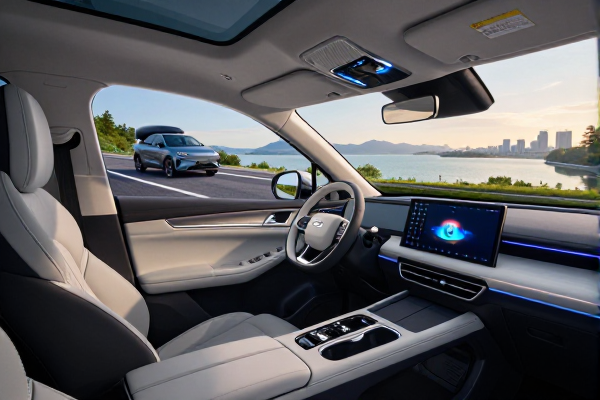
Wuhu, China — October 18, 2026 — Charging an EV in the time it takes to finish a coffee has been the industry's favorite promise for years. This week in Wuhu, EXEED is showing what that promise looks like when it's wired into an actual parking lot.
The 2026 EXEED International User Summit, themed "The Pulse Lives On," opened today and runs through October 23, drawing more than 2,000 owners, journalists, and industry partners to a smart-energy campus developed by Chery, EXEED's parent company. It's one of the largest owner-centric gatherings in China's premium-vehicle segment, and this year the agenda is less about horsepower and more about electrons.
A Charger That Gives Back to the Grid
The centerpiece is what Chery describes as China's first scaled alternating-current (AC) vehicle-to-grid (V2G) demonstration station. The site operates as a self-contained microgrid: rooftop photovoltaic arrays generate the electricity, on-site battery banks store it, and high-power chargers deliver it. A lounge and rest area run entirely on the renewable energy moving through the system — even the coffee machine is powered by the same solar electrons that fill the cars outside.
The defining feature is bidirectional flow. Instead of treating every plugged-in vehicle as a one-way drain, the station's software lets each car switch between charging and discharging. Late at night, when off-peak tariffs are low, vehicle batteries charge up at modest cost. During late-afternoon peak hours, when grid prices climb, those same cars can push stored electricity back into the building or the local network. An AI dispatch system makes the call per vehicle, in real time, weighing price signals against each driver's range needs.
The financial case is easy to grasp. In markets with steep time-of-use rates, the gap between cheap overnight energy and expensive peak energy is wide enough to make an EV a small energy arbitrage vehicle. Charge when power costs little; sell when it costs a lot. Where rules permit, an EV can also keep a home running during an outage, giving owners a built-in backup generator that doesn't burn fuel or make noise. That flexibility also helps utilities: batteries that would otherwise sit idle become a dispatchable reserve, ready precisely when the network is tightest.
Fast Charging, With a Stubborn Streak
Speed gets equal billing. The station deploys Chery's Volt-dragon charger, a high-power fast-charging platform designed to sharply reduce the time spent attached to a cable, with megawatt-class output that can restore serious range during a typical coffee stop. The combination of high output and intelligent scheduling also means peak-hour lines should stay short, even at a site designed to host hundreds of vehicles a day.
Just as important is what happens when the outside grid misbehaves. The microgrid can switch into island mode, disconnecting from the regional network and continuing to charge vehicles from stored solar power during a disruption. For drivers in storm-prone regions or places with fragile grids, that operational independence is arguably more valuable than the raw charge rate. A charger that works when the lights are out is a charger you can trust.
From the Home to the Truck Park
Chery is applying the same logic at home. The Energy Cube, a home battery unit, sits between rooftop solar, the utility connection, and a bidirectional charger. It lets households bank cheap daytime solar power and draw on it in the evening, when retail rates typically rise. The home battery market is still young in most countries, but the pattern is familiar: as production scales and integration with vehicle charging improves, a box on a garage wall becomes the control hub of a household energy loop. Alongside the Energy Cube, the company is developing long-cycle Rhino batteries and says it continues early-stage research into solid-state cells. Laboratory samples, Chery says, have shown high mechanical stress tolerance — a property the company says matters for safety in both vehicle and home energy applications.
There's also an operational proof point beyond China. At an electric heavy-duty truck park in Spain, Chery's integrated microgrid — solar generation, storage, and high-power charging bundled into one installation — is already in commercial service. The project gives freight operators a working, replicable model for cutting diesel reliance and shows that renewable microgrids can survive the brutal daily cycles of logistics, not just the gentler rhythms of a car park.
Why U.S. Drivers Should Pay Attention
For American readers, the Wuhu demo looks less like a futuristic curiosity and more like a preview of changes already arriving in U.S. garages. The Ford F-150 Lightning brought bidirectional home backup to the mainstream. GM's Ultium platform is rolling out broader vehicle-to-home integration. California utilities, including PG&E and Southern California Edison, have run grid-integrated EV pilots, and FERC Order 2222 requires wholesale markets to accept bids from aggregated distributed energy resources — a category that can include EV batteries.
What's still missing in the U.S. is the coordination layer. It's one thing for a single homeowner to flip a switch and power a fridge from a truck battery. It's another to run an entire campus where AI software constantly decides which cars should charge, which should discharge, and when — treating vehicles, solar arrays, and storage as one synchronized asset. Federal and state incentives are nudging in the same direction: tax credits cover home battery systems, several states are updating interconnection rules for bidirectional chargers, and grid operators are beginning to value batteries that can respond in seconds rather than hours. What has lagged is the software that lets a whole neighborhood of cars act as one resource — which is exactly where Chery's approach departs from the typical pilot project.
Cars as Grid Citizens
Look past the hardware and the strategy becomes clear. Chery frames the effort as a closed loop spanning generation, storage, distribution, and consumption. Within that loop, new-energy vehicles stop behaving as static loads and start functioning as active grid citizens — absorbing cheap power and releasing it where and when it's needed. It also aligns with the global push toward carbon neutrality, a shift that demands not just cleaner vehicles but electricity systems flexible enough to absorb intermittent wind and solar. A car battery that can smooth those swings is worth far more than a car that merely drives. For EXEED, positioned as Chery's premium global brand, the energy story doubles as a luxury story: ownership is not only about performance and design but about a smarter, more efficient relationship with electricity.
The summit continues through October 23, with attendees free to test the coffee-break charge and watch the AI dispatcher do its work in real time. Chery says future steps could include superconducting charging and larger home-to-grid integrations. The takeaway from Wuhu, though, is already big enough: the future of EV charging will be defined less by how many kilowatts a cable can push and more by how intelligently the car, the grid, and the home talk to one another.