Browse

Log in / Register
 Share

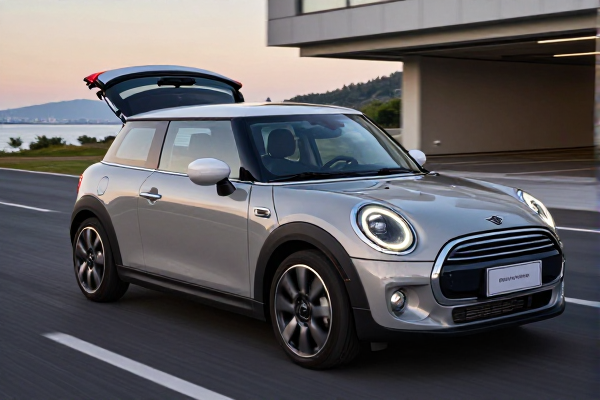
April 27, 2026 — A new design study from Uygar, a self-described “professional daydreamer,” takes MINI’s familiar styling cues and wraps them in a full pixel-light makeover. The concept, first reported by Yanko Design, transforms the British brand’s circular headlights, grille, wheels, and taillights into a glowing dot-matrix display. It’s the latest sign that pixel-based lighting is becoming a serious language for automotive identity.
Hyundai’s 45 EV concept is often credited with introducing pixels into mainstream car design, but Uygar’s MINI pushes the idea much further. Rather than using a few pixel-shaped graphics as accents, the entire front end is covered in luminous mini-squares. The result is a face that reads less like a conventional car and more like a programmable canvas on wheels.
The circular headlights keep the classic MINI outline, but inside those familiar rings sits a dense grid of tiny light cells. It’s a clever trick: the eye still sees a retro-friendly shape, while the details feel completely new. The overall effect is playful and slightly futuristic, like a high-fashion take on an arcade machine.
Traditional MINI grilles have always been about structure and symmetry. This version abandons that logic entirely. Instead of slats or mesh, the designers used a matrix of illuminated squares that brightens at the center and gently fades toward the edges. The glow isn’t uniform, which gives the front end depth and a sense of motion, even when the car is standing still.
That light-driven approach gives the MINI a clearer digital identity than the restrained pixel applications seen on some other EV concepts. It’s not just a signature lamp pattern; the light itself becomes the design.
The wheels also get the pixel treatment. Each wheel is designed as a disc of sparkling squares that forms a rotating mosaic. At speed, the pattern would swirl and shift, making the car feel alive from every angle. While the idea may be impractical for production wheels, as a concept it reinforces the message that this MINI is meant to be noticed.
The design language carries across the body, too. Creases and surfaces are simplified so the light is allowed to do the talking. That’s a smart move: digital elements only work if the surrounding shape gives them room to breathe.
The rear of the concept pays tribute to MINI’s British roots in a way that feels both nostalgic and new. The signature Union Jack taillights are rebuilt using pixelated blocks, blinking in a way that calls to mind old-school LED displays. The MINI logo sits in the center, framed by that glowing, flag-inspired pattern.
It’s a fine line between heritage and gimmick, but this execution works. The pixel effect adds a layer of charm without cheapening the iconic symbol. It also gives designers far more flexibility than a traditional taillight layout, allowing different light sequences and even the possibility of animated messages in future production models.
This isn’t MINI’s first flirtation with pixel art. The Aceman concept, which debuted in 2022, introduced playful pixel motifs that recalled toys like Lite-Brite. That study was mostly about graphics and interior details, but Uygar’s rendering takes the idea and runs with it, making pixels the dominant visual theme of the entire car.
By removing physical chrome and replacing it with software-driven light, the concept points to where MINI could be heading. Digital lighting allows carmakers to update visual identity over time, without changing the hardware. A customer could, in theory, switch between minimalist white, energetic multi-color, or retro amber light signatures to match their mood.
There’s a practical side to this trend, too. Pixelated LED units are cheaper to integrate than complex optical lenses, and they age better from a design standpoint. Instead of a headlight that looks dated in five years, the same hardware can be refreshed with new software.
Safety is another angle. Smaller light cells make it easier to create adaptive beams that avoid dazzling oncoming drivers. They can also support communication features, such as displaying simple warnings to pedestrians or other road users. Regulators still impose strict limits on brightness, so a car that’s purely pixel-based will need to balance creative expression with real-world illumination requirements.
That said, the concept is clearly a design study, not a production-ready blueprint. The wheels and grille would likely be simplified before any road-going version ever appeared. But the fact that designers are increasingly exploring this territory suggests that the auto industry is taking digital aesthetics seriously.
MINI has already moved toward more expressive light signatures in recent production models. The current generation uses sharper LED graphics and more personalized lighting modes than previous cars. A fully pixel-covered exterior would be the next logical step, if the technology matures and costs come down.
Uygar’s vision is remarkable for its coherence. Every light element on the car tells the same story: retro shapes, digital soul. If a MINI like this ever reaches production, it could appeal to older buyers who love the classic proportions and younger drivers who expect their car to feel as connected and playful as their phone.
For now, it remains a striking piece of design fantasy. But it’s precisely these kinds of bold visual experiments that push car brands forward. After all, every production pixel light that appears in a showroom starts with someone daring to imagine a car that glows differently.