Browse

Log in / Register
 Share

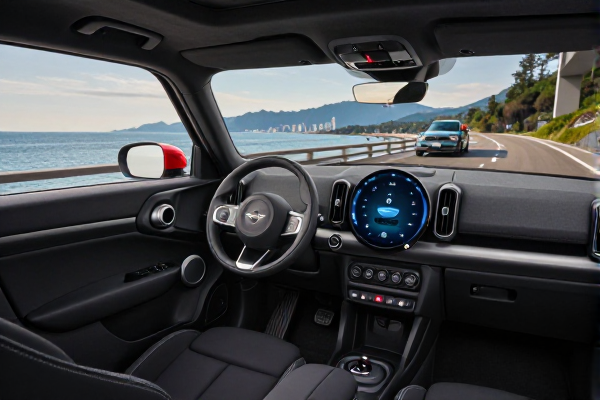
As of April 26, 2026, MINI's battery-powered Countryman is one of the most distinctive compact EVs on the U.S. market. This guide breaks down its entire technical package — powertrains, performance, battery, charging, towing, and segment position — so you can choose the right version with confidence.
The Countryman Electric is currently offered with two drivetrain configurations. The entry-level E uses a single front-mounted electric motor producing 204 hp (150 kW) and 184 lb-ft (250 Nm) of torque. The range-topping SE ALL4 adds a second motor on the rear axle, bringing combined output to 313 hp (230 kW) and 364 lb-ft (494 Nm). Both versions route power through a single-speed automatic gearbox — the standard transmission type for modern EVs — and both draw from the same 66.0 kWh lithium-ion battery pack, of which 64.0 kWh is usable.
MINI's official figures show a 0–62 mph (0–100 km/h) sprint of 8.6 seconds for the E and a much quicker 5.6 seconds for the SE ALL4. Top speed is electronically limited to 106 mph (170 km/h) in the E and 112 mph (180 km/h) in the SE ALL4.
On the efficiency side, the lighter front-drive model consumes 14.7 kWh/100 km, which translates to about 4.2 mi/kWh, or 23.7 kWh/100 miles. The heavier all-wheel-drive SE ALL4 uses 15.8 kWh/100 km, equal to roughly 3.9 mi/kWh, or 25.4 kWh/100 miles. Those numbers put the MINI in the middle of the compact EV pack — not the most efficient, but not wasteful, either.
Both powertrains share the same 66.0 kWh gross / 64.0 kWh usable battery. WLTP-rated range reaches 287 miles (462 km) for the E and 268 miles (432 km) for the SE ALL4. Because U.S. EPA testing is stricter, expect lower official numbers on the window sticker; the WLTP figures are still useful for comparing the two trim levels with each other.
Charging hardware consists of an 11 kW AC onboard charger and a 130 kW DC fast-charging capability. A heat pump is included as standard on both versions, which helps preserve range in cold weather — an important consideration for buyers in northern states. The 11 kW AC unit will refill the battery from empty in roughly six hours with a suitable home wallbox.
A 130 kW peak DC rate is acceptable, but not impressive, in the 2026 electric crossover class. The Hyundai Ioniq 5 and Kia EV6 can accept up to 350 kW on their 800-volt platforms, making them far quicker at public fast chargers. The MINI's moderate charging speed doesn't ruin day-to-day usability, but road-trippers planning frequent quick-charging stops should weigh this drawback before committing.
MINI doesn't publish an official 10–80% fast-charging time for the Countryman Electric in its standard technical sheets, which makes direct comparisons with 800-volt rivals difficult. Given the 130 kW ceiling, expect the MINI to spend noticeably more time connected to a DC charger than the quickest Korean or Tesla alternatives on a long interstate run.
Kerb weight comes in at 4,277 lb (1,940 kg) for the E and 4,575 lb (2,075 kg) for the SE ALL4. That's heavy for a compact SUV, but typical for an EV carrying a 66 kWh battery. The power-to-weight ratio reflects the difference: 77.3 kW/t for the front-drive E, 110.8 kW/t for the all-wheel-drive SE ALL4.
Towing is a genuine strength of the MINI. The E is rated at 1,653 lb (750 kg) braked, while the SE ALL4 steps up to 2,646 lb (1,200 kg) — a 60-percent increase over the base model. If you plan to pull a small trailer, a lightweight camper, or a couple of jet skis, the SE ALL4's extra capacity is worth the price premium.
In a sample of 98 electric drivetrains from the compact class, the Countryman Electric's average power of 190 kW beats the field average of 163.5 kW. It's also heavier than average, with a mean kerb weight of 2,008 kg versus the segment's 1,887 kg, but its power-to-weight ratio of 94.6 kW/t still outpaces the 85.4 kW/t average.
In practical terms, the MINI feels punchier than most compact EV rivals, yet its extra mass helps explain why consumption and range are more middle-of-the-road. That combination of above-average power and below-average efficiency is exactly what you'd expect from a performance-biased crossover.
This is the first Countryman generation to be fully electric, and it shares its platform architecture with the BMW iX1 and X1. That relationship brings a mature chassis, solid build quality, and a premium interior ambience that mainstream rivals often lack. In the U.S. market, the Countryman Electric competes with the Tesla Model Y, Ford Mustang Mach-E, Volkswagen ID.4, and Hyundai Ioniq 5.
Next to those models, the MINI stands out for its polarizing design, compact footprint, and go-kart-like handling. It sacrifices some cargo practicality and charging speed for personality — which is exactly what many MINI buyers want. If you're shopping on emotion rather than sheer utility, the Countryman Electric makes a stronger case than any spec sheet suggests.
Moving to electric power removes several traditional trouble spots in older MINI models, including timing chains, fuel injectors, and exhaust systems. The battery and electric motors are covered by an eight-year/100,000-mile high-voltage warranty in the U.S., and the overall complexity is lower than a turbocharged combustion drivetrain.
That said, MINI's infotainment and driver-assistance electronics have drawn mixed reviews, so it's worth checking for software updates and reading ownership reports. For an in-depth defect breakdown, a comparison with rivals, and an analysis of how this model ages, see our dedicated Countryman Electric reliability page.
The front-drive E is the budget-friendly choice. It offers better WLTP range (287 miles vs. 268 miles), lower energy consumption, and a more attractive starting price, while still delivering acceptable acceleration for daily driving. The E is the smart pick for city commuters, warm-weather states, and anyone who prioritizes efficiency.
The SE ALL4 justifies its premium with all-weather traction, a 3.0-second-faster sprint to 62 mph, and a substantially higher braked towing rating. If you live in snowy regions, want the quickest Countryman Electric, or need that 2,646 lb towing capacity, the price difference is money well spent. Just be ready to give up roughly 19 miles of WLTP range in exchange.
The MINI Countryman Electric is an expressive, engaging take on the compact electric SUV. It won't win any efficiency awards, and its 130 kW DC charging ceiling lags the fastest 800-volt rivals. But for buyers who value styling, driving dynamics, and everyday usability over extreme numbers, the Countryman Electric remains one of the more charming EVs in the segment. Choose the E for efficiency, the SE ALL4 for performance and capability.