Browse

Log in / Register
 Share

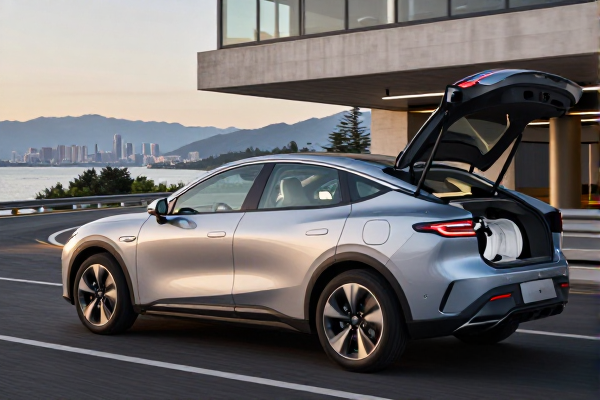
Mexico City, March 21, 2025 – Mexico has officially unveiled a mass-market electric vehicle priced at just $9,000, leveraging Chinese technology to bring affordable zero-emission mobility to Latin America. The car, called the Olinia (a name derived from the Nahuatl word for “movement”), is produced by the state-backed startup Olinia EV in partnership with Chinese suppliers including CATL for batteries and Huawei for the electric drive system.
The announcement came during a press conference at the National Palace, where President Claudia Sheinbaum called the vehicle “a symbol of Mexican sovereignty and technological cooperation.” The base model is a two-seat city car with a 120 km (75-mile) range, targeting urban commuters who currently rely on used gasoline cars or motorcycles. Three variants will be offered: a standard hatchback, a cargo van for last-mile delivery, and a compact pickup for small businesses.
The Olinia’s low price point is achieved by sourcing the most expensive components from China. The battery pack, a 15 kWh lithium-iron-phosphate (LFP) unit from CATL, costs roughly $1,200. The electric motor and inverter come from Huawei’s Digital Power division, which supplies the same drive system used in Chinese electric microcars. The chassis and body are stamped in Mexico at a former General Motors plant in Puebla that was retooled with Chinese welding robots.
Production is set to begin in Q3 2025 at an initial capacity of 50,000 units per year, with plans to scale to 300,000 by 2027. The Mexican government will provide a $2,000 subsidy per vehicle, effectively bringing the price below $7,000 for qualifying low-income buyers. The company also announced a battery subscription model: owners can lease the battery for $30 per month, reducing the upfront cost to $6,000.
Industry analysts see the Olinia as a potential game-changer for Latin America, where EV adoption has lagged behind China and Europe due to high costs. Dr. Carlos Mendoza, a professor of automotive engineering at the National Autonomous University of Mexico (UNAM), told EV News Today: “The partnership with CATL and Huawei gives Mexico access to proven, mass-produced components. The $9,000 price point is roughly one-third of the cheapest Tesla or BYD models sold in Mexico today. If the quality holds up, this could be the vehicle that finally brings electric mobility to the middle class.”
However, challenges remain. The Olinia’s top speed is limited to 90 km/h (56 mph), and it lacks advanced safety features like airbags and ABS on the base model. The Mexican government has mandated that the crash-tested version sold in 2026 will include dual airbags, a requirement that may push the price up by $800. Competitors are also watching closely: BYD already sells the Seagull in Mexico for $12,000, and Chinese automaker Wuling has hinted at a sub-$10,000 entry for the North American market.
While the Olinia is not currently destined for the US market (it does not meet National Highway Traffic Safety Administration (NHTSA) crash standards), the low-cost production model could pressure US automakers to accelerate their own affordable EV plans. Ford and General Motors have both struggled to produce EVs under $30,000. The Olinia’s use of Chinese components also highlights the deepening integration of Chinese supply chains into North America, a trend that US policymakers have tried to curb with tariffs and the Inflation Reduction Act.
The Olinia represents a bold experiment: can a middle-income country leapfrog into the EV era using Chinese technology without sacrificing local manufacturing jobs? The Mexican government is betting that the answer is yes, and the auto industry is watching closely.