Browse

Log in / Register
 Share

Aug. 17, 2026
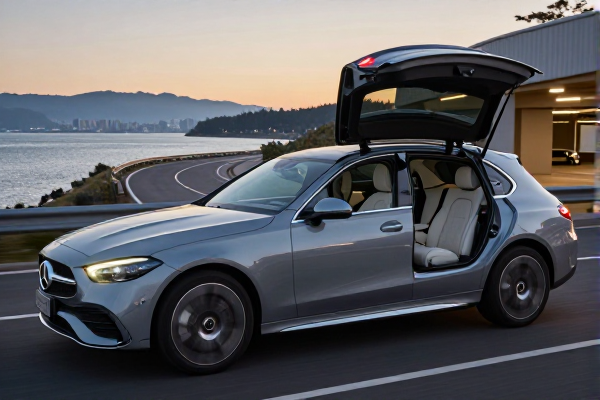
Mercedes-Benz isn’t betting on a single powertrain winner. Instead, the company is trying to cover the map: fully electric, hybrid, and combustion-powered vehicles, all built on modular technology that can scale across segments.
By the end of 2027, Mercedes-Benz says it will have launched more than 40 new or significantly updated models. That kind of product cadence would have been hard to imagine a decade ago. The push depends less on any one engine or battery format than on the ability to mix and match components, software, and vehicle architectures without reinventing everything from scratch.
At the core of that strategy is the Mercedes-Benz Operating System, or MB.OS. It integrates key vehicle functions into one system that can be updated over time, regardless of whether a car runs on electricity, gasoline, or a combination of both. That’s how Mercedes plans to keep its signature driving character – comfort, safety, composure, sportiness, and precision – consistent across a rapidly expanding lineup.
“No technology shapes the character of a vehicle as much as the powertrain, whether fully electric or hybrid,” said Jörg Bartels, Vice President of Powertrain Development at Mercedes-Benz AG. “Our customers around the world have different needs and expectations. That is why we are committed to utilising the best technology in such a way that it delivers tangible added value and inspires our customers.”
Customer data drives the engineering
Mercedes-Benz says powertrain development starts with real-world usage data, not just dyno numbers. The company collects anonymized driving information from millions of kilometers in actual customer vehicles. That data covers acceleration behavior, throttle input, towing, hill starts, and typical daily drive cycles. Engineers use those patterns to set development targets before a single physical prototype is built.
From there, the work moves into simulation. Power, torque, gear ratios, and control strategies are tested virtually in thousands of combinations. Only after the concept looks promising does it go to the test bench, where components are run under realistic loads and temperatures. The final stage is in-vehicle testing.
This process is designed to make sure a Mercedes-Benz doesn’t just perform well on paper. The suspension, brakes, and steering are developed together with the powertrain as one integrated system, so the driving experience remains cohesive whether you’re cruising on a highway or moving through stop-and-go city traffic.
Modular engines and scalable EV architecture
For combustion and hybrid models, Mercedes-Benz uses what it calls the FAME family of modular engines. These are petrol and diesel units with a high degree of component commonality, built to work across everything from the GLA to the S-Class. The latest generation of integrated starter-generator technology, ISG 2.0, helps bring fuel consumption down while adding power.
The engines share several engineering details: an all-aluminum crankcase with NANOSLIDE® coating, a cylinder head with partially integrated manifold, a turbocharger with segmented turbine and switchable bypass, and a compact intercooler system. Standardized software architecture also creates synergies across the powertrain line.
On the electric side, Mercedes-Benz says its modular EV architecture traces its roots to the VISION EQXX technology program. The platform can be scaled across model ranges and segments. It’s already used in models like the CLA, CLA Shooting Brake, GLB, and GLA, as well as the GLC and C-Class. Next, the company is expanding its 800-volt architecture upward into larger vehicles, including the E-Class and S-Class.
That 800-volt system allows faster charging and better efficiency. But customers don’t just want spec-sheet triumphs; they want the car to work in everyday situations. Mercedes-Benz says the entire electric powertrain – high-voltage battery, electric drive unit, thermal management, charging system, and software – is designed to operate as a single system with the goal of minimizing energy loss from cell to wheel.
The electric drive unit is built in-house
The second-generation electric drive unit, called EDU 2.0, is one of the most important pieces of the EV puzzle for Mercedes-Benz. In a break from automakers that buy off-the-shelf motors, Mercedes developed the EDU 2.0 in-house and manufactures it within its own powertrain production network.
EDU 2.0 was designed from the start for 800-volt operation. It uses silicon carbide in the inverter to improve efficiency, and it pairs a two-speed gearbox with a dog clutch. That combination resolves a common trade-off between maximum torque, top speed, and energy consumption. Thanks to its compact package, it also frees up room for the rear cabin.
For a brand with Mercedes’ engineering pride, in-house development of the EDU is significant. It gives the company direct control over performance, cost, and future upgrades.
Battery chemistry: moving beyond NMC and LFP
Mercedes-Benz is also pushing deeper into battery cell chemistry, something that automakers rarely did in earlier EV generations. The company says different vehicles and customer needs require different cell technologies, so it’s working on several chemistry platforms rather than betting everything on one.
One promising direction is the combination of lithium manganese oxide, or LMO, with nickel manganese cobalt oxide, or NMC. This mix increases the share of manganese while reducing cobalt and nickel. The result is a more attractive balance between cost and energy density. Mercedes also sees this as a bridge to future manganese-rich cathode materials.
Another path is lithium nickel manganese oxide, or LNMO. This chemistry could eliminate cobalt entirely and require significantly less nickel than today’s NMC cells. It could also operate at voltages up to five volts. According to Mercedes-Benz, compared with LFP lithium iron phosphate cells, LNMO may offer range advantages of up to 30 percent at comparable weight and packaging space.
Developing cell chemistry platforms in-house gives Mercedes-Benz more flexibility to respond to technology shifts, market changes, and regulatory pressures, rather than depending on suppliers for every major breakthrough.
Solid-state batteries are moving from lab to road
Solid-state battery development is no longer just a research project for Mercedes-Benz. The company has been working with Factorial Energy and ProLogium, and it says tangible progress has already been made.
One notable milestone: a lithium-metal solid-state battery developed with Factorial Energy was tested in an EQS under real-world driving conditions. The development vehicle covered 1,205 kilometers from Stuttgart to Malmö without recharging, demonstrating the potential for long-range EV travel.
Mercedes-Benz is now looking at next-generation solid-state cells with several partners, including ProLogium’s Gen4 cell technology. These cells are being tested for performance, safety, and thermal behavior. Mercedes also says it’s testing solid-state cells developed in-house, with input from its Formula 1 powertrain experts in the UK.
Formula 1 tech flows into road cars
The link between Mercedes-AMG High Performance Powertrains in Brixworth, England, and the road-car development team isn’t about sharing physical parts. It’s about transferring expertise, development methods, and the speed of racing innovation.
That collaboration is already showing up in production vehicles. The latest example is an electric turbocharger used in the most powerful four-cylinder engine in Mercedes-Benz’s compact segment. Technology originally refined in Formula 1 helps reduce turbo lag and improve response in a way that’s immediately noticeable to drivers.
Mercedes-Benz says the broader partnership helps accelerate innovation across all powertrain types, not just performance models. The goal is to bring racing-inspired precision into mainstream vehicles without compromising efficiency or everyday usability.
What it means for the US market
For U.S. buyers, this strategy means more choice rather than a single forced path. Mercedes wants to offer fully electric models for customers who are ready to go battery-only, hybrids for those who want more flexibility, and refined combustion engines for regions where charging infrastructure or customer preferences haven’t fully shifted.
None of this is an admission that one technology is always better than another. In Mercedes’ view, the right powertrain depends on where someone lives, how they drive, and what they expect from a premium vehicle. The company’s challenge is to make each option feel unmistakably like a Mercedes-Benz.
With more than 40 new models due by the end of 2027, the proof will be in the portfolio. Between the modular EV architecture, in-house electric drive units, next-generation cell chemistry, and solid-state battery development, Mercedes-Benz is trying to build a powertrain strategy that can adapt even as the market keeps changing.
What’s clear is that the company is no longer thinking of powertrain development as a choice between electric and combustion. It’s a system of shared components, software, and manufacturing capability, designed to let Mercedes respond quickly to what customers actually want.