Browse

Log in / Register
 Share


Stroll through any suburban parking lot these days, and you'll see that most American families treat a three-row SUV as the default answer to "how do we move everyone?" It usually works, but with a tall roof and a sliding door, an electric minivan can make just as much sense. The Maxus MIFA 7 Elite, reviewed here on May 7, 2026, is a reminder that a people carrier doesn't have to be a penalty box for the driver either.
Maxus isn't a brand you'll find on U.S. dealer lots just yet, and there's no indication that this particular electric MPV is headed to North America soon. That's a pity, because what the MIFA 7 Elite does is quietly undercut the idea that practical family transport has to be bland. It's a boxy seven-seater with a surprisingly polished ride, a long electric range, and a to-do list that reads exactly like a minivan should.
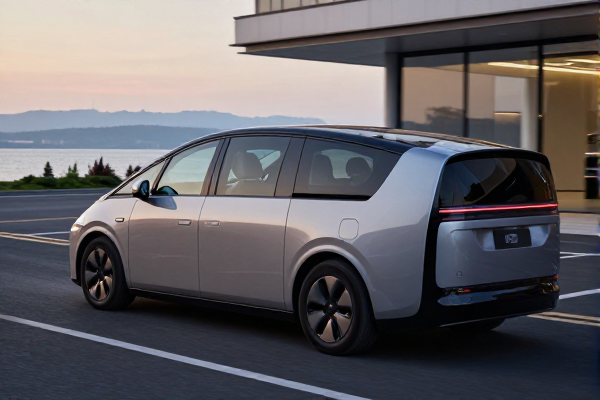
Let's start with the obvious: the MIFA 7 is big. At 4,907 mm (about 193 inches) long, 1,885 mm wide, and 1,756 mm tall, with a 2,975 mm wheelbase, it's noticeably larger than popular Asian-market MPVs like the Toyota Sienta, Honda Freed, or BYD M6. Even without knowing those specific competitors, the message is clear: this van puts occupant space first.
The styling is unapologetically upright. There's no fake coupe roofline or silly creases pretending to make it look sporty. Every straight line and sharp corner exists to liberate cabin space. That's not a compromise if you're buying a seven-seater; it's the whole point.
Then there's the Twilight Blush paint. It's a newish shade for the MIFA 7, and it's a genuinely smart addition. The color is distinctive without being loud, giving this tall van a bit of unexpected personality. Plenty of soccer moms will find it attractive. Honestly, why shouldn't the school run look good?
The cabin doesn't try to be a tech showcase. That shallow approach works in the MIFA 7's favor. The dashboard is logically arranged, the controls are clearly labeled, and you'll feel familiar with everything after about five minutes. That counts for more than a bunch of glossy touch surfaces.
Equipment levels are respectable for the entry-level Elite trim, which is the version tested. It holds its own against mainstream rivals in its segment, with conveniences that cover the basics thoroughly. There's no glaring omission for average family duty.
But not everything feels premium. The indicator and wiper stalks have a slightly hard, low-rent tactile quality, and the gear selector has the same problem. They all function well enough, but they don't quite live up to the otherwise pleasant cabin ambiance. Given how often you touch those components, better switchgear would make a difference.
The audio system is similarly middle-of-the-road. It's fine for a podcast-heavy commute, but budding audiophiles will want to upgrade or simply learn to tolerate it. It doesn't spoil the experience; it just doesn't elevate it.
Comfort, though, is where the MIFA 7 becomes genuinely impressive. The cabin is spacious enough for seven real adults, and the long wheelbase translates directly into generous legroom across all three rows. The optional roof-mounted air-conditioning vents keep cool air flowing to every seat, something that matters in a warm climate or during summer road trips. Keeping seven people happy is hard enough without third-row complaints about the heat.
Cargo space is a more restrained story. With all seats in place, there's 280 liters behind the third row. That's enough for a few soft bags, but if you're going on a week-long trip with seven passengers and their luggage, you'll need to pack carefully. Roof rails aren't mentioned, but this is the kind of van where a cargo box would feel right at home.
Under the hood, or more accurately under the floor, sits a single electric motor driving the front wheels. Output is a modest 108 kW, which translates to around 145 bhp, with 350 Nm of torque. That's not hot-hatch material, but this isn't a hot-hatch.
The 0-100 km/h sprint takes 11.9 seconds. That won't scare anyone at the drag strip, but that was never the goal. What matters is that the electric motor delivers torque smoothly and predictably, making around-town acceleration easy to modulate.
The 77 kWh nickel-manganese-cobalt battery gives a quoted WLTP range of 410 km. In U.S. terms, that's roughly 255 miles on the more optimistic European cycle, which generally runs ahead of EPA estimates. Still, it's a comforting figure for a vehicle of this size and weight. Official efficiency is 20.8 kWh/100 km, or about 2.98 miles per kWh.
Charging is practical enough. The MIFA 7 supports 11 kW AC charging, which will refill the battery from empty in about 4.7 hours, and up to 120 kW DC fast charging. A 30-80% top-up takes around 30 minutes at a suitably capable station. That allows the van to slot reasonably into everyday life without constant range anxiety.
Here's the surprise: the Maxus chassis is genuinely well sorted. At 2,200 kg, the MIFA 7 is by no stretch light. Yet the front MacPherson struts and rear multi-link suspension have been tuned with real care.
Over broken pavement, the suspension absorbs impact without becoming floaty. Body movements stay settled, and the van doesn't feel as massive as its dimensions suggest. It's composed in a way that many dedicated family haulers aren't.
You won't carve canyons with enthusiasm, but the MIFA 7 responds to steering inputs with enough confidence to show that Maxus actually spent engineering time on the driving experience. That's commendable for a tall box designed around passenger space.
On the highway, the MIFA 7 really settles into its natural rhythm. Power delivery is smooth, the ride is comfortable, and long-distance cruising feels genuinely relaxed. You can picture the whole family heading out on a long weekend, everyone comfortable, and the driver stepping out with less fatigue than expected.
Maxus clearly knows its target buyer. Instead of pumping in fake sportiness, it has focused on ride comfort, stability, and predictable handling. The result is a suspension setup that feels purpose-built for the job.
In the markets where the MIFA 7 is offered, it competes against more familiar names like the Toyota Sienta, Honda Freed, and BYD M6. Against those, the Elite makes a strong case: larger dimensions, more passenger room, respectable equipment, and that unusually polished chassis.
It's not the quickest van on the market. Some interior details feel a little cheap. And the generous footprint means you'll want to be patient in tight parking garages. But those are small compromises when the fundamentals—space, comfort, and driving composure—are so solid.
For American buyers, the takeaway is broader. Electric family vans are still scarce in U.S. showrooms. Vehicles like the Kia EV9 have made three-row EV SUVs common, but a truly van-shaped, family-first EV remains a niche. The Volkswagen ID. Buzz has started to fill that gap, but it's pricey and more style-oriented than pure practicality. If Maxus ever brought the MIFA 7 to North America, it would face little direct competition.
What Maxus has delivered here is a family seven-seater that keeps everyone content while treating the person behind the wheel like an actual driver. The MIFA 7 Elite is big, comfortable, easy to live with, and better to drive than you'd reasonably expect.
The Twilight Blush paint? That's just a bonus.