Browse

Log in / Register
 Share

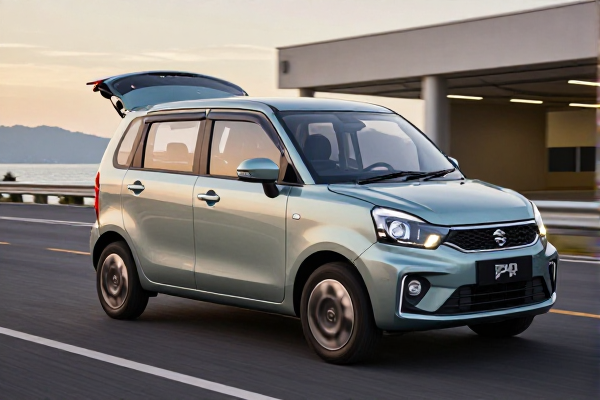
July 18, 2025 – The Maruti Suzuki Wagon R has long been the king of India’s entry-level hatchback segment, topping sales charts for years thanks to its spacious cabin and stellar fuel economy. Now, the tall-boy icon is getting a major mid-cycle facelift that promises more than just a nip and tuck. In a move that could reshape expectations for budget cars, Maruti is dropping a new three-cylinder engine and—crucially—an underbody CNG tank that frees up precious boot space.
Testing of the 2026 Wagon R facelift has already begun, and sources indicate the mechanical upgrades are the real headline. Let’s break down what’s coming.
The biggest shift is under the hood. Maruti Suzuki is phasing out its long-serving 1.2L four-cylinder K-Series petrol engine in favor of a lighter, more efficient 1.2L three-cylinder Z-Series unit (codenamed Z12E). This engine already powers the Swift, Dzire, and Baleno in India. The Z12E focuses on thermal efficiency and lower emissions—key to meeting India’s tightening BS7 norms.
Key specs comparison:
| Specification | Current Wagon R (1.2L 4-cyl) | 2026 Wagon R Facelift (expected) |
|---|---|---|
| Engine | 1.2L K-Series 4-cyl petrol | 1.2L Z12E 3-cyl petrol |
| Power | 89 bhp | 81 bhp |
| Torque | ~113 Nm | 112 Nm |
| Transmission | 5MT / 5AMT | 5MT / 5AMT |
| Fuel types | Petrol / CNG | Petrol / CNG |
Power drops, but low-end torque improves. While peak horsepower falls by 8 bhp, the three-cylinder delivers better low-end grunt for stop-and-go city traffic. Expect smoother crawling and quicker pick-up from a standstill. The real gain, however, is fuel efficiency—Maruti claims the Z12E is significantly more economical than the outgoing K-series, a critical selling point for cost-conscious Indian buyers.
Transmission choices remain familiar: a 5-speed manual and a 5-speed Auto Gear Shift (AMT). No CVT or DCT is expected, keeping the Wagon R affordable.
Perhaps the most practical update is the CNG arrangement. The current Wagon R’s CNG model mounts a cylindrical tank in the boot, leaving virtually no luggage room—often a dealbreaker for families. The facelift is expected to adopt an underbody CNG tank, similar to what competitors like the Tata Tiago CNG have offered.
This shift liberates a substantial portion of the 225-liter boot (petrol version), making the CNG variant genuinely usable for outstation trips and shopping runs. Combined with the tall-boy cabin, the Wagon R facelift could become the most practical CNG hatchback in India.
The iconic jellybean shape stays, but the facelift adds subtle sharpness.
Exterior details:
Interior touches:
Maruti is unlikely to change the overall dash layout or the trademark upright seating position, but the infotainment and safety upgrades bring the Wagon R in line with rivals like the Hyundai Grand i10 Nios and Tata Tiago.
While the Wagon R is not sold in North America, this facelift offers a window into global small-car trends. The shift from four-cylinder to three-cylinder engines is happening worldwide—even in U.S. models like the Ford Bronco Sport EcoBoost and Toyota Corolla’s upcoming hybrid three-pot. More importantly, the underbody CNG solution shows how automakers are creatively adapting to alternative fuel demands in emerging markets. For U.S. readers, similar packaging strategies (underfloor fuel tanks) are used in compressed natural gas vehicles (CNG) for fleets, though passenger CNG cars are rare.
Expert take: Automotive analyst Rajesh K. from IHS Markit notes: “By moving to a three-cylinder and underbody CNG, Maruti is future-proofing its bestseller. Expect sales to remain dominant, especially if the CNG model gets a small price hike but significantly better practicality.”
The 2026 Wagon R facelift isn’t just a refresh—it’s a deliberate pivot to meet stricter fuel norms and customer demand for usable CNG. If Maruti nails the execution, expect the Wagon R to extend its reign as India’s favorite tall