Browse

Log in / Register
 Share

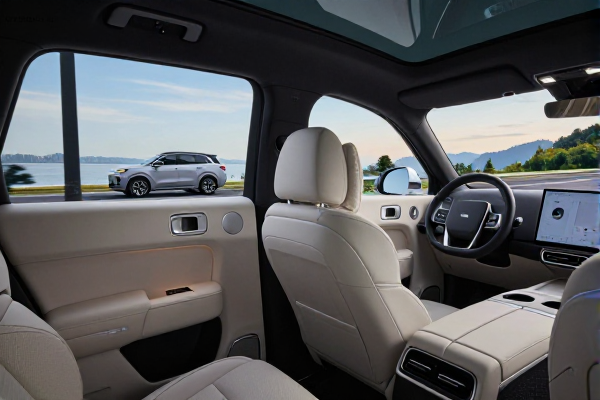
Li Auto CEO Li Xiang has drawn a bold parallel between the upcoming second-generation Mega electric minivan and the original iPhone, declaring that the MPV segment is at a “turning point.” In a March 31, 2025 post on Weibo, the founder argued that traditional gasoline-powered minivans have long suffered from inferior suspension systems, compromising both driver and passenger comfort. The new Mega, he says, will rewrite the rulebook thanks to a dedicated battery-electric vehicle (BEV) architecture.
The revised model, slated to begin customer deliveries on September 2, 2025, brings a suite of advanced chassis technologies: an 800V active suspension system with anti-roll bar, steer-by-wire, and rear-wheel steering. Li Xiang claims these features make the large minivan as “agile” as the Li Auto L6 and i6 crossovers, hinting that its turning radius will shrink to around 5.8 meters—a significant improvement for a vehicle stretching 5.35 meters in length.
Li Xiang framed the launch as a “new product definition” analogous to the iPhone’s disruption of Nokia’s hegemony. “Just as the iPhone redefined what a phone could be, the second-generation Mega will redefine the MPV experience,” he wrote. The comparison is ambitious, especially given the first-generation Mega’s underwhelming market performance. Launched in March 2024, the original Mega accumulated only 32,508 units in China through early 2025, according to China EV DataTracker, and was part of a recall campaign covering 11,000 minivans. Its price tag of 529,800–559,800 yuan ($78,760–$83,220) positioned it as a premium offering, but sales never matched expectations.
The second-generation Mega retains the same exterior silhouette with subtle refinements, such as semi-hidden door handles. Dimensions remain essentially unchanged: 5,355 mm long, 1,965 mm wide, and 1,850 mm tall, with a 3,300 mm wheelbase. Inside, seating is a 2+2+3 layout for seven passengers. The powertrain uses a dual-motor all-wheel-drive system producing 413 kW (553 hp), paired with a CATL-supplied 108 kWh ternary NMC battery pack that delivers a CLTC-rated range of 710 km. Notably, the new model adds four LiDAR sensors and two in-house-developed Mach M100 chips providing 2,560 TOPS of computing power—a level of sensor redundancy rarely seen in the MPV segment.
Industry analysts note that the first Mega struggled to gain traction partly because of its unconventional styling and high price. “The second-gen Mega has a chance if Li Auto can convince buyers that the technology leap is real,” said John Zeng, a Shanghai-based automotive analyst. “The steer-by-wire and rear-wheel steering are genuinely novel for a people mover, but the brand still needs to overcome the first model’s reputation.” Li Auto, meanwhile, is betting that the combination of chassis innovation, robust computing, and the company’s expanding sales network will turn the MPV into a hit. The company’s overall delivery volume in 2024 exceeded 500,000 units, with the L-series SUVs driving the bulk of sales.
With the September 2 launch date set, the stage is now ready for a direct comparison: will the second-gen Mega live up to the iPhone analogy, or will it follow the first gen’s underwhelming path? Li Xiang clearly believes the answer is the former, and the industry is watching closely.