Browse

Log in / Register
 Share

Pangyo, South Korea — May 7, 2026
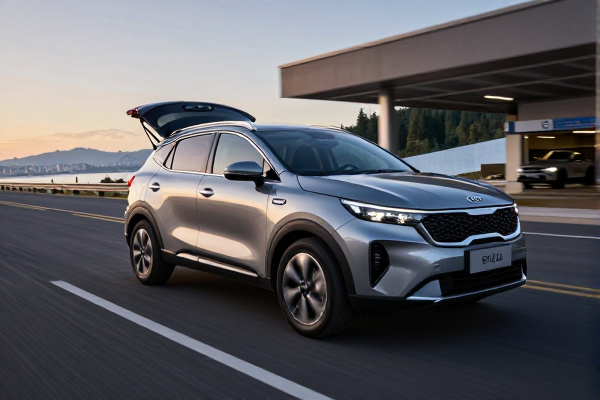
Kia has launched South Korea’s first public car-sharing service powered by remote driving technology. The pilot, which began operating Thursday in Pangyo, Gyeonggi Province, uses the Kia PV5 electric van and will run through the end of the year.
The service is built around a simple app-based experience. A user reserves a PV5 through a dedicated platform, and the van then drives itself to the requested pickup point — no driver in the vehicle. When the reservation ends, the user parks the van wherever is convenient, and a remote operator takes over and guides it back to a designated parking location using 4G or 5G wireless connectivity.
This makes the PV5 feel less like a traditional rental car and more like a personal vehicle that can be summoned on demand. For users, the biggest convenience is the flexibility: no need to visit a rental lot, no paperwork at a counter, and no waiting for a driver to deliver the van. For businesses, the model removes the cost and complexity of maintaining a fixed fleet with staffed depots.
Kia says the goal is to help companies operate vehicle pools more efficiently while giving customers a smoother pickup-and-drop-off experience. The PV5 was chosen for the pilot because it is Kia’s purpose-built electric van platform, designed for exactly the kind of flexible commercial use cases — last-mile delivery, ride pooling, and cargo transport — that remote driving can unlock.
Remote driving is different from full autonomy. The vehicle still relies on a human operator, but that operator is not physically in the car. Instead, the driver works from a remote station and uses live video feeds and telemetry to steer, accelerate, and brake. In this pilot, Kia’s remote control system is supplied by SUM, the autonomous driving startup, while the ride-hailing and operations side is handled by Mobiops.
Kia described the service as the first of its kind in South Korea, and the launch follows years of regulatory groundwork. In April 2025, the Ministry of Land, Infrastructure and Transport granted Kia an exemption under the country’s regulatory sandbox program for remote driving. That exemption allowed Kia to test the technology on public roads ahead of a formal commercial rollout.
In November 2025, Kia formed a Remote Driving Consortium with Socar, KT, and SUM. The group staged what Kia called Korea’s first remote driving demonstration on public roads by a domestic automaker, using Kia vehicles and live telecom networks. The demonstration was an important step toward proving that remote driving could work outside closed test tracks and in real traffic conditions.
The company also signed an MOU with KT and SUM in July 2025 to push remote driving technology toward commercialization. At the time, Kia said it planned to launch a service within a year — a target it has now met with the Pangyo pilot.
The Pangyo pilot is being run as a consortium project with several organizations playing specific roles.
Kia is supplying the PV5 vans and managing the overall program. SUM is developing the remote driving technology and the control systems used by the remote operators. Mobiops is responsible for day-to-day service operations, including customer support and vehicle logistics. The Korea Road Traffic Authority is involved on the regulatory side, helping review and validate the service under South Korean road safety rules.
Supporting partners include Gyeonggi Province, KT, UMOS ONE, the Next Generation Convergence Technology Research Institute, and the Gyeonggi Automobile Rental Business Association. Their involvement gives the pilot a practical dimension that goes beyond technology testing: the rental business association, for example, provides input on how remote driving can fit into existing car rental and fleet management operations.
KT’s role is particularly important because the entire remote driving experience depends on network reliability. If the wireless link drops, the remote operator loses visibility. The pilot will therefore test not just driving software, but also the stability of 4G and 5G connections in urban and semi-urban environments around Pangyo.
During the trial period, the consortium will evaluate two things: how well the remote driving technology performs under real-world conditions, and whether the overall service model makes sense from an operational and business perspective.
The Pangyo location was chosen strategically. The district is home to a dense cluster of tech companies, making it a natural place to find early adopters who are comfortable with app-based mobility services. At the same time, it has enough road variety — main avenues, office parking lots, and residential areas — to stress-test the remote driving system in realistic situations.
Data collected from the trial will be used to refine the technology and improve the user experience. Kia has said it plans to use the results to expand the service in 2027, with the goal of accelerating the commercialization of PV5-based remote driving. In other words, the current pilot is best understood as a bridge between regulatory approval and a larger commercial launch.
For U.S. audiences, this pilot is more than a regional experiment. Remote driving technology has the potential to change how last-mile delivery and car-sharing services are structured in North America, especially for fleets that want to reposition vehicles without paying drivers to move them.
The PV5 is already being positioned as a global platform for electric commercial vehicles. If the Korea pilot proves that remote driving can reliably deliver vehicles to customers, move them between parking spots, and consolidate them at the end of the day, Kia could extend the model to other markets, including North America.
American fleet operators often spend heavily on driver labor for vehicle repositioning, fueling, and maintenance checks. Remote driving could cut those costs in controlled environments such as campus shuttle services, airport parking lots, and urban commercial zones. It could also make car-sharing services more practical in suburbs, where poor walkability makes traditional station-based car-sharing less convenient.
That said, U.S. deployment would depend on state and federal rules around remote operation of vehicles on public roads. No national standard currently exists, and states vary widely in their approach to teleoperation. Kia’s experience working with Korean regulators will be valuable if the company decides to pursue a similar path in the U.S., but it will still need to navigate a patchwork of local rules.
Kia’s interest in remote driving is not limited to car-sharing. The company sees it as a core enabler for future mobility services, including autonomous delivery, fleet management, and connected commercial vehicles. The ability to move a vehicle without a driver creates new operating models for logistics companies, ride-hailing platforms, and corporate mobility programs.
For now, the Pangyo pilot is small in scale and limited in duration. But it gives Kia and its partners something no amount of lab testing can provide: real usage data, real network conditions, and real customer feedback. Every reservation, every remote repositioning, and every parking maneuver adds to the dataset Kia will use to decide how fast to scale the service.
The 2027 expansion target is ambitious, but not unrealistic. Kia has already secured the regulatory foundation, assembled the right consortium, and placed the service in a controlled but busy urban environment. If the pilot hits its technical and operational targets, remote driving car-sharing in South Korea could move from pilot stage to commercial service within the next two years.
That would put Kia in a strong position globally, as few automakers have managed to move remote driving out of demonstrations and into actual revenue-generating services. The PV5 pilot, in that sense, is not just about one van in one Korean tech hub. It is a test case for the future of driverless convenience in personal and commercial mobility.
For now, users in Pangyo can experience the service through the dedicated app, and the partners will continue to monitor performance until the end of the year. The results will shape not only Kia’s next moves, but also the broader conversation about how remote driving can be used safely, efficiently, and commercially in cities around the world.