Browse

Log in / Register
 Share

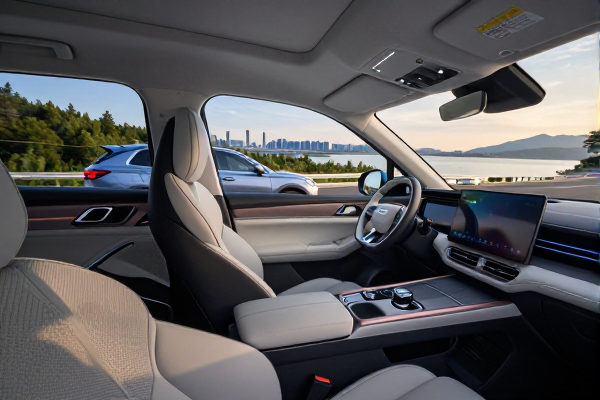
WUHU, China — Oct. 23, 2026 — JETOUR International has laid out a technology roadmap that treats the car as more than a machine for moving from one place to another. At its 2026 Global Technology Experience Day, the brand showed a series of technologies covering artificial intelligence, autonomous driving, robotics and clean energy. The underlying idea was directed at people who expect a vehicle to understand the rhythm of a trip, not just respond to a voice command.
A new measure of progress
For much of automotive history, progress was defined by hardware. Engineers improved engines, gearboxes, suspension and four-wheel-drive systems until performance figures became the main way to compare cars. JETOUR's presentation in Wuhu pointed in a different direction. The company is arguing that a vehicle's value increasingly depends on its ability to fit into a lifestyle, handle different types of journeys and connect with other devices and energy networks.
At the event, JETOUR demonstrated an automotive-specific large model, a chip strategy, AiMOGA robots, Robotaxi technology and a solar-storage-charging system. Those demonstrations can be grouped into three layers: intelligent interaction, autonomous mobility and energy. The interaction layer is designed to make vehicles better at understanding what passengers need. The autonomous layer explores how vehicles can drive or park themselves in certain situations. The energy layer ties vehicle charging to solar power, home storage and electricity grids, turning the car into a mobile energy unit rather than just a consumer of fuel or electricity.
Practical technology, not a showcase
Ke Chuandeng, president of JETOUR International, said the purpose of the company's technology work is not to pile up functions but to solve real travel problems. "Technological innovation has value only when it turns advances into practical capabilities that meet users' changing needs," he said. "On top of our existing technology foundation, we will continue to explore ways to bring that capability into more travel scenarios."
That position is intended to separate JETOUR from automakers that treat software and artificial intelligence as a sales add-on. For JETOUR, which markets its vehicles around a "Travel" strategy, the technology is meant to make journeys smoother, safer and more enjoyable. The company says it is not chasing technology for its own sake; each element is expected to support the way owners actually use cars.
Built for the road less traveled
JETOUR's engineering roots are in off-road performance, and that remains the foundation of its product lineup. The company's technology portfolio includes C-DM super hybrid power, XWD fully automatic intelligent 4WD and the GAIA hybrid architecture. Together, these systems are meant to handle tough terrain, changing altitudes and long distances.
The brand also tests its vehicles in demanding real-world conditions. JETOUR says its models have been taken through Middle Eastern deserts, African wilderness, the Andes and the Pan-American Highway. Those expeditions are designed to reveal how vehicles behave in extreme heat, loose sand and thin air. The lesson, according to the company, is that durability and mechanical capability are the prerequisite for any kind of advanced technology. A car that cannot survive an unpaved mountain road will not be much help to a traveler who depends on its digital tools.
Intelligence moves past voice commands
The next stage of JETOUR's development is centered on interaction. Many current vehicles allow drivers to adjust climate control, navigation and music with voice messages. JETOUR is going further by testing multimodal large models and AI agents that are able to handle more complicated requests. A future system might monitor weather, traffic and battery state before suggesting a route or a charging stop. It might set up a campsite reservation, adjust lighting and temperature for a rest stop, or alert the owner to maintenance needs before they become urgent.
This requires more computing power inside the vehicle, which is why the company's chip strategy was part of the event. The aim is to move significant processing from mobile phones to the vehicle itself. That allows faster responses, better privacy and more reliable operation in places with weak mobile coverage.
Cars as energy partners
JETOUR is also rethinking how vehicles consume and supply energy. Its new energy roadmap stretches from conventional fuel and hybrid powertrains to full battery-electric models. The company is working on intelligent energy management, regenerative braking and V2G bidirectional charging technology. V2G is especially important for travelers because it lets a vehicle send power back to a home, a campsite, or the grid. When paired with solar generation and on-board or external storage, an electric vehicle can become part of a flexible energy system.
In off-road and camping situations, that capability has practical value. Travelers need power for cooking, lighting, medical devices or tools. A vehicle with bidirectional charging can supply that power without needing a generator. JETOUR's solar-storage-charging display pointed in that direction: a car charging from solar panels during the day and powering a tent or small appliance at night.
Global reach and local relevance
JETOUR says it has entered more than 100 countries and regions, with more than 2,000 sales and after-sales service outlets and a global user base exceeding 50 million. Its research and development network spans the EU, the Middle East, Central and South America, and ASEAN. Those numbers matter because the brand's travel-focused strategy is not limited to China. Different markets bring different challenges: cold climates, tropical rain, high-altitude passes and long-distance highway cruising. JETOUR says its global presence helps it apply lessons from one region to another.
Industry observers see integration as the key
Some industry watchers say the significance of JETOUR's event lies less in any single product and more in how the technologies are combined. "A hybrid powertrain is not new," said one auto technology analyst who attended the event and asked not to be named. "Robotics and Robotaxi concepts are not new either. What is interesting is whether a brand can combine all of those pieces into a coherent experience for someone who sees their vehicle as part of an active life."
The analyst added that JETOUR's focus on travel gives it a different set of priorities from mainstream carmakers. "For a typical urban commuter, the order might be efficiency, cost and parking. For JETOUR, the order is more likely range, reliability, space and the ability to support outdoor activities. That changes how you design the AI functions and the energy system."
The road ahead
JETOUR's product line already includes the T-Series for the light off-road segment and the G-Series for premium luxury off-road. The company says these models are intended to cover urban commuting, family road trips, camping and long-distance touring. The technologies shown at the Global Technology Experience Day are expected to become more integrated over time, so that navigation, powertrain control, energy management and in-car assistance work from a shared base of data.
That cross-system coordination is likely to be the hardest part. Integrating data from different hardware and software systems is more complex than adding features. But JETOUR is signaling that it is willing to make that investment. Its ambition, in short, is to move from selling durable vehicles to delivering complete mobility experiences. The event in Wuhu was a progress report on that project, and the company left little doubt about the direction it believes future mobility will take.