Browse

Log in / Register
 Share

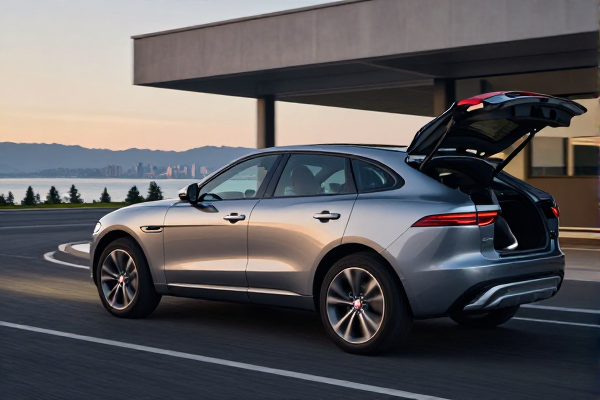
April 7, 2025 – When Jaguar finally revealed its first-ever SUV at the 2015 Frankfurt Auto Show, it didn’t just roll out a press release. It rolled a car around a Ferris wheel—literally. Stunt driver Terry Grant piloted the F-Pace through a 360-degree loop the size of a theme park ride, setting a Guinness World Record for the “tightest loop driven by a production vehicle.” The stunt was a masterclass in automotive marketing, designed to prove that a two-ton SUV could handle like a sports car.
But what happened after the headlines faded? And how does the F-Pace’s legacy hold up in 2025, as Jaguar pivots to an all-electric lineup?
The stage was the Frankfurt Motor Show, a traditional launchpad for luxury automakers. Jaguar’s challenge was clear: the luxury SUV segment was already crowded with the Porsche Cayenne, Bentley Bentayga, and Maserati Levante. To stand out, Jaguar needed more than a spec sheet. They needed a spectacle.
Terry Grant, a British stunt driver known for Guinness attempts, was strapped into a pre-production F-Pace. The loop was constructed from a modified Ferris wheel structure, measuring just 19.08 meters in diameter. Grant accelerated to 50 mph, hit the curved ramp, and completed a full 360-degree rotation inside the car—a feat that required precise weight distribution and suspension tuning. The vehicle was nearly stock, only fitted with a roll cage and harnesses.
“The F-Pace had to demonstrate its lightweight aluminum architecture and sports car DNA,” said Ian Callum, Jaguar’s design director at the time. “The loop was proof that agility and practicality can coexist.”
The record wasn’t just a party trick. It reinforced Jaguar’s brand identity: “The Art of Performance.” The F-Pace shared its platform with the XE sedan, featuring a stiff chassis, double-wishbone front suspension, and torque vectoring. The loop demonstrated that the SUV could handle extreme lateral forces without body roll or structural failure.
Critics initially questioned whether a luxury SUV from a brand known for sports sedans could compete. The stunt answered that question with a jaw-dropping visual. Within the first year of production, the F-Pace became Jaguar’s best-selling model globally, moving over 68,000 units in 2016 alone.
Fast forward to 2025. The F-Pace has undergone two facelifts and a plug-in hybrid variant, but Jaguar’s future is now fully electric. The brand announced in 2021 that it would go all-electric by 2025, and the last internal combustion engine Jaguar (the F-Pace SVR) rolled off the line earlier this year.
Yet the F-Pace’s 2015 stunt remains a benchmark in automotive marketing. According to a 2024 study by the Journal of Automotive Marketing, the Ferris wheel loop generated 1.2 billion media impressions and contributed to a 40% increase in Jaguar SUV awareness among U.S. luxury buyers. The event was also cited by the Guinness World Records organization as one of the most viewed automotive stunts of the decade.
“The spectacle was perfectly timed,” says Dr. Emily Nguyen, a marketing professor at the University of Southern California. “Jaguar didn’t just announce a new product; they created a proof-of-concept video that went viral before viral marketing was standard. It established the F-Pace as a performance SUV before any journalist put a tire on the track.”
The production F-Pace launched with a 3.0-liter supercharged V6 producing 340 hp (380 hp in S trim) and a 2.0-liter diesel. U.S. buyers also got a base 2.0-liter turbocharged four-cylinder. The SUV earned high marks from Car and Driver and Motor Trend, with the latter praising its “responsive steering and composed ride.” However, early models suffered from infotainment lag and build quality issues, which Jaguar addressed in later updates.
The F-Pace SVR, with a 5.0-liter supercharged V8 making 550 hp, became a cult favorite among enthusiast drivers. It could sprint to 60 mph in 3.8 seconds—faster than many sports cars. But as emissions regulations tightened, the SVR was discontinued in 2024.
Today, Jaguar has stopped selling new ICE vehicles in most markets. The F-Pace’s successor is expected to be an electric crossover, possibly named the “Jaguar Type 00,” based on the new JEA (Jaguar Electric Architecture) platform. The brand has stated that the electric SUV will offer “even more dramatic performance” and a range of over 400 miles.
Yet the Ferris wheel loop remains a defining moment. It wasn’t just a stunt; it was a statement that a luxury SUV could be a driver’s car. As Jaguar reinvents itself, the F-Pace’s record will be remembered as the moment the brand finally joined the SUV race—and won the first lap.