Browse

Log in / Register
 Share

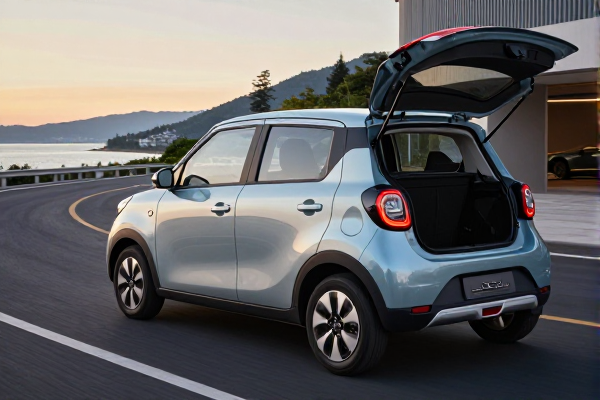
As of May 7, 2026, Maruti Suzuki still hasn't said much about its second electric car. But the company's plan to widen its EV lineup is no secret, and the next model could be a compact SUV aimed squarely at India's Tata Punch EV. While no name, range, or launch date has been officially confirmed, the prospect of a genuinely affordable Maruti EV is enough to shake up India's growing electric-vehicle market.
Maruti Suzuki entered the Indian electric SUV space with the e Vitara, but that's only one piece of the puzzle. A smaller EV would let the automaker move below the e Vitara's price point and reach buyers who want an electric vehicle for daily commuting rather than long highway trips. That kind of positioning is what made Tata's Punch EV popular in the first place.
The smaller Maruti model would likely be styled as a compact SUV or crossover, which is the body style that practically owns the Indian car market right now. Official details on dimensions, design, and cabin layout are still missing, but it's reasonable to expect a five-door format with decent ground clearance and a tall seating position.
There has been plenty of speculation about what this Maruti EV will actually be. Some industry watchers have floated the idea of an electric Fronx, while others think Maruti could electrify the Brezza. So far, neither is confirmed as a production program.
What seems more likely is a purpose-built small EV platform, because shoehorning electric powertrains into existing combustion models can lead to packaging compromises. But Maruti has played its cards close to its chest, and the company hasn't revealed whether this will be a fresh design or something based on an existing nameplate.
If Maruti does bring a compact electric SUV to market, the Tata Punch EV will be the benchmark it has to beat. Tata has used the Punch EV to lock in an early lead in India's small-electric-car segment, helped by a familiar design, reasonable driving range, and a price that undercuts many larger electric SUVs.
A similarly sized Maruti EV would have to compete on more than just price. Range, cabin space, feature content, charging speed, and after-sales costs all matter to Indian buyers. Maruti's strongest advantage is its giant service network and reputation for low maintenance, which could carry real weight in the EV conversation.
Of course, all of this comparison depends on details that Maruti hasn't provided. If the company ends up making a slightly larger crossover or a more premium hatchback, the matchup changes completely.
Maruti has not released any technical information for this potential model. Battery capacity, motor output, driving range, and charging specifications are all unknown.
For a car aimed at city commuting, a larger battery isn't necessarily the priority. Maruti could focus on keeping weight down and efficiency high, which would help the car feel nimble in traffic and keep the price manageable. There's also the question of whether Maruti will offer one battery pack or multiple configurations, as many automakers do now.
The lack of details is normal at this stage. Maruti won't want to overpromise before the program is locked in, especially with the Indian EV market still sensitive to range anxiety and charging infrastructure gaps.
India's central government has pushed different incentive schemes for electric vehicles over the years, but passenger-car EV adoption is still in its early phase. The current PM E-DRIVE program places more emphasis on two-wheelers, three-wheelers, and public transport, which means automakers entering the passenger-EV segment have to sell on product strength, not subsidy windfalls.
That makes the potential Maruti-Tata showdown even more interesting. Tata has had the early advantage. Maruti, with its high sales volume and brand trust, could bring enormous scale to the segment. If anyone can make compact EVs a mainstream purchase in India, it's likely to be one of these two.
At first glance, an Indian-market small EV may not matter much to American readers. But the comparison is useful because it highlights how different the global EV market is from the U.S. one.
Kelley Blue Book data has put the average new EV transaction price in the U.S. near $55,000 in recent years. In India, compact EVs like the Tata Punch EV are often priced in the low-to-mid-$10,000 range before any local taxes or conversion costs. That huge gap explains why Indian buyers gravitate toward small, efficient cars while American EV shoppers spend on large SUVs and pickup trucks.
Maruti's small EV isn't heading to the U.S. anytime soon, but the engineering and packaging ideas behind it could influence global small-car platforms, especially as more automakers look for ways to lower EV costs. For anyone in the U.S. waiting for a truly cheap electric runabout, models like this are worth watching.
Several Indian auto publications have pointed to 2027 as a possible reveal date for Maruti's next EV. But there's a catch: Maruti is also expected to launch a three-row electric MPV, reportedly known by the codename YMC, around the same time. It is unclear whether the 2027 window refers to that model, the compact EV, or both.
A lot can change between now and then. Maruti might choose a different segment, change its platform approach, or adjust the timeline based on how the e Vitara performs in the market. Official confirmation is still the missing piece.
The real news here isn't a confirmed specification sheet. It's that Maruti Suzuki is exploring a second, cheaper electric vehicle at all. That signals confidence in India's EV transition and puts Tata on notice in a segment Tata currently dominates.
If Maruti brings out a compact electric crossover with strong real-world range, a sensible starting price, and the brand's usual focus on low running costs, it could quickly become one of India's best-sellers. Until the company makes an official announcement, the name, battery, and launch date will remain open questions — but the direction is becoming clearer by the month.