Browse

Log in / Register
 Share

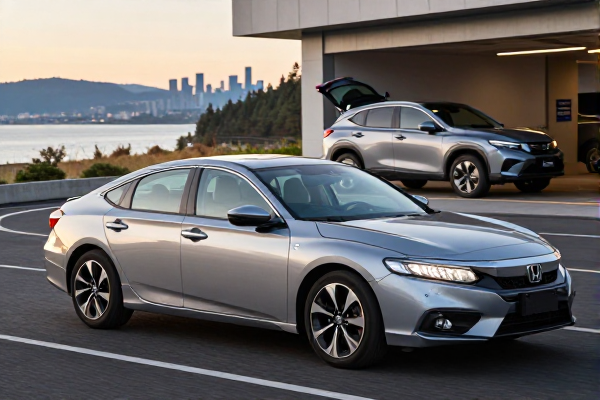
I’m a petrolhead at heart, so the idea of faking a core part of the driving experience usually makes me wince. Yet every time I’ve actually sat behind the wheel of a car that does this, I’ve found myself pleasantly surprised—except, perhaps, when it comes to synthetic exhausts. Honda’s new S+ Shift system lands squarely in that strange territory. The 2026 Prelude wears a two‑motor hybrid setup that has no conventional transmission; an electric motor drives the front wheels most of the time, while an electronically controlled clutch lets the engine kick in for steady highway cruising. That is, frankly, a recipe for a rather uninvolving powertrain—which is precisely why Honda created S+ Shift, a software‑driven simulation of an eight‑speed dual‑clutch transmission (DCT). It’s so unusual that the Prelude earned a spot in our “Weird” issue largely because of this feature.
Despite the oddity, I remained hopeful. Honda has a long history of delivering driving experiences that exceed the sum of their mechanical parts, and the Prelude has always been a shining example. I sat down with Yoshiharu Saito, the Prelude’s powertrain project leader, to dig into how S+ Shift works. What I learned is a fascinating blend of clever software tuning, engine control, and auditory trickery.
Building Blocks: Linear Shift Control and Direct Acceleration
Honda’s journey to S+ Shift started with two earlier hybrid‑drivetrain innovations. The first, Linear Shift Control, aimed to align engine sound with driver input. In a conventional two‑motor hybrid, the internal combustion engine mostly just spins as a generator at a constant speed to charge the battery, while the electric traction motor does the actual accelerating. Drivers found the disconnect between engine noise and forward motion disconcerting. Linear Shift Control alters the engine speed and sound so that it appears to “rev” and “shift” through gears whenever you press the accelerator, mimicking a traditional automatic.
The second innovation, Direct Acceleration, simply starts the engine earlier during hard launches to ensure the battery gets ample juice, delivering a more natural torque surge off the line. Together, these two features laid the groundwork for the more sophisticated S+ Shift.
The Heart of S+ Shift: Software‑Driven Illusions
Push the S+ Shift button on the center console and the Prelude enters Honda’s “Narnia” of simulated shifting. Without it, the car behaves like any other Honda hybrid. With it, you get a convincing facsimile of a DCT—complete with shift paddles and a flashing rev counter.
“S+ Shift was developed not only to create the enjoyment of a DCT, but also as a technology that enhances fundamental powertrain values like responsiveness and linearity,” Saito explained. “The response to even slight accelerator input changes during acceleration and deceleration—on uphill roads or freeways—are capabilities not previously achieved in conventional hybrids. We believe this allows drivers to enjoy a true dialogue with the vehicle.”
The secret sauce lies in precisely coordinating the electric motor and internal combustion engine. Honda isn’t trying to replicate the sound of any specific historic engine, but the torque curve and acceleration feel are intentionally modeled after a 2.4‑liter naturally aspirated four‑cylinder. Given that the electric motor provides a mild but satisfying twist, that’s a reasonable choice.
The Magic of Shift Paddles
The real fun happens when you pull a paddle to “upshift” while in S+ mode. Honda briefly puts the motor into regeneration mode, which instantly drops the engine revs and reduces electric motor output. This creates the slight interruption in acceleration you’d expect from a physical upshift. The Active Sound Control system then plays matching audio through the car’s four speakers to complete the illusion. Because of these intentional interruptions, the Prelude is actually 0.8 seconds slower to 60 mph in S+ mode—a small price for engagement.
Downshifts are even more satisfying. When you pull a downshift paddle, the generator motor’s power output artificially increases, causing the internal combustion engine to blip its revs—just like a DCT downshift. Depending on the situation, Honda may briefly reduce the drive motor’s output to deliver that subtle forward lurch you feel when a conventional gearbox drops revs. In other words, the “man behind the curtain” is real, but the physical sensations you feel come from genuine powertrain components being manipulated by software.
“During downshifts, the system is tuned to make the blipping sound stand out,” Saito added.
Challenges and Inspiration from the NSX
The Active Sound Control (ASC) implementation was one of the biggest mechanical hurdles. “ASC requires noise smoothing as a prerequisite,” Saito noted. “That involves engine block and crankshaft rigidity, coupling stiffness with the front drive unit, placement of component natural frequencies, and the vehicle’s sound insulation. While we fully leveraged knowledge from the Civic Type R, we tailored the sound to align with the Prelude’s concept and driver’s intentions.”
Interestingly, Honda borrowed the shift control logic from the discontinued NSX’s nine‑speed DCT. The same corner‑holding logic applies here: during cornering, upshifts are delayed to prepare for acceleration on exit; downshifts during braking are timed to provide optimal driving force afterward. The system also performs sequential downshifts that exploit the “close gear ratios” (even though no physical ratios exist) to mimic a performance DCT.
Where Does This Fit in the Market?
Honda’s S+ Shift is not alone in the trend of simulated transmissions. Toyota’s GR models have offered an “iMT” (intelligent manual transmission) mode that matches revs on downshifts, and some electric vehicles (like the Hyundai Ioniq 5 N) now fake gear shifts via software. But the Prelude’s approach is unique because it uses a two‑motor hybrid that genuinely lacks a transmission—unlike EVs with a single‑speed gearbox. The result is a lighter, simpler drivetrain that still offers the tactile thrill of shifting.
As of February 2025, Honda has confirmed the 2026 Prelude will enter production with S+ Shift as a standard feature. Industry insiders expect the system to influence