Browse

Log in / Register
 Share
Share
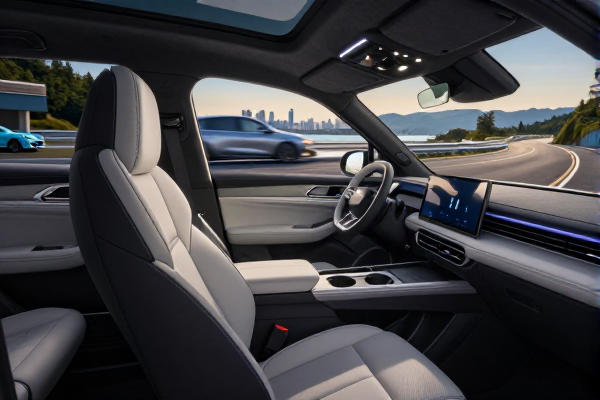
On the Dash: General Motors is rolling out a proprietary AI assistant later this year that goes beyond generic voice assistants by tapping into vehicle-specific data and telematics. The move aims to deepen customer engagement and give dealers a fresh technology advantage.
Detroit, MI – May 28, 2025 – General Motors announced it will launch a new in-vehicle AI assistant later this year that leverages the automaker’s unique access to vehicle telemetry and OnStar intelligence to deliver a level of integration far beyond what general-purpose AI assistants like Google Gemini can offer. The system, whose official name has not yet been revealed, is designed to understand not just the driver’s voice commands, but the vehicle’s current state, driving history, and individual preferences.
According to GM’s Director of Product Management for Voice and AI/Machine Learning, Anna Santos, the assistant will combine conversational AI with proprietary GM knowledge to create a more intuitive ownership experience. “This isn’t about just turning on the radio or setting the temperature,” Santos told CNBC. “It’s about the assistant knowing that your tires might need attention soon, that your spouse prefers a different seat position, or that you always listen to a specific podcast on the way to work.”
The move marks a significant step in GM’s broader AI strategy, which focuses on automotive-specific applications rather than relying solely on third-party platforms. The automaker has already integrated Google’s Gemini AI into millions of vehicles from the 2022 model year onward, providing natural language interactions for climate, media, and entertainment. However, GM acknowledges that Gemini lacks deep vehicle context—such as real-time odometer readings, battery health, or diagnostic trouble codes.
GM’s new assistant will fill that gap by using vehicle telemetry and proprietary data to enable predictive maintenance alerts, personalized “driver profiles” that adjust multiple settings simultaneously, and even context-aware safety reminders. For example, the assistant could warn the driver of an upcoming maintenance interval based on actual driving patterns, or suggest a more efficient route based on battery charge and traffic conditions.
One potential feature highlighted by the company is a “kids mode” that automatically adjusts music volume, rear-seat climate controls, door locks, and entertainment options when children are detected in the vehicle. While GM has not confirmed a rollout timeline beyond “later this year,” the technology is expected to debut on select 2026 model-year vehicles.
New Selling Point for Dealers
The AI assistant also represents a new technology selling point for GM dealerships. As electric vehicle adoption and connected-car services grow, dealers are seeking ways to differentiate themselves beyond price and inventory. “An AI that truly knows the car can be a powerful retention tool,” said Mark Thompson, a senior analyst at IDC covering automotive technology. “It shifts the conversation from hardware to ongoing service, which is exactly what dealers need to build long-term customer relationships.”
Thompson noted that predictive maintenance, in particular, could drive repeat service visits and increase customer lifetime value. The assistant could proactively notify owners of upcoming service needs and even schedule appointments directly through the infotainment system.
Competitive Context
GM’s approach stands in contrast to automakers like Tesla, which rely on their own software stack but have been slower to deploy conversational AI features. Others, such as BMW and Mercedes-Benz, have partnered with large language model providers to embed generative AI into their vehicles, but none have yet announced a system that integrates such deep telemetry data.
GM is working with an unnamed large language model provider to develop the assistant’s core intelligence, but retains control over the vehicle data layer. The company emphasizes that all data processing will comply with privacy regulations, and users will have the ability to opt out of data collection.
What’s Next
While GM has not disclosed whether the assistant will be available as a retroactive update for existing vehicles or only on new models, the company is expected to share more details at its next investor day in late July. If successful, the AI assistant could become a key differentiator in the increasingly competitive connected-car market, offering a glimpse into a future where the car truly understands its driver.